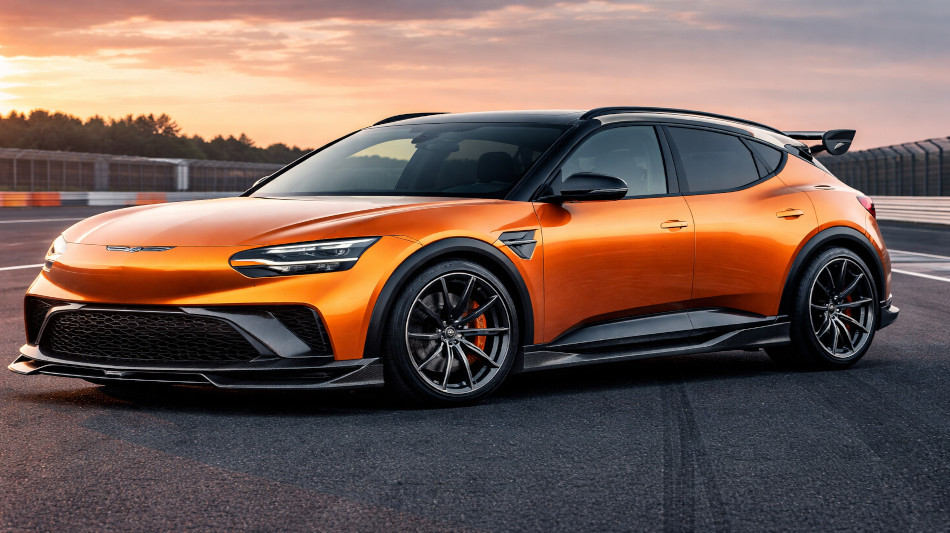
Genesis GV60 Magma before launch

 Pope urges Europe to help combat 'deceit and lies' in international ties

 Injured Buttler to miss England ODI series in Pakistan

 Madrid housing protesters vow to maintain pressure on government

 In kayaks or waist-deep in floodwater, shoppers return to Bangkok markets

 UK police probes Iran link to air base bomb scare: media

 Eala blasts into Asian Games quarters in just 55 minutes

 Taiwan gender-row boxer Lin Yu-ting guarantees Asian Games medal

 Comedian on trial for allegedly insulting Erdogan in standup show

 More Asian Games transport woes as bus takes Pakistan to wrong venue

 Death toll in South Africa bar shooting rises to 18

 Aide to Venezuelan opposition leader returns from exile

 Messi and Alcaraz love it, now padel takes step closer to Olympics

 Tolls mount in Thailand, Myanmar floods

 Why India's opposition wants top poll official out

 PU Prime Strengthens UAE Momentum with Strong Showing at Forex Expo Dubai 2026

 Eight dead in Thailand floods since mid-September

 Oil prices spike after Trump rejects Iran truce offer

 Taylor Swift sets new record at MTV VMAs

 Seoul seeks apology after Ukraine reveals transfer of North Korean POWs

 Messi on target again but Miami downed by Columbus

 In Washington's political cauldron, a fight over foie gras

 Flavio Bolsonaro: political heir in his father's shadow

 Ravens grab last-second win in Rio as Commanders stop Seahawks

 Scheffler makes sportsmanship stand over tee screamer

 Anthropic CEO Amodei to dine with Trump at White House

The new Genesis GV60 Magma is a model that means much more to the brand than just another particularly powerful version of an existing electric car. The car represents a strategic change of direction. Genesis no longer wants to define itself solely through design, material quality and quiet luxury, but also through its own credible form of high performance. That's exactly why the GV60 Magma is so important: it's not just any sporty derivative, but the first production vehicle in the new Magma world – and thus concrete proof that an idea is now becoming a real product.
The timing is well chosen. The regular GV60 has recently undergone noticeable technical and visual enhancements, the brand has visibly sharpened its electric expertise, and at the same time, pressure is growing in the premium segment to more closely link performance, digitalisation and brand character. Many manufacturers today can build fast-accelerating electric cars. The real question is no longer just how much power a vehicle offers, but how this power is staged, dosed and translated into a credible overall picture. This is precisely where Genesis is trying to make its mark with the GV60 Magma.
Even at first glance, it is clear that the Magma is not just a cosmetically enhanced GV60. The car appears wider, lower and significantly more taut. The proportions seem more compact, the body sits more solidly on the road, and the add-on parts are not merely decorative, but designed for downforce, cooling and high-speed stability. The front end, side skirts, rear spoiler and air ducts visibly follow a functional logic. Added to this are forged 21-inch wheels, wide tyres and an overall appearance that focuses less on striking aggression and more on controlled presence. This is precisely one of the most interesting features of this vehicle: Genesis is attempting to define sportiness not through visual exaggeration, but through excitement, attitude and technical credibility.
The GV60 Magma also goes a clear step beyond the previous GV60 range in terms of drive technology. Two electric motors and all-wheel drive form the technical basis. A very high level of performance is already available as standard, and in boost mode, the system performance increases significantly once again. Genesis is thus positioning the Magma at the top of its electrified model range. Added to this is a top speed that stands out in this class, as well as a 0-200 km/h time that clearly shows that this is not just the usual electric sprint from a standing start, but real performance beyond the first few metres. This is an important difference: many electric cars feel spectacular at first, but lose their punch as speed increases. The GV60 Magma is designed to close this gap.
It is noteworthy that Genesis does not present the car as an uncompromising race track machine despite its performance orientation. Instead, the focus is on a synthesis of power, control and premium comfort. The battery is generously sized at 84 kWh, the fast-charging capability remains high, and the official range also shows that the vehicle does not sacrifice everyday usability for mere effect. The GV60 Magma therefore aims not only to impress, but also to remain usable. This is crucial for its future market role.
A model like this has to meet two expectations at the same time: it should be emotionally charged, but at the same time not seem exhausting in everyday use. It is precisely this balancing act that Genesis has made its core message.
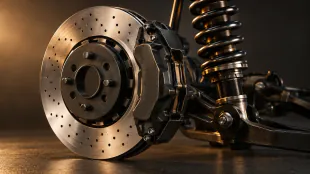
A look beneath the surface shows that the Magma is not just a show car exercise. The chassis, geometry and roll centre have been specifically revised, and electronic damper systems, special control strategies and a braking system tuned to the increased performance level have been added. Equally important is the temperature control of the battery system. Anyone who takes high-performance electric cars seriously knows that raw peak values alone mean little if thermal management, reproducibility and stability cannot keep up. Genesis addresses precisely these points with its own high-performance battery management system. This is an indication that the GV60 Magma is not only designed for spectacular acceleration manoeuvres, but also for repeatable performance under load.
The interior is particularly interesting because it encapsulates the actual philosophy of the vehicle. Genesis does not compromise on luxury – on the contrary. High-quality surfaces, a deliberately calm interior, special seats, exclusive material combinations and the brand's characteristic attention to detail remain intact. At the same time, a new, more performance-oriented operating logic has been introduced. A special Magma mode changes the instrument display, bringing important driving data to the fore, while the head-up display focuses more on driving-related information. Added to this are virtual gear changes, specific soundscapes, launch control, drift function and various driving programmes designed to noticeably change the character of the vehicle. This is interesting from both a technological and cultural perspective, because Genesis is bringing two worlds together here: the classic premium idea of calm and sovereignty on the one hand, and the digitally supported performance experience that has been reinvented in the electric age on the other.
It is precisely this combination that is likely to distinguish the GV60 Magma from other high-performance electric cars on the market. While some competitors focus on maximum toughness, aggressive communication and the most spectacular driving dynamics possible, Genesis is clearly opting for a more refined interpretation. The driver should feel fast, but not overwhelmed. The car should make its reserves felt without constantly proclaiming how serious it is about them. This approach is anything but insignificant. It could become the actual identity of the model – and, in the long term, the calling card of an entire Magma family.
The development programme also shows how seriously Genesis takes this claim. The GV60 Magma was not left in the protected space of a design study, but was put through a broad-based test programme. Winter testing, heat, high altitude, real roads, racetracks and fine-tuning in the home market – all this is part of the preparation. Added to this is the early public demonstration of the concept car in Goodwood, where the Magma gained attention as a serious performance project even before series production began. This is important for the brand's image. Genesis presents high performance not as an afterthought, but as something that has been systematically developed.
What the GV60 Magma heralds for the coming years is also exciting. The Magma idea is bigger than this one car. Genesis sees it as a long-term programme and a testing ground for future performance models. The GV60 is a logical starting point for this: it is compact enough for agility, modern enough for a consistently digital interpretation of performance, and emotional enough to bring new substance to the brand. In this sense, the GV60 Magma is a production vehicle – and at the same time a manifesto. It shows how Genesis wants to see its future: electric, fast, luxurious and technically independent.
For the European market, the most interesting question is how quickly the premiere will translate into a real presence on the roads. The launch has already taken place in Korea, and according to current plans, the model is expected in Germany from mid-2026. It remains to be seen how Genesis will position the car in terms of price in Europe and how limited or generous its availability will be. Likewise, only everyday use will reveal how convincing the balance between range, charging capacity and sustained performance actually is. But that is precisely what makes this vehicle so appealing: The GV60 Magma does not seem like a distant dream car, but rather a very concrete harbinger of a near future in which luxury brands no longer define their electric strategy solely in terms of efficiency and equipment, but once again more strongly in terms of character, driving identity and emotional differentiation.
The bottom line is that the new Genesis GV60 Magma is one thing above all else: a signal. It announces that Genesis wants to shape its electric future not defensively, but confidently. Not with loud activism, but with a car that visibly combines performance, technology and brand essence. The GV60 Magma is thus less of an outlier than the beginning of a new chapter. And that is precisely what makes it one of the most exciting performance electric cars of the near future.