Quake-hit Syria city buries its dead on farmland / Photo: © AFP

 South Korea FA apologises after sex scandal adds to controversies
 Indonesia closes national park as wildfire spreads
 ZXMoto leads China's charge to dominate the global motorbike market
 Top-ranked Sabalenka, Pegula stunned in Toronto fourth round
 Japan nuclear debate unnerves proponents of pacifism
 Spanish teen Jodar ousts eighth seed Lehecka at Montreal

 Angers mounts in US over vast network of car license plate cams
 Darderi to face Nakashima in Montreal quarter-finals
 Espresso power fires Darderi past Borges in Montreal

 Shnaider upsets Pegula to book Toronto quarter-final with Swiatek

 Mount injury overshadows Man Utd draw with Paris Saint-Germain

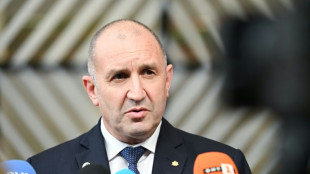 Ukraine denies targeting Bulgaria as drone explodes near pipeline
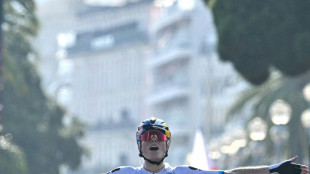 Vollering grabs Tour de France lead in Nice

 Euros to showcase new TV guidelines on non-sexualisation of women athletes

 'Calm' Kiss savours first win as Wallabies boss
 Duplantis bids for fourth European title as stars align in Birmingham
 Ukraine warns of tough winter as Russia strikes kill 4 in Kyiv region

 Recovering Marchand to skip medleys at European swim champs
 MotoGP leader Martin speeds to British Grand Prix pole

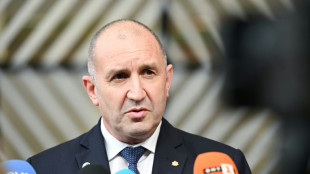 Drone enters Bulgaria, explodes near pipeline at Romanian border: Bulgarian PM

 Arsenal sign Brazil midfielder Guimaraes from Newcastle
 Atletico will not sell Alvarez, says Simeone

 Ford Fathom turns affordable electric pickup into reality

 Lise Klaveness, the Norwegian thorn in Infantino's side

 Europe’s electric car boom exposes a widening market divide

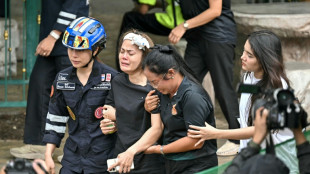
In Syria's coastal city of Jableh, Mohammed Daya has turned his farmland into a makeshift graveyard, with cemeteries overwhelmed as more bodies are pulled from the rubble after Monday's devastating earthquake.
The 7.8-magnitude quake struck near the Turkish city of Gaziantep, about 40 kilometres (25 miles) from the Syrian border, killing more than 22,000 people, including at least 3,377 in the war-torn Arab country.
"We could not help the living, but at least we should honour the dead," Daya told AFP from his farm-turned-cemetery, where dozens of people were hard at work digging graves in fields where tomatoes and peppers once grew.
The 47-year-old said he gave away most of his farmland, which he had planned to sell later for construction, so the dead could be laid to rest.
Sixteen bodies were already buried in the field and he said he was ready to give away more land if needed.
"I never expected this land would one day become a cemetery," he said, his eyes puffy and red from crying.
Relatives of those who lost their lives wrote the names of the dead by hand on nearby cement blocks used as makeshift tombstones.
Obituaries were plastered everywhere on the walls of the city.
- 'Death has come again' -
Jableh is located in mostly government-controlled Latakia, a province that is one of the war-ravaged country's worst impacted by the tremor.
The earthquake killed more than 500 people and destroyed 100 buildings in the province alone, authorities said.
But there is little hope that rescuers, who have already scoured 60 percent of affected sites in the province, will find anyone alive under the flattened buildings.
Experts say more than 90 percent of survivors are rescued within the first three days of emergency operations after an earthquake, on average.
Near the makeshift cemetery, many have been sleeping outside in the cold and toiling alongside rescuers with their bare hands, pots and pans to sift through the debris in hopes of finding their loved ones -- dead or alive.
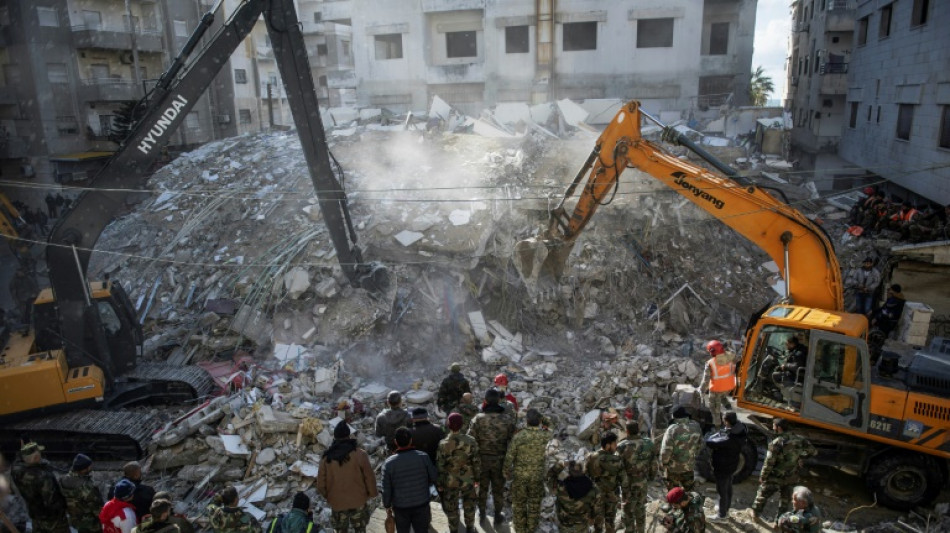
In the neighbourhood of Rihawi, dozens of families anxiously waited for news of relatives still trapped under a crumbled structure, as bulldozers lifted concrete slabs.
Standing in the middle of the destruction, Adam Shaabo waited for a family member to be pulled out.
"I can't forget their faces," he said, recalling their lifeless, crushed bodies.
Jableh has been relatively spared the worst of Syria's almost 12-year civil war, but it has witnessed violent attacks and its residents have been killed in action, mostly alongside government forces.
"We thought we had bid farewell to big funerals," he said, "but death has come to Jableh again."
- 'Dying breath' -
Syrian first responders, as well as rescuers from Lebanon and Russia, have been rummaging in the rubble in a losing race against time.
Moscow is one of Damascus' main allies, and has two military bases in Syria: the airport in Hmeimim five kilometres (three miles) from Jableh; and the naval port of Tartus, roughly 60 kilometres to the south.
Lebanese rescuers pulled out a corpse from under slabs of concrete as relatives dashed to them, crying out as they recognised a deceased loved one.
"We are using primitive methods; we yell out for any survivors and wait for a response," said one of the Lebanese, Ali Safieddine.
"The building crumbled like a biscuit."
In one neighbourhood, residents took shifts guarding abandoned, damaged buildings, while others were busy distributing bread to shelters.
Nearby, rescuer Jalal Daoud dug in the wreckage hoping to catch survivors in their "very last hours", he told AFP.
"We are trying to work quickly... to catch the living before their last dying breath."
Y.Bouchard--BTB