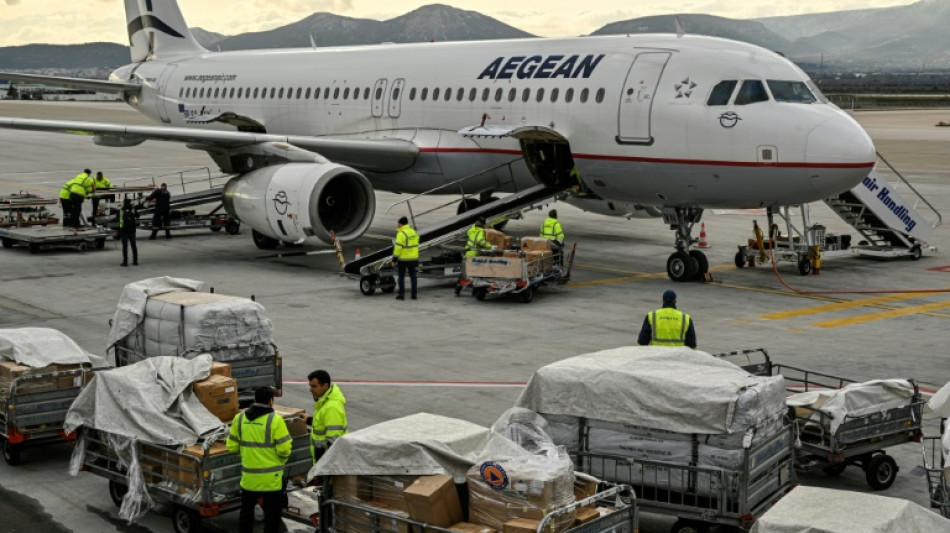
Greeks put politics aside to rush aid to Turkey / Photo: © AFP

 South Korea FA apologises after sex scandal adds to controversies
 Indonesia closes national park as wildfire spreads
 ZXMoto leads China's charge to dominate the global motorbike market
 Top-ranked Sabalenka, Pegula stunned in Toronto fourth round
 Japan nuclear debate unnerves proponents of pacifism
 Spanish teen Jodar ousts eighth seed Lehecka at Montreal

 Angers mounts in US over vast network of car license plate cams
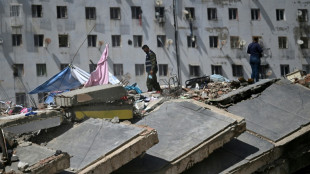
 Darderi to face Nakashima in Montreal quarter-finals
 Espresso power fires Darderi past Borges in Montreal

 Shnaider upsets Pegula to book Toronto quarter-final with Swiatek

 Mount injury overshadows Man Utd draw with Paris Saint-Germain

 Ukraine denies targeting Bulgaria as drone explodes near pipeline

 Vollering grabs Tour de France lead in Nice

 Euros to showcase new TV guidelines on non-sexualisation of women athletes

 'Calm' Kiss savours first win as Wallabies boss
 Duplantis bids for fourth European title as stars align in Birmingham
 Ukraine warns of tough winter as Russia strikes kill 4 in Kyiv region

 Recovering Marchand to skip medleys at European swim champs
 MotoGP leader Martin speeds to British Grand Prix pole

 Drone enters Bulgaria, explodes near pipeline at Romanian border: Bulgarian PM

 Arsenal sign Brazil midfielder Guimaraes from Newcastle
 Atletico will not sell Alvarez, says Simeone

 Ford Fathom turns affordable electric pickup into reality

 Lise Klaveness, the Norwegian thorn in Infantino's side

 Europe’s electric car boom exposes a widening market divide

Aimilia Balta's mother fled Turkey after a vicious war with Greece a century ago but it has not stopped the elderly Greek donating clothes for the thousands left homeless by the deadly earthquake there.
"People are cold, so we do what we can" to help, Balta -- whose mother survived the Greek-Turkish war of 1922 -- told AFP as she left bags of woollens and overcoats at the town hall of a northern Athens suburb.
Thousands of Greeks have responded to calls for aid to quake-hit Turkey, reviving memories of how a spontaneous outpouring of help after a similar disaster in 1999 brought the squabbling neighbours together when they seemed to be on the brink of war.
At the Athens offices of the Red Cross, sleeping bags, blankets, milk cans and boxes of medicine are piling up, the organisation's spokesman Konstantinos Gavriilidis said.
A convoy carrying 40 tonnes of aid left earlier Friday, he told AFP.
"A nationwide appeal was launched two days ago... and the response was immediate and abundant," Gavriilidis said.
The Greek government has separately sent 80 tonnes of medical and first aid equipment.
The 7.8-magnitude tremor has claimed the lives of some 22,000 people in Turkey and Syria.
NATO allies Greece and Turkey have a history of rivalry that goes back centuries.
Balta told AFP that her mother never returned to her home city of Izmir after 1922, and she cannot bring herself to do so either.
"It's too sad, I don't want to go back," she said, vowing to return on Monday with more clothes.
The regional rivalry has been exacerbated by territorial and energy disputes and by Turkish President Recep Tayyip Erdogan's recent bombastic threats of invasion, which Athens attributes to his difficult re-election campaign.
But the two countries that lie on seismic fault lines also have a tradition of helping each other in quake emergencies.
Greece was among the first European countries to send rescue workers and humanitarian aid on Monday, a few hours after the disaster.
"We must make all our forces available to Turkey," Greek Prime Minister Kyriakos Mitsotakis said on Monday.
A day later, he tweeted in Turkish: "Greeks and Turks are fighting side by side, together to save lives."
On Wednesday, a second aircraft carrying firefighters, engineers and doctors left Greece.
Local authorities, trade unions, NGOs and civil society initiatives have also called for donations.
Greek mobile phone companies Vodafone and Cosmote have meanwhile announced calls to Turkey will be free.
- 'Solidarity is alive' -
"Solidarity is alive in these difficult times," Simos Roussos, the mayor of a northern suburb of Athens, said in a Facebook post as he announced local aid collection areas.
"The public reaction is to be expected," Fotini Tsibiridou, a professor of social anthropology at the University of Macedonia in northern Greece, told AFP.
Greeks "want to give their support because they are moved by the drama that contrasts with the political rhetoric of division and rivalry," she said.
Greek TV channels are running rescue operation footage live from the disaster zone, reflecting the nation's own quake concerns.
A video showing Greek rescuers pulling a child from the rubble in the quake-stricken Turkish region of Hatay has been shared tens of thousands of times.
Greece lies on major fault lines and is regularly hit by earthquakes, but high casualties are less common. The worst killed 476 people on the Ionian islands of Zakynthos and Cephalonia in August 1953.
In 1999, three years after the two countries nearly went to war over an uninhabited islet in the Aegean Sea, two deadly earthquakes struck Turkey and Greece within a month of each other.
- Quake diplomacy -
A 7.6-magnitude earthquake in Izmit near Istanbul on 17 August, 1999 killed over 17,000 people. It was followed on September 7 by a 5.9-magnitude earthquake near Athens that left 143 dead.
A thawing of relations overseen by Greek and Turkish foreign ministers George Papandreou and Ismail Cem, accompanied by closer economic, tourism and trade ties, was later dubbed "earthquake diplomacy".
But analysts note that the present situation is very different from that of the 1990s.
"In 1999 Turkey had a more European orientation. Today Erdogan plays the card of tension with Greece to galvanise his electorate ahead of presidential elections," said Antonia Zervaki, of the University of Athens.
Tsibiridou is sceptical on that front.
"Once the impact of this tragic event is over, it will be easy to return to the highly nationalistic and divisive policy" pursued by Ankara, she said.
I.Meyer--BTB