Along underwater highway, workers fix Channel tunnel at night / Photo: © AFP

 Iran Guards say won't reopen Hormuz without US meeting all Tehran's conditions
 Messi absent after father's death as Miami lose in Leagues Cup
 Flight cancellations, evacuations in China as Typhoon Dolphin looms
 Iran issues demands for reopening of Hormuz

 Afghanistan's gold rush upends lives and landscapes

 Messi missing after father's death as Miami lose in Leagues Cup

 World number one Sabalenka ousted in Toronto by Alexandrova
 Olympic weightlifter hoists debris for Venezuela earthquake recovery

 FIFA condemns 'concerted and ongoing effort' to weaken Infantino

 South Africa win after surviving late Argentina surge

 Man Utd boss Carrick being 'careful' with Mount as Man Utd draw with PSG

 All Black Tuipulotu surprised after Sharks include Nonu

 Infantino denies allegations of affair, favouritism while at UEFA: report

 MotoGP leader Martin soars to victory in British GP sprint race
 Mosimane set to succeed Broos as South Africa coach

 Drone enters Bulgaria, explodes near pipeline at Romanian border

 Paris orders e-scooter users to wear helmets, reflective gear

 Lionel Messi's father Jorge dies aged 68

 Johnson reveals 'stress' of Grand Slam Track collapse, clarifies payment
 Defending champion Ferrand-Prevot out of Tour de France Femmes

 Wallabies squeeze past Japan to give Kiss a winning start

 Kyiv mourns recovery volunteer, whose life 'intertwined with the fallen'

 Only two vehicles earn perfect child-seat scores for 2026

 Chinese car brands reshape Australia’s automotive market

 Electric cars enter their most decisive generation yet

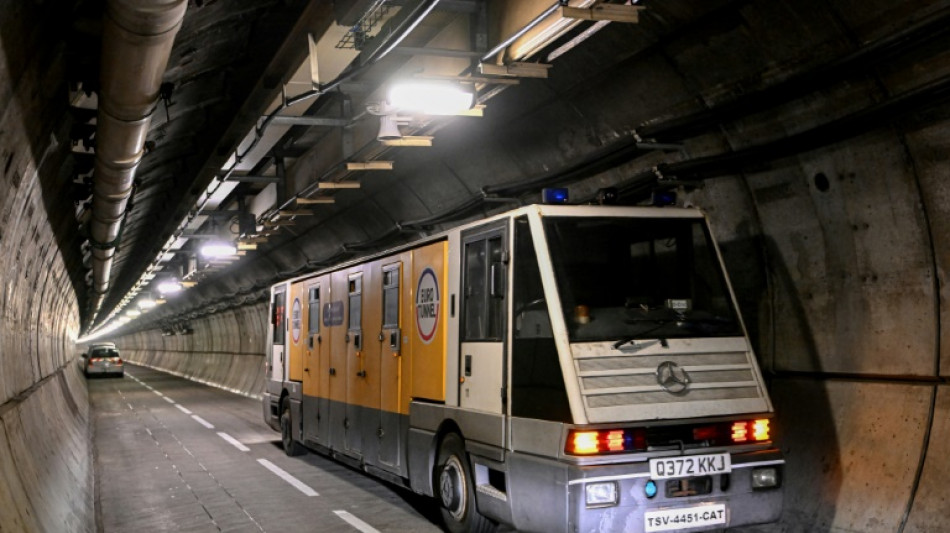
Deep under the Channel, men in orange jackets and white hard hats drive up and down one of the world's longest underground highways, beavering away to keep passenger trains running.
They ply the 50-kilometre (30-mile) service road linking France and Britain, maintaining the railway tracks in two adjacent tunnels that at their deepest point reach some 100 metres below sea level.
It's a unique universe between two countries following different driving conventions and time zones, says Eurotunnel maintenance supervisor Remi Dezoomer.
"We drive on the left like in England, but stay on French time," he said on Saturday night, switching on his hazard lights and honking his horn as he approached a parked car.
The service tunnel is kept at a higher air pressure than the surface atmosphere for safety reasons, so workers first have to transit through a chamber at intermediate pressure before they can drive down into it.
None of their vehicles have number plates, nor right-side mirrors to avoid hitting each other when they cross paths.
"We used to have Clios," said Dezoomer, referring to a small French-made hatchback similar in size to a VW Beetle.
"But now the vehicles are getting bigger and it's becoming tricker."
U-turns are near impossible between the tunnel's hemmed-in walls, and everybody dreads having to deal with a flat tyre so far away from base.
- Brisk work -
Caution is key, Dezoomer said.
The speeding limit is set at 50 kilometres an hour (30 miles per hour) when the tunnel lights are off, but just 30 kph when they are on, which usually indicates someone is in the area.
Two nights a week, during the weekend, Eurotunnel at least partially closes one of the two train tunnels to perform maintenance, while carriages continue ferrying passengers or goods on the other track.
Workers drive up and down in buses, or vehicles pulling trailers, and firemen make the rounds.
Every 375 metres along the service tunnel, corridors lead up to highly secured, heavy yellow doors that open onto the adjacent railway tracks.
On Saturday night alone, 160 workers were busy working on 66 different spots up and down the railway, Jeffrey Guy, one of the project managers, told AFP.
"It's a normal night," he said.
Most -- some 70 people -- were busy replacing rail sections as part of a three-year plan to renovate the entire length of the track.
Jean-Louis Merlin, who is in charge of that project, said his team had to carry out brisk work.
"Tonight, we have five hours and ten minutes to replace more than a kilometre of tracks," he said.
- Underwater border -
Over the years since the tunnel opened in 1994, freight trains as well as carriages carrying lorries and cars have worn down the tracks.
"It's the forth time we're replacing them since the start" of operations, Merlin said.
Miner lights ablaze on their white helmets, staff have to be quick to finish before trains start up again at dawn.
Some weld, while others attach the new tracks to ties.
the railroad ties across the tracks.
In another part of the tunnel, workers in orange safety jackets pump resin into the sides of the tunnel to avoid any water filtering through.
"Water and the 25,000 volts of the overhead catenary don't really mix," maintenance supervisor Dezoomer said.
Elsewhere, workers blast a high-pressure hose against the wall to clean it, creating thick clouds of droplets in the dim golden light.
And halfway between both countries they have their own touristic landmark.
At the border under the sea, near a small sign reading "midpoint", some visitors have graffitied their names on the wall to leave a mark.
F.Pavlenko--BTB