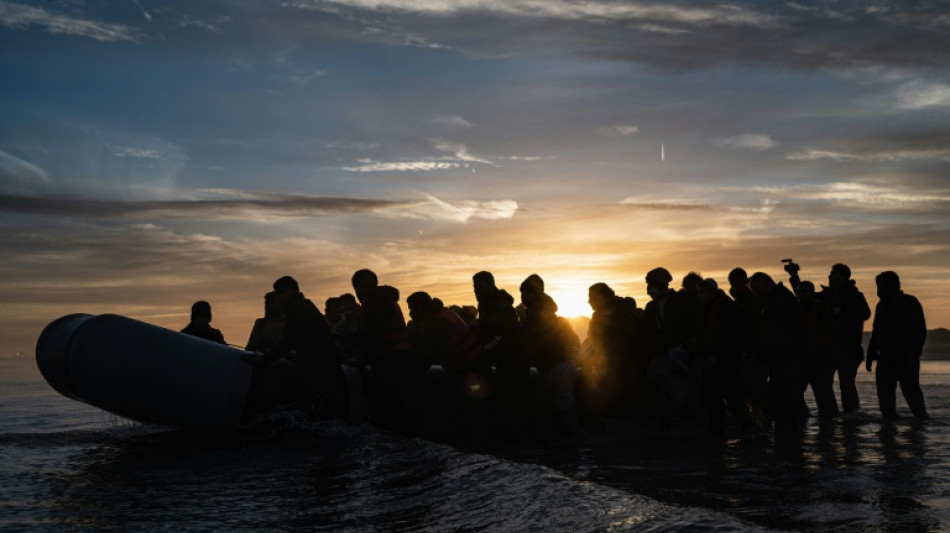
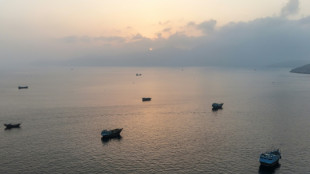
In Channel, major resources track small boats / Photo: © AFP

 Iran Guards say won't reopen Hormuz without US meeting all Tehran's conditions

 Messi absent after father's death as Miami lose in Leagues Cup
 Flight cancellations, evacuations in China as Typhoon Dolphin looms
 Iran issues demands for reopening of Hormuz
 Afghanistan's gold rush upends lives and landscapes

 Messi missing after father's death as Miami lose in Leagues Cup

 World number one Sabalenka ousted in Toronto by Alexandrova
 Olympic weightlifter hoists debris for Venezuela earthquake recovery

 FIFA condemns 'concerted and ongoing effort' to weaken Infantino

 South Africa win after surviving late Argentina surge

 Man Utd boss Carrick being 'careful' with Mount as Man Utd draw with PSG

 All Black Tuipulotu surprised after Sharks include Nonu
 Infantino denies allegations of affair, favouritism while at UEFA: report

 MotoGP leader Martin soars to victory in British GP sprint race

 Mosimane set to succeed Broos as South Africa coach

 Drone enters Bulgaria, explodes near pipeline at Romanian border

 Paris orders e-scooter users to wear helmets, reflective gear

 Lionel Messi's father Jorge dies aged 68

 Johnson reveals 'stress' of Grand Slam Track collapse, clarifies payment

 Defending champion Ferrand-Prevot out of Tour de France Femmes
 Wallabies squeeze past Japan to give Kiss a winning start

 Kyiv mourns recovery volunteer, whose life 'intertwined with the fallen'

 Only two vehicles earn perfect child-seat scores for 2026

 Chinese car brands reshape Australia’s automotive market

 Electric cars enter their most decisive generation yet

Fifteen months after 27 migrants drowned in the Channel, the efforts to prevent another tragedy are visible from the bridge of the French navy boat BSAM Rhone as it patrols on a cold February night.
The 70-metre warship is one of two extra vessels ordered late last year by the French government to join monitoring and rescue operations in the busy waters off the port of Calais from where most migrants leave for England.
On the night of February 9, it spent more than three hours shadowing a packed inflatable dinghy as it weaved between container ships and ferries in the inky blackness, heading for the lights of England on the horizon.
"Our job is to make sure it doesn't get hit," says Gaspard, the officer on watch, as he keeps an eye on the radar and makes sure his ship is a steady one kilometre (0.6 miles) behind the inflatable and its dozens of passengers.
A look-out checks regularly on its progress with infra-red binoculars.
Overhead, a surveillance plane from the European Union border force Frontex can be seen doing loops. A grey Belgian navy vessel stands on alert nearby.
Shortly after midnight, after a bone-chilling journey of around five hours in total, the dinghy crosses the international boundary and enters British waters.
Following the instructions passed on to them by people smugglers, someone on board makes an SOS call.
The Volunteer, a UK Border Force vessel positioned nearby, then swoops in to pick them up, its powerful lights illuminating the gently rolling waves.
It's a familiar routine for the onlooking French.
"Once they're in British waters, they've reached their target," says captain Enoal Gabriel. "If they need saving while they're in French waters, then we're there and we take them back to France."
- 'Stop the boats' -
Around 46,000 asylum seekers crossed the Channel last year in this way -- mostly Afghans, Iranians and Albanians.
This compared with almost none in 2017, before the seaborne route to Britain became the favoured option for migrants.
Around 8,000 were rescued in French waters.
The surge in numbers has left the British government vowing to stem the flow and the French determined not to see a repeat of the November 2021 tragedy that left 27 dead and a deep well of distrust between the neighbouring countries.
On that night, a dingy deflated near the international maritime boundary. Overwhelmed coastguard services on both sides passed the buck as people drowned.
The incident and four more deaths in late 2022 were the backdrop to the deployment of the 3,000-tonne BSAM Rhone, which is big and powerful enough to tow an aircraft carrier but is now being used to shadow tiny inflatables.
One of the 28 crewman on board grumbles privately that he can't wait until the French state follows through on plans to charter two private vessels to replace the sophisticated navy assets.
"We have lots of other missions we could be getting on with," he says, asking not to be named.
The monitoring and rescue operations have also drawn crossfire in Britain, where Prime Minister Rishi Sunak is weighing up radical new plans to "stop the boats".
He reportedly favours mass deportations as a deterrent but has not revived an idea of pushing migrant dinghies back into French waters which was once floated by former interior minister Priti Patel.
Some right-wing media have accused the French of "guiding" migrants to British waters.
Anti-immigration politicians also regularly describe UK Border Force vessels as acting like "a taxi service" by bringing them ashore.
- Policing -
France presently has six vessels in the Channel around Calais to monitor the dinghies, up from four at the end of last year.
Despite the wishes of hardliners in Britain, their role is not to intercept migrant boats -- a task seen as too dangerous because of the risk of accidents.
All the efforts to stop the departures take place on the wide sandy beaches and rugged dunes of the French coast, where hundreds of police equipped with drones and night-vision binoculars run round-the-clock operations.
Improving UK-French relations after years of tensions meant Britain secured a deal in November to send British "observers" to join the French patrols.
London also agreed to pay another 72.2 million euros ($78 million) to cover some of the cost of French security operations and deploy an additional 350 people.
But Pierre Roques, coordinator at Calais migrant support charity Auberge des Migrants, says extra police won't make a difference to the number of boats.
"The coast is so huge. It won't stop people from leaving," he says.
L.Janezki--BTB