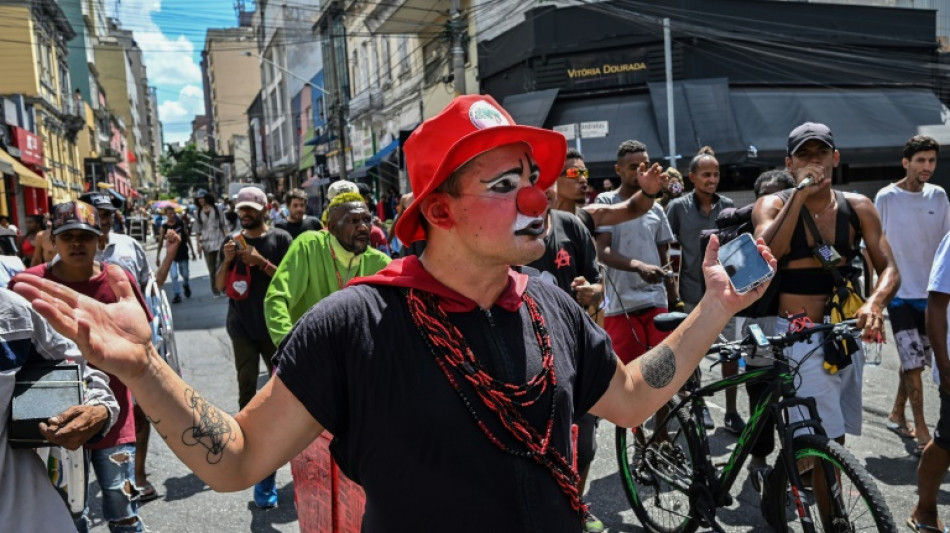
'Crackland' clown seeks to bring hope to Brazil addicts / Photo: © AFP

 Iran Guards say won't reopen Hormuz without US meeting all Tehran's conditions

 Messi absent after father's death as Miami lose in Leagues Cup
 Flight cancellations, evacuations in China as Typhoon Dolphin looms

 Iran issues demands for reopening of Hormuz

 Afghanistan's gold rush upends lives and landscapes

 Messi missing after father's death as Miami lose in Leagues Cup

 World number one Sabalenka ousted in Toronto by Alexandrova

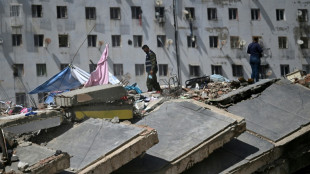 Olympic weightlifter hoists debris for Venezuela earthquake recovery

 FIFA condemns 'concerted and ongoing effort' to weaken Infantino

 South Africa win after surviving late Argentina surge

 Man Utd boss Carrick being 'careful' with Mount as Man Utd draw with PSG

 All Black Tuipulotu surprised after Sharks include Nonu

 Infantino denies allegations of affair, favouritism while at UEFA: report

 MotoGP leader Martin soars to victory in British GP sprint race

 Mosimane set to succeed Broos as South Africa coach

 Drone enters Bulgaria, explodes near pipeline at Romanian border

 Paris orders e-scooter users to wear helmets, reflective gear

 Lionel Messi's father Jorge dies aged 68

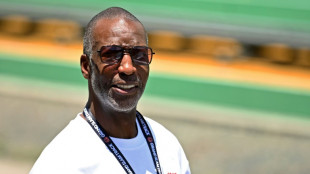 Johnson reveals 'stress' of Grand Slam Track collapse, clarifies payment

 Defending champion Ferrand-Prevot out of Tour de France Femmes

 Wallabies squeeze past Japan to give Kiss a winning start

 Kyiv mourns recovery volunteer, whose life 'intertwined with the fallen'

 Only two vehicles earn perfect child-seat scores for 2026

 Chinese car brands reshape Australia’s automotive market

 Electric cars enter their most decisive generation yet

Every Thursday, Brazilian psychiatrist Flavio Falcone trades his white lab coat for a red clown nose and heads to a decidedly unfunny place: a squalid Sao Paulo neighborhood known as "Crackland."
Wearing a baggy red-and-black outfit with a floppy hat and make-up to match, the 43-year-old doctor dances a goofy routine through the sordid streets of the downtown neighborhood, which is known as Brazil's biggest open-air narcotics market.
"Good morning, Crackland!" he shouts to the strung-out addicts meandering through the trash and decaying buildings that line the district's streets, where authorities have tried in vain for years to restore law and order.
"Crackland is where people who have failed in the capitalist system seek refuge," says Falcone.
"And clowns represent hope in the face of failure: we laugh when they stumble, and people here can relate to that."
Falcone's goal is to build a relationship of trust with addicts, many of whom fear being forced into treatment facilities by the authorities.
It is a first step, he says, in helping them get off the street.
There are around 800 to 1,700 addicts in Crackland, 39 percent of whom have lived in or frequented the neighborhood for more than a decade, according to a study by the Federal University of Sao Paulo published last year.
The number was previously as high as 4,000, before a series of police operations dispersed the addict population.
But the operations also had the side-effect of dispersing Crackland, which went from a clearly delimited district to a hazier area covering much of the city center in this sprawling economic capital of 12 million people.
- Funky beats -
Falcone arrives in the neighborhood jamming to the beats of Brazilian funk music pouring from a sound system wheeled in by his volunteer assistants.
At first, most of the addicts ignore him.
But then a few curious onlookers gather and Falcone talks them into participating in a singing contest.
The first to take the mic is Peterson P.P. -- his stage name -- a 29-year-old homeless man who has been living in Crackland for three years.
He says his dream is to become a funk singer.
"It's almost like being on stage," he beams.
As he sings, another man lights a metal pipe and smokes a crack rock, for an intense but fleeting high that costs around 20 reais ($3.85).
The idea of the singing contest, says Falcone, is to "reawaken a life force" in participants, in order to start steering them toward a treatment program.
It is a three-step process, he says.
"First, we help them get housing. After that, jobs" -- often as cleaners, garment workers or in municipal work-placement programs.
"Then and only then, we help them get treatment for their addictions," he says.
The project, which he started around 10 years ago, has helped dozens of people overcome addiction, Falcone says.
He started the project with government funding, but now relies on corporate donations to keep it going.
One beneficiary, Vanilson Santos Conceicao, says the program helped him find a roof over his head and begin rebuilding his life.
"I suffered a lot on the street. I took a lot of drugs. But I've been clean for three years now," says Conceicao, 35, who now helps prepare free meals for addicts.
- 'Pulling in different directions' -
The clown show comes to an abrupt halt with every police raid.
Charitable organizations that work in the neighborhood accuse the police of brutal tactics.
Local residents and businesses meanwhile complain the district is a security nightmare.
The administration of newly installed Sao Paulo Governor Tarcisio de Freitas has just launched a Crackland action plan with the mayor's office -- the latest in a long line of efforts to address the area's problems.
Officials admit the government has struggled to organize effective policies for the zone.
"Charitable organizations are more present than the state in Crackland right now, and we're all pulling in different directions," says Deputy Governor Felicio Ramuth.
Ramuth, who is leading the administration's initiative, says it includes "hiring specialists to work on-site" and "more treatment options, including self-help groups."
Authorities also plan to install 500 security cameras and offer 1,000 spots in treatment facilities.
Forced hospitalization will be a "last resort," Ramuth says.
F.Müller--BTB