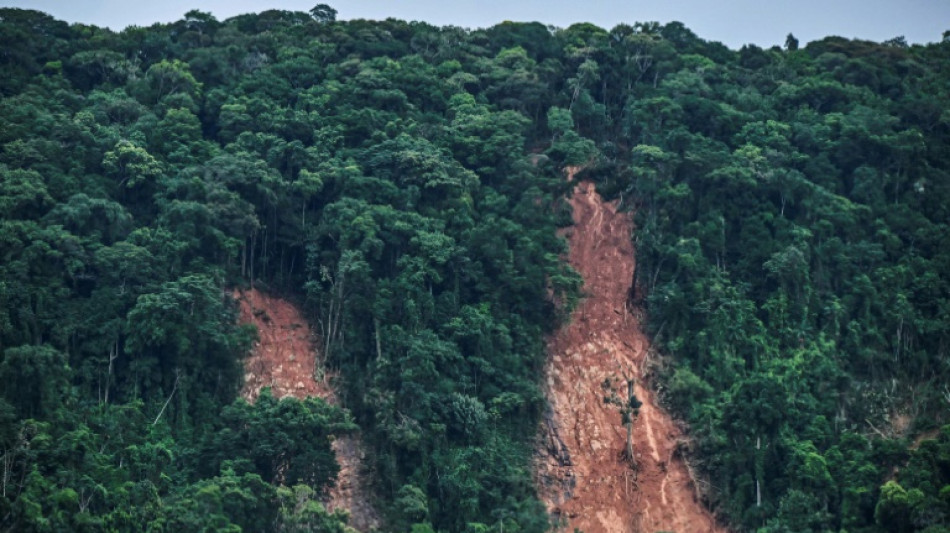
Climate change, rampant urbanization fuel Brazil storm disasters / Photo: © AFP

 Raul Fernandez wins British MotoGP Grand Prix

 Tesla FSD secrecy puts Europe’s safety oversight under scrutiny

 Mercedes-AMG GT 53 balances speed, range and daily usability

 Lion queen Werro focused on Euro medal, not 800m world record

 Changan uses FILDA 2026 to accelerate its African expansion

 Honda plots a profitable European comeback without a price war
 Iran Guards say won't reopen Hormuz without US meeting all Tehran's conditions

 Messi absent after father's death as Miami lose in Leagues Cup
 Flight cancellations, evacuations in China as Typhoon Dolphin looms

 Iran issues demands for reopening of Hormuz

 Afghanistan's gold rush upends lives and landscapes
 Messi missing after father's death as Miami lose in Leagues Cup

 World number one Sabalenka ousted in Toronto by Alexandrova

 Olympic weightlifter hoists debris for Venezuela earthquake recovery

 FIFA condemns 'concerted and ongoing effort' to weaken Infantino

 South Africa win after surviving late Argentina surge

 Man Utd boss Carrick being 'careful' with Mount as Man Utd draw with PSG

 All Black Tuipulotu surprised after Sharks include Nonu

 Infantino denies allegations of affair, favouritism while at UEFA: report

 MotoGP leader Martin soars to victory in British GP sprint race

 Mosimane set to succeed Broos as South Africa coach

 Drone enters Bulgaria, explodes near pipeline at Romanian border

 Paris orders e-scooter users to wear helmets, reflective gear

 Lionel Messi's father Jorge dies aged 68

Climate change and unchecked construction in flood- and landslide-prone areas are making disasters like the violent storm that killed at least 48 people in southeastern Brazil ever more frequent, according to a leading expert.
Francis Lacerda, a researcher at Brazil's IPA Climate Change Laboratory, spoke with AFP about the forces driving disasters like the one that hit the coast of Sao Paulo state last weekend, and what can be done to stop them.
What is causing so many tragedies like this in Brazil?
"It's a consequence of global warning, which has generated more extreme weather events not just in Brazil, but across South America and the entire planet.
"There has actually been a decrease in the total amount of rain in Brazil in the southeast, central-west, north and northeast in the past 30 or 40 years, even as these extreme episodes have increased.
"The large amount of heat in greenhouse gases is being absorbed by our oceans, which is changing ocean currents. That's causing changes in the way heat is distributed at Earth's poles and the equator, and the atmosphere responds with these extreme weather events.
"So total precipitation has decreased, but the distribution has become more intense, with an entire year's worth of rain falling in a few hours in some cases."
Is entire country at risk?
"Yes, although mountainous areas are at higher risk.
"On the Sao Paulo coast, for example, the phenomenon was intensified by the mountain range and the arrival of a cold front with high-speed coastal winds. But rain like that can also occur in coastal areas without mountains."
Could deaths have been avoided?
"It was a tragedy foretold. A day before the storm, meteorological models started indicating a high probability of a phenomenon like this. It would have been possible to get enough information to emergency officials to evacuate these areas and save lives.
"Governments at the city, state and federal levels are unprepared for climate change. We need adaptation and mitigation plans."
Millions face such danger. How does Brazil address it?
"Real-estate speculation has basically pushed poor people on the urban periphery into these high-risk areas. They have no other option.
"It's not enough to just say, 'Get those people out of there.' We need to fundamentally reexamine our cities with a view to reformulating urban public policies.
"There are a lot of things that can be done, including fixing the lack of decent housing."
O.Krause--BTB