'Keep calm': Teaching Venezuelan kids to hide from bullets / Photo: © AFP

 Raul Fernandez wins British MotoGP Grand Prix

 Tesla FSD secrecy puts Europe’s safety oversight under scrutiny

 Mercedes-AMG GT 53 balances speed, range and daily usability

 Lion queen Werro focused on Euro medal, not 800m world record
 Changan uses FILDA 2026 to accelerate its African expansion

 Honda plots a profitable European comeback without a price war
 Iran Guards say won't reopen Hormuz without US meeting all Tehran's conditions
 Messi absent after father's death as Miami lose in Leagues Cup
 Flight cancellations, evacuations in China as Typhoon Dolphin looms
 Iran issues demands for reopening of Hormuz
 Afghanistan's gold rush upends lives and landscapes
 Messi missing after father's death as Miami lose in Leagues Cup

 World number one Sabalenka ousted in Toronto by Alexandrova
 Olympic weightlifter hoists debris for Venezuela earthquake recovery

 FIFA condemns 'concerted and ongoing effort' to weaken Infantino

 South Africa win after surviving late Argentina surge

 Man Utd boss Carrick being 'careful' with Mount as Man Utd draw with PSG
 All Black Tuipulotu surprised after Sharks include Nonu
 Infantino denies allegations of affair, favouritism while at UEFA: report
 MotoGP leader Martin soars to victory in British GP sprint race
 Mosimane set to succeed Broos as South Africa coach

 Drone enters Bulgaria, explodes near pipeline at Romanian border

 Paris orders e-scooter users to wear helmets, reflective gear

 Lionel Messi's father Jorge dies aged 68

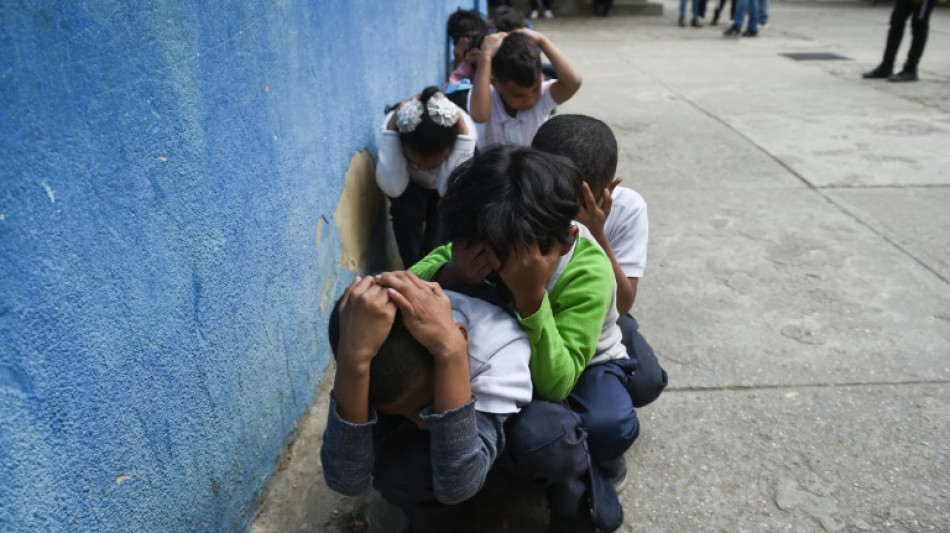
Children fling themselves onto the floor and cover their heads with their hands as loud bangs ring out in the classroom. In one of Venezuela's most violent neighborhoods, this is a shootout drill.
Three boys beat a metal sheet to mimic shots fired. Their peers -- from the first grade of school to the last -- react quickly.
Some take cover in classrooms, others in corridors or the courtyard of the Manuel Aguirre primary and secondary school in the sprawling, crime-riddled slum complex of Petare in the capital, Caracas.
Just days earlier, there was a shootout between gangs nearby, which forced classes to be suspended.
The drill takes about 20 minutes.
For the smallest children, it starts as they are playing with hoops in sports class. They drop to the floor and crawl to a demarcated "safe space" against the wall.
Some of the children scream as they curl up, face down, and cover their ears.
Finally, the school bell chimes three times to indicate the end of the drill.
It will be repeated in two months' time.
"Just as we teach to read and write, we have to give children tools so that they can protect themselves," Yanet Maraima, principal of the school with 900 pupils told AFP.
It is also important that the children can apply what they learned if needed "at home."
- Afraid to go to school -
The training is organized by the International Committee of the Red Cross (ICRC) at Manuel Aguirre and other schools in Caracas.
Manuel Aguirre is in a sector of Petare overflowing with houses of naked brick walls and zinc roofs built into the mountainside, connected by narrow alleys and staircases.
Violence between drug gangs is so rife here that children can distinguish with frightening ease between shots fired from different guns, and at what distance.
"It's a dangerous area," pupil Breylis Breindenbach, 16, told AFP.
"Sometimes I'm afraid to come to school."
Petare had a rate of 80 violent deaths per 100,000 inhabitants in 2022, according to the Venezuelan Violence Observatory, an NGO. There are no official statistics.
The rate is more than double the already alarming national figure of 35.3 per 100,000 -- six times the world average.
In the same neighborhood, Marisela Mujica, a nun, leads a prayer at the Jesus Maestro school in the gang-disputed Jose Felix Ribas neighborhood.
"We had a tense week, we are going to pray for peace," the nun tells pupils gathered in the courtyard.
"What do we want?" she asks the kids. "Peace!" comes the response in chorus.
The Jesus Maestro school has 722 preschool and primary school pupils, but when tensions flare up, not even 200 attend, with civilians caught up in the crossfire and many afraid to leave their homes.
"You never get used to the shots, you live with that constant worry," principal Ivonne Gonzalez told AFP.
"It is like having a school in the Wild West."
In Petare, added Mujica, "the gun is the law. We must fight so that the children see it differently."
- 'Keep calm' -
Similar security drills happen in other Latin American countries with high levels of violence, such as Brazil and Mexico.
In Rio de Janeiro, they have been in place since 2009 in over 1,500 schools in areas where drug gangs or vigilante militia run rife.
"To have training to live in this kind of environment is very important," Renan Ferreirinha, Rio's municipal secretary of education, told AFP.
"Hopefully one day it will no longer be necessary."
For Gonzalez, the most important thing is that the children internalize what they learn.
She recounted that a pupil recently told her about getting caught up in a street shootout.
"What did you do?" she asked the child. "I fell to the ground and crept under a car," was the response.
Mujica goes from class to class to reinforce the lessons.
"What is the first thing we should do" in case of a shooting? she asked one group of students.
A girl replies, correctly: "Keep calm."
Y.Bouchard--BTB