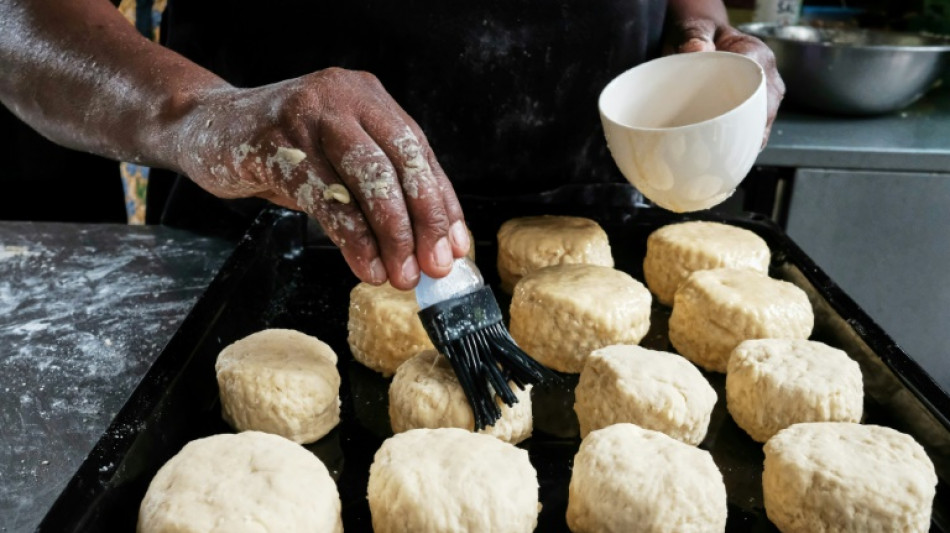
Across Zimbabwe, British scones are the taste of home / Photo: © AFP

 Demi Vollering wins Tour de France Femmes

 Iraola's first Anfield match as Liverpool manager ends in Monaco defeat

 Bodies hanging from bridge revive violence in once-calm town in Mexico

 Lionel Messi bids farewell to father who guided his glittering career

 Raul Fernandez wins British MotoGP Grand Prix

 Tesla FSD secrecy puts Europe’s safety oversight under scrutiny

 Mercedes-AMG GT 53 balances speed, range and daily usability

 Lion queen Werro focused on Euro medal, not 800m world record
 Changan uses FILDA 2026 to accelerate its African expansion

 Honda plots a profitable European comeback without a price war

 Iran Guards say won't reopen Hormuz without US meeting all Tehran's conditions

 Messi absent after father's death as Miami lose in Leagues Cup

 Flight cancellations, evacuations in China as Typhoon Dolphin looms

 Iran issues demands for reopening of Hormuz

 Afghanistan's gold rush upends lives and landscapes

 Messi missing after father's death as Miami lose in Leagues Cup

 World number one Sabalenka ousted in Toronto by Alexandrova

 Olympic weightlifter hoists debris for Venezuela earthquake recovery

 FIFA condemns 'concerted and ongoing effort' to weaken Infantino

 South Africa win after surviving late Argentina surge

 Man Utd boss Carrick being 'careful' with Mount as Man Utd draw with PSG

A sweet doughy treat from Britain has become a beloved part of Zimbabwe's national cuisine, where despite the country's colonial past, mothers and chefs alike now claim the pastry as their own.
The scone, which Brits normally enjoy with afternoon tea, is ubiquitous in Harare, the southern African country's capital.
A breakfast favourite in these parts, it can be found everywhere from high-end eateries to the market stalls of impoverished townships.
"We love scones. They are not British, they are ours, our local scones," Nyari Mashayamombe, a rights activist, says as she leaves an upmarket restaurant in Harare's Belgravia district, its garden dotted with open umbrellas.
Dense yet airy, Zimbabwean scones are the result of the intercultural mix that came with colonisation, says Mashayamombe, a red-haired 42-year-old who is also a singer and media personality.
In "fancy places like here... a beautiful scone goes as high as six bucks," she said, referring to the American dollars that have become Zimbabwe's parallel and preferred currency.
"It's worth it."
A few kilometres away at a market in Harare's oldest township of Mbare, scones are impossible to find after midday.
"We sold them all this morning. They move quickly," one vendor says.
- Yeast and buttermilk -
The main communal bakery in Mbare, a bustling working-class district, opens at dawn.
Tawanda Mutyakureva, 26, arrives at around five in the morning to his work station, measuring two square metres, where he has to bend over to spread the dough on a knee-height countertop.
Every day he cranks out around 200 scones in an overheated room with cinder-block walls, lit by two bulbs hanging from a wire.
Brandishing a cookie cutter, he works quickly to whip out one batch after another, with each scone selling for 25 American cents.
In the hot, humid atmosphere redolent of yeast, his wife -- with their baby strapped to her back -- helps him with buttering the pastries and clearing plates.
Resellers come in to buy 10 or 20 pieces that will be sold at small grocery stores.
Memory Mutero, 46, was at the bakery to buy bread, since she makes her own scones at home.
"I make scones for my three kids. It takes about 45 minutes," she tells AFP.
Her ingredients are simple: flour, salt, yeast, sugar, butter and milk.
But at the Bottom Drawer, an upscale tearoom in Harare, cook Veronica Makonese is unimpressed after tasting a scone brought back from the township.
"There is no milk in those, they used water!" the 46-year-old claims.
A white kerchief on her head, Makonese says she makes her own buttermilk for her scones, to control temperature and acidity levels, and uses only real butter to ensure the proper taste and softness.
Her boss, Sarah Macmillan, a 53-year-old Zimbabwean, says she longs for the scones she would eat as a child.
Back then, two shops in the centre of Harare, now closed, competed for the crown of best scone in the country, and Macmillan wanted her tearoom to make some that are "just as good".
Macmillan says the secret of the little cake's enduring success, in a country struggling with endemic poverty, is simple: "It's very filling and affordable."
F.Pavlenko--BTB