Once banned, now back: Iran sees timid return of neckties / Photo: © AFP

 Brennan captures Wyndham crown for second PGA win
 Rybakina, Gauff advance to Toronto quarter-finals
 Rahm three-peats as LIV Golf season champ while Niemann wins at New York

 Vollering wins Tour de France Femmes after war of nerves

 BMW’s next chapter accelerates with New Class rollout

 Five dead in new Russia, Ukraine strikes
 PSG sign France full-back Digne from Villa

 Sinner withdraws from Cincinnati Open with knee injury

 Fernandez's 'perfect' race earns him British MotoGP Grand Prix win

 Iran Guards say won't reopen Hormuz without US meeting Tehran's demands
 Hogh's hat-trick inspires Celtic to 5-1 victory over Kilmarnock

 London grants first licences for supervised Uber robotaxis

 Erasmus hopeful Kolisi hamstring injury not 'too bad'
 Luxury car buyers trade prestige for mainstream value

 Students, teachers mourn girl killed in Thailand school shooting

 Jacobson to lead New Zealand for first time against Sharks

 Typhoon Dolphin makes landfall in China after flight cancellations, evacuations

 South Korea FA apologises after sex scandal adds to controversies
 Indonesia closes national park as wildfire spreads

 ZXMoto leads China's charge to dominate the global motorbike market

 Top-ranked Sabalenka, Pegula stunned in Toronto fourth round
 Japan nuclear debate unnerves proponents of pacifism
 Spanish teen Jodar ousts eighth seed Lehecka at Montreal

 Angers mounts in US over vast network of car license plate cams
 Darderi to face Nakashima in Montreal quarter-finals
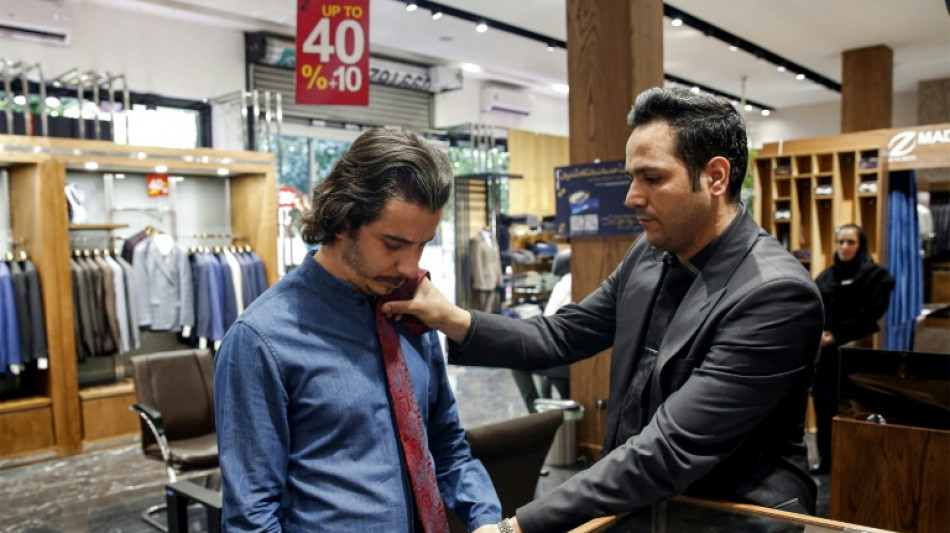
Mohammad Javad enters a fashionable shop in well-to-do north Tehran with his mother. For the first time ever he wants a necktie, long banned in Iran as a symbol of Western decadence.
The 27-year-old dentist said he opted for this clothing accessory in hopes of looking his best during the first meeting with his future in-laws.
"In our society, wearing a tie is like wearing a mask before Covid-19 hit," he said as the salesman adjusted his suit. "People would look at you differently because the negative view still remains.
"I think a man looks chic with one. Unfortunately, we Iranians have imposed strange and unnecessary restrictions on ourselves. It'll take time for that to change, but hopefully it will."
Dress rules have stoked strong passions in Iran, especially restrictions on women who have long been required to wear modest clothing and headscarves.
Iran was gripped by unrest, labelled "riots" by the authorities, after the September 16 death in custody of Iranian Kurd Mahsa Amini, 22, following her arrest for an alleged violation of the country's strict dress code for women.
Iran banned the tie for men after the 1979 overthrow of the US-backed monarch as a symbol of Western culture. Although it has made a slow comeback since, government officials and most Iranian men continue to shun the cravat.
The upmarket Zagros shop on the capital's Nelson Mandela Boulevard however displays rows of ties in different colours and in wool, cotton or silk.
"We sell around 100 a month," said deputy store manager Mohammad Arjmand, 35. "We import them mostly from Turkey, but some are also made in Iran.
"Customers buy them for ceremonies or for work. In this neighbourhood, you will find that two out of 10 people wear one. These days more people are wearing ties compared with previous decades."
The recent unrest "had no effect on our sales", said branch manager Ali Fattahi, 38. "Our customers who were wearing ties before still do so and come to us regularly to buy new ones."
- 'Sign of decadence' -
Iran's Shiite clerics who came to power in 1979 banned the tie because, in their eyes, it was un-Islamic, a sign of decadence, a symbol of the cross and the quintessence of Western dress imposed by the shah, said one trader who asked not to be identified.
After vanishing for decades, ties reappeared in some shop windows during the era of reformist president Mohammad Khatami from 1997 to 2005.
Today, government ministers, senior civil servants and heads of state-owned companies don't wear ties with their suits and opt for shirts with buttoned, open or Mao collars.
Lawyer Masoud Molapanah said "wearing a tie is certainly not a crime" under the constitution or Islamic sharia law. "But there are dress restrictions in certain places such as on television."
Javad, while choosing his tie, was accompanied by his chador-clad mother, who not only encourages him to wear one but also asked the salesmen to teach her how to tie it properly for her son.
"At one time, some sought to remove it," said the 50-year-old state employee, with a smile. "The reason given was the rejection of any sign of Westernisation.
"But then it would have been necessary to also remove the suit and return to the traditional dress worn at the time of the Qajar dynasty" of 1794-1925, she said, adding this "was obviously impossible".
- 'Ties give prestige' -
The head of a nearby Pierre Cardin store, Mehran Sharifi, 35, said many young people now are enthusiastic about the necktie.
"Ties give prestige to people -- a lot of people buy them," said this son and grandson of a tailor, pointing to a century-old photograph on the wall of his grandfather wearing a tie.
"Customers come to buy suits and we match ties to their choice of clothing. Others buy them as a gift."
In some classy cafes, the black tie or bowtie are part of the uniform of waiters, and doctors in several Tehran districts have also sported ties.
The fashion accessory is almost compulsory for Iranians working at embassies and in some foreign companies, although most remove it when they go out on the street.
Sadeq, 39, employed at the Japanese embassy, said he puts on his tie when he gets to work "because wearing a tie in public is not very common in Iran".
"If you dress up like that and walk in the street, you'll definitely turn a few heads. People will think you're either a foreigner or someone headed to a very formal meeting with foreigners."
L.Dubois--BTB