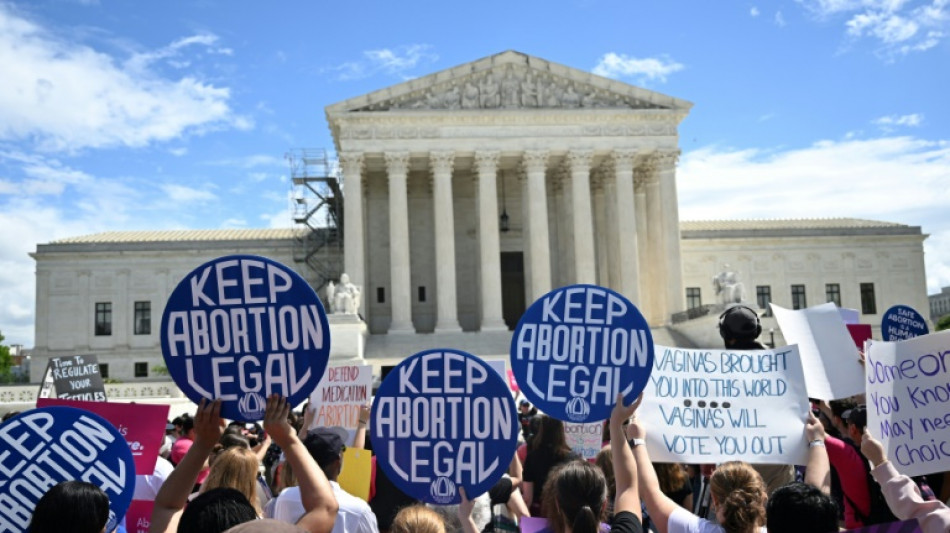
US a country divided one year after Supreme Court abortion ruling / Photo: © AFP

 Swiatek races into Toronto semis as Svitolina battles through

 'Big Four' bowlers back as ageing Australia begin gruelling run

 AI's hunger for power sparks US private gas plant boom

 Memphis AI data center fuels pollution fight in Black neighborhood
 Ceuta leader wants migrant detention centre after influx
 Colombia scrambles to find survivors as quake kills 111
 Rain postponements wreck Montreal Masters schedule
 Notts Forest owner Marinakis sues Palace over gun banner - reports

 Koech gets three-year ban, stripped of US 1,500m title

 Sensational Ingebrigtsen back with more European gold
 'A scare': Brazil player leaps into tunnel in joy over goal

 USA Swimming CFO Hilliard arrested for alleged theft

 Trump insists Netanyahu relationship 'very good' despite Gaza rift

 Ingebrigtsen delivers masterclass for seventh European athletics gold

 Colombia declares state of emergency after quake kills 111

 Golden relay double for Britain at Europeans as Marchand takes silver

 Barcelona's Araujo heads to Liverpool on loan

 Tupac Shakur murder trial begins 30 years after rapper's death

 Russia bars only anti-war party from elections

 Boeing to divest tech ventures for stake in air-taxi startup

 Major quake rocks Colombia and neighbors, 18 confirmed dead

 Brazil aircraft maker Embraer raises outlook after record revenue

 Drought forces water restrictions across nearly 70 percent of France
 Europe wary as gas stocks languish at lows while winter looms

 Freedom Holding Corp. Reports 40% Increase in Quarterly Revenue to $732.5 Million

The historic US Supreme Court about-face on abortion a year ago has created a nightmare for women seeking the procedure, a legal morass for the courts and a challenge for the Republican Party.
On June 24, 2022, a court reshaped by Republican president Donald Trump overturned the landmark 1973 Roe v. Wade decision that guaranteed a constitutional right to abortion and left it up to each state to decide.
That same day, several conservative states moved to ban abortion, forcing clinics to hastily shut down or move to places where they could still operate.
Since then, the United States is divided. Some 20 states, mostly in the south and Midwest, have prohibited abortion outright or severely restricted access while others, mainly on the coasts, have moved to protect it.
The nationwide impact, in terms of sheer numbers, remains limited.
According to a study by the Society of Family Planning, the average number of monthly abortions nationwide between July 2022 and March 2023 was 79,031, 3.3 percent fewer than in April and May 2022, when an average of 81,730 abortions a month were performed.
"Many people are still getting the abortions that they need," said Ushma Upadhyay, a public health social scientist at the University of California, San Francisco, and a co-author of the study.
"It's just that they have to face great challenges to be able to get those abortions," Upadhyay told AFP.
The closure of abortion clinics in about a dozen states has forced tens of thousands of women to travel elsewhere to terminate a pregnancy.
Beyond the financial burden, getting days off from work or explaining an absence to one's family is not always easy.
Logistical problems can delay the procedure further into a pregnancy, having a psychological impact, not to mention health risks.
- 'Russian roulette' -
Anna Zargarian, a plaintiff in a lawsuit filed in Texas, recounted her harrowing experience after her water broke at 19 weeks, far too early for the fetus to survive.
She was forced to fly to Colorado for an abortion since doctors in Texas would not perform one, a trip she described as "terrifying."
"It was like Russian roulette, knowing I was at risk of infection, hemorrhaging or going into labor at any moment," Zargarian said.
During the early days of a pregnancy, many women in the United States use the abortion pill but it is illegal in several states and women who acquire it over the internet or through a network of volunteers run the risk of being prosecuted.
Upadhyay said it is women "who are the poorest of the poor," mostly African Americans and Hispanics, who are being forced to carry pregnancies to term.
"It's disproportionately people of color who are impacted," she said.
The long-term outlook is uncertain.
Over the past year, a number of private groups have mobilized to help women obtain abortions but "one or two years down the line these private efforts are going to get exhausted," Upadhyay said. "It's not sustainable."
The legal landscape is equally uncertain.
Every state restriction imposed on abortion is being challenged in the courts and the legal battle is ongoing in heavily populated states such as Georgia and South Carolina.
- Abortion pill -
One of the biggest unknowns is the fate of the abortion pill, which is used for more than half of the abortions in the United States.
In April, a federal judge in Texas banned the widely used drug mifepristone (RU 486), which was approved by the Food and Drug Administration in 2000 and has been used since then by more than five million women.
Mifepristone is one component of a two-drug regimen that can be used through the first 10 weeks of pregnancy.
The judge's decision was put on hold by the US Supreme Court but a conservative lower court currently considering the case could uphold his ruling.
The battle is also ongoing in the political arena.
President Joe Biden, a devout Catholic who supports abortion rights, and other Democrats have made defending the procedure one of their priorities and it seems to have paid dividends in the 2022 midterm elections.
Democratic candidates performed better than expected in the midterms and referendum proposals that would have effectively banned abortion in the conservative states of Kansas and Kentucky were soundly defeated.
Republican candidates have been forced to perform a delicate balancing act, satisfying the fiercely anti-abortion religious right, a key base of support, while not alienating more moderate voters.
Anti-abortion groups such as SBA Pro-Life have said they will only support a presidential candidate in 2024 who pledges to enact a nationwide abortion ban.
The Republican frontrunner, Trump, who frequently boasts about naming the three Supreme Court justices who overturned Roe v. Wade, is yet to give that commitment.
J.Fankhauser--BTB