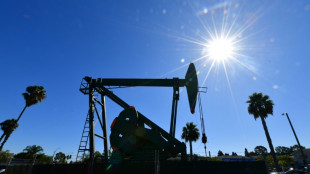
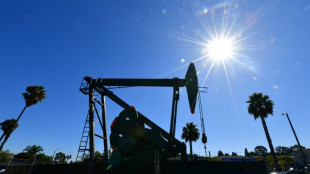
Why American communities are suing Big Oil for climate damages / Photo: © GETTY IMAGES NORTH AMERICA/AFP/File

 Somali referee denied World Cup 'proud' to oversee UEFA Super Cup
 French newspapers target Google over AI summaries

 Ebola death toll in DR Congo outbreak rises to more than 2,000

 PrimeXBT Launches MT5 Cent Account for Beginners and Risk-Conscious Traders

 British sprinter Hunt chasing three more golds after winning 100m

 Ethiopia's Tigray rebel authorities condemn army drone strikes

 Too hot to live? French buyers rethink housing choices after heatwaves
 Ukraine says Russia fired N. Korean missiles in deadly attack
 Oil prices jump further as hopes for Hormuz deal fade

 Trump says would be 'terrible mistake' to oust embattled Infantino

 Charity races to raise millions to buy historic English estate
 Hungary parliament to elect Orban-critic judge as president
 Wallabies lock Amatosero given three-match ban for Japan red card

 Swiatek races into Toronto semis as Svitolina battles through
 'Big Four' bowlers back as ageing Australia begin gruelling run

 AI's hunger for power sparks US private gas plant boom
 Memphis AI data center fuels pollution fight in Black neighborhood

 Ceuta leader wants migrant detention centre after influx

 Colombia scrambles to find survivors as quake kills 111

 Rain postponements wreck Montreal Masters schedule

 ePropelled to Increase Manufacturing Footprint with $60 Million in U.S. Government Funding to Strengthen U.S. Drone Propulsion Supply Chain

 Power to Hydrogen Delivers First-of-a-Kind Industrial-Scale AEM Electrolyzer to the Port of Antwerp-Bruges
 Notts Forest owner Marinakis sues Palace over gun banner - reports

 Koech gets three-year ban, stripped of US 1,500m title

 Sensational Ingebrigtsen back with more European gold
Attorney Jeffrey B. Simon helped families affected by the opioid crisis obtain settlements worth more than $2.7 billion against leading pharmaceutical companies.
Now, he's part of a legal team taking on Big Oil over the 2021 Pacific Northwest Heat Dome disaster -- and says the era of fossil fuel companies evading responsibility for their role in the climate crisis is ending.
"We contend that they put out an enormous amount of disinformation so that their business activities and their wealth creation would not be interrupted," the Texan told AFP in an interview, after filing a $52 billion case on behalf of Oregon's Multnomah County.
"The defendants' old saw -- that this science is uncertain and unproven -- will fail," added the trial lawyer at Simon Greenstone Panatier PC.
These defendants include the world's biggest energy interests: ExxonMobil, Shell and Chevron to name a few, but also the American Petroleum Institute, and the consultancy firm McKinsey & Company.
Multnomah County, which encompasses the state's biggest city Portland, is seeking the sum for past and future damages, as well as for a fund to "climatize" its infrastructure in preparation for a future of frequent and intense heat waves, drought and wildfires.
Its suit, filed in late June, alleges it suffered 69 deaths, extensive property damage, and significant expenditure of taxpayer money as a result of the 2021 heat wave, which saw it sizzle in temperatures up to 116F (46.7C).
A peer-reviewed analysis by the World Weather Attribution group said the phenomenon would have been "virtually impossible" without human-caused climate change.
- Explosion of cases -
The case is the latest in a wave of litigation that began around 2017 in the United States, the world's biggest economy, responsible for the greatest share of accumulated global carbon emissions.
More than 40 cities, counties, and states across the US are suing fossil fuel interests over climate change impacts as well as campaigns of disinformation spanning decades, according to the Center for Climate Integrity, which tracks such cases.
"We're at a really important moment," Delta Merner, lead for the Science Hub for Climate Litigation at the Union of Concerned Scientists, told AFP.
The oil and gas industry has been fighting for years to keep these cases out of state courts, where she argues they belong because the harms of global warming differ from place to place.
Florida experiences more intense hurricanes, for example, while California has worsening wildfires.
Industry, on the other hand, has sought to characterize the cases as attempts to regulate emissions and policy, making them a federal matter.
These efforts at federalization received blows in April and May when the Supreme Court declined to hear appeals by oil companies against appearing in state courts, meaning the cases can now start to be heard on their merits.
These cases are distinct from a trial that concluded in Montana, where a group of young people say the western state violated their state constitutional rights to a clean and healthy environment.
They are not seeking damages, but rather a judgment declaring as unconstitutional regulations that allow state agencies to ignore climate impacts when making permitting decisions for fossil fuel development. That trial is now awaiting a verdict.
- Parallels with opioid settlements -
Beyond the jurisdictional debate, the fossil fuel industry and its advocates contend that their products are lawful and have helped grow the economy and raise standards of living.
Chevron's legal counsel Theodore J. Boutrous told AFP: "The federal Constitution bars these novel, baseless claims that target one industry and group of companies engaged in lawful activity that provides tremendous benefits to society."
Simon argued there's nothing novel about their legal arguments.
"In opioid litigation, we never contended that there was no appropriate medical use for prescription opioids -- it's oversupply," which he says is the same case for fossil fuel use.
Multnomah County's suit alleges the defendant companies' own internal documents showed they knew of the environmental harms of their products more than 50 years ago, but engaged in deception campaigns that prevented communities from making the best choices.
"This is much closer to an arson case than it is a climate change case," said the lawyer, who has spent his career doing public health work through the civil justice system and has an upcoming book, "Last Rights," on how the right to trial by jury is being erased.
On the plaintiffs' side are advances in attribution science, or modeling that helps disentangle the role of climate change from natural weather patterns and climate variability.
Michael Burger, executive director of Columbia Law School's Sabin Center for Climate Change Law, told AFP that he accepted that policymaking legislation is the best way to ultimately deal with the climate crisis.
But "clearly policymakers have failed to date to adequately address the problem," leaving communities to "take to the courts to seek justice, where others have failed them."
N.Fournier--BTB