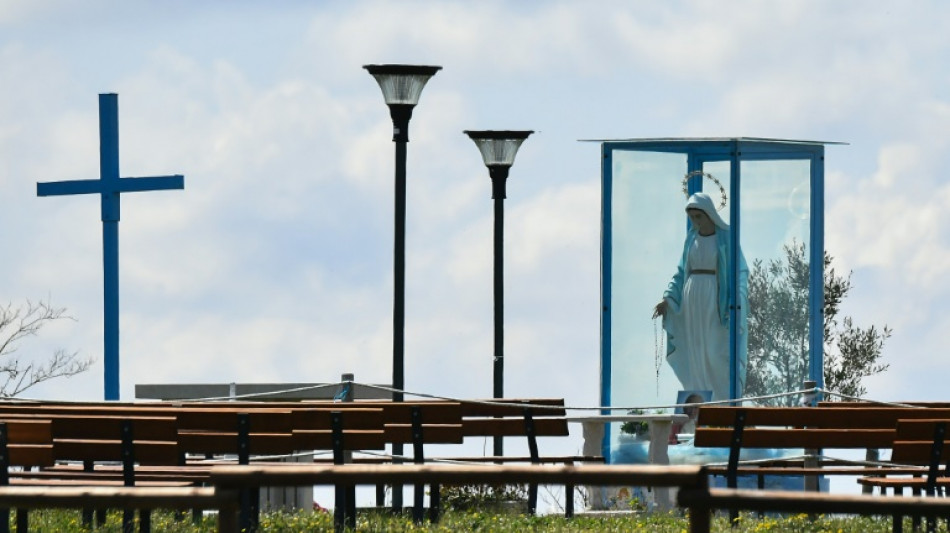
Italy's 'miracle' of the pizzas spurs Vatican to action / Photo: © AFP

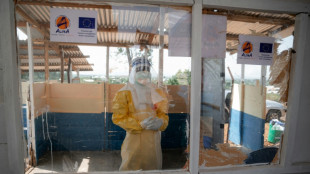
 Ebola outbreak in DR Congo kills more than 2,000
 ChargeAfter Powers BYLD Finance Expansion into Consumer Financing for Equipment Retailers

 MEXC Upgrades RealStocks With Three New Features to Enhance U.S. Stock Trading Experience

 Israel demolishes home of slain Palestinian involved in deadly West Bank clash
 Liverpool fans seek clarity on Bezos bid to buy stake

 Solar eclipse sparks scramble for protective glasses across Europe

 Oil prices jump as US-Iran deal hopes falter

 Newly crowned world's best pastry chef stays true to artisan roots
 Johnson signs for Everton in McNeil swap deal

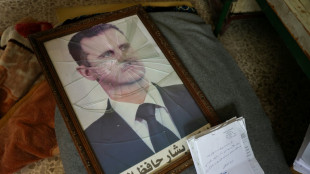 Syria sentences Bashar al-Assad to death in absentia over atrocities

 Hong Kong's tech index plans expansion with AI and robotics themes

 The Infantino saga -- What they said
 Economic losses from natural disasters fall to $100 bn in first half of 2026: Swiss Re
 Colombia scrambles to find survivors as quake kills 132
 Singapore says AI-related demand lifting economy

 Demeter Tactical Investments (ME) Limited bolsters governance with two board appointments
 Russian barrage on Ukraine kills 9, wounds dozens
 Schools closed as Indonesia battles wildfires

 Swiatek dominates Shnaider to set up Toronto semi with Svitolina

 Oil prices rise further as hopes for Hormuz deal fade
 One year after Putin-Trump summit, 'spirit of Anchorage' dissipated

 Farage vs Count Binface: What to know about UK snap poll
 Torment of Afghan fathers as daughters deprived of education
 Return of displaced Syrian Kurds to hometown suspended after violence
 Swiatek races past Shnaider into Toronto semi-finals
On the third of every month, hundreds of the faithful gather in a windswept field in a village near Rome where they believe a statue of the Virgin Mary is crying tears of blood.
They also come to see the 53-year-old woman who they believe has been performing miracles and healing the sick since she brought the statuette home from a pilgrimage to Medjugorje in Bosnia Herzegovina, where many Catholics believe the Virgin Mary has been appearing since 1981.
Gisella Cardia claims the statue was responsible for a modern twist on Christ's miracle of the loaves and fishes, feeding visitors to her home in Trevignano Romano from a never diminishing pizza.
"It was a pizza for four and 25 of us ate from it. It never got any smaller," she told an Italian YouTube channel. "We were shocked!"
On another occasion Cardia claimed to have fed others with leftover gnocchi that never ran out no matter how much she dished out.
Believers say Cardia is a visionary, claiming she predicted the war in Ukraine and the Covid pandemic, her body marked by the stigmata of Christ's wounds from the crucifixion.
In a country where three-quarters of the population still identify as Catholic, the case has rekindled public fascination with the supernatural -- even more so since it has echoes of a hit television series, "The Miracle".
But many in wealthy, picturesque Trevignano are deeply sceptical of what they call a "giant scam", with some almost coming to blows with droves of pilgrims who turn up every month.
"If it's not true -- which I believe is probably the case -- people's weakness will have been abused when so many people are fragile," pensioner Maria-Alessandra Conti told AFP.
"And that angers me. There are lots of troubling elements," the 72-year-old added.
- 'Bleeding' statues -
Chief among them is Cardia's conviction for bankruptcy fraud in 2013 and the charity the former businesswoman has set up to help the sick.
Although it has been swollen by donations -- one man giving 123,000 euros ($134,000) -- some say their generosity has been abused.
Then in March a private detective said tests showed the statue's tears were of pig's blood. Prosecutors are now investigating Cardia, and the shrine she set up on a hill outside the village overlooking Lake Bracciano is threatened with demolition.
The local Catholic bishop, Monsignor Marco Salvi, has ordered his clergy to have nothing to do with the shrine, and has asked the faithful to stay away.
A Church commission of inquiry composed of independent experts is now looking into the phenomena.
But Father Salvatore Perrella, the influential head of a theological group in Rome dedicated to studying the Virgin Mary, did not hide his hostility.
"We have known for a while that this so-called visionary was absolutely not reliable," he told AFP.
"Trevignano should not be counted among the apparitions" of the Virgin Mary.
Yet the faithful continue to flock to Cardia's hilltop shrine with its altar, large blue cross and almost life-sized statue of the Virgin.
Since the "Virgin of the Tears" in Syracuse, Sicily began to cry in 1953 -- the only weeping statue acknowledged by a pope -- Italy has seen countless strange or unexplained phenomena around religious statues.
The oldest and most celebrated is the cult of San Gennaro, the patron saint of Naples, an ampoule of whose blood liquifies three times a year by popular tradition.
Beyond Italy statues have been reported to secrete water, oil or perfume as far afield as Akita in Japan and Naju in South Korea.
The Catholic Church says some are "inexplicable scientifically".
Scientists say many have rational explanations like condensation, varnish coming off or chemical reactions between paint and the air.
However, "science cannot shake faith," said Romy Sauvayre, a sociologist from France's CRNS who specialises in belief.
"Scientists can say whatever they want and (the faithful) will not believe them because they have felt and seen it with their own eyes."
- Fervour -
While Pope Francis warned against certain "apparitions" in June in a thinly veiled reference to the "Virgin of Trevignano", some of his predecessors have not been so reticent. John Paul II was supportive of another "miraculous" plaster statuette from Medjugorje which has been drawing crowds to Civitavecchia, an hour's drive from Trevignano, since 1995.
A family there claims to have witnessed it crying tears of blood on 14 separate occasions.
Although never officially recognised by the Vatican, fervour around the statue has not dampened over the years, with the statuette housed in a church on the edge of port city north of Rome.
Photos displayed inside show her cheeks red with blood, with tents outside to welcome visitors, and vendors selling religious icons and effigies of the Virgin.
However, analysis of the blood has shown it came from a man. However, the men of the family who own the statue stubbornly refuse to take DNA tests.
On the other side of the Adriatic in Medjugorje, where both statues were made, locals firmly believe in the apparitions that have been happening there since 1981.
Every day Ivan Perutina's 20 workers make around 400 statues from a mix of powdered stone and synthetic resins renowned for their resistance to all weathers.
In the two decades he has been making them, Perutina told AFP that he has heard of "some things that were out of the ordinary".
Like the clients in Portugal who reported that a statuette smelled of roses and lavender even though "we had not added anything to it," he insisted. The little statues are solid, so nothing can be put inside them, a worker explained.
Asked if there was any way in which they could be tampered with, Perutina replied, "Oh no! God preserve us from that!"
- 'Church has to be prudent' -
The Catholic Church tends to be wary of these cases, leaving its dioceses to pronounce.
"One absolutely cannot base faith on people's credulity," said Father Perrella. "Precisely because of its experience in these situations, the Vatican is very rigorous and asks bishops to be just as rigorous in their investigations."
In April, the Vatican created the Observatory for Apparitions and Mystical Phenomena Related to the Figure of the Virgin Mary to help bishops, because "many do not know how to deal with the subject," its president, Father Stefano Cecchin, told AFP.
There is a whole protocol to follow, said its director Sister Daniela del Gaudio.
Before deciding on a case, "the commission (of inquiry) questions the protagonists... Its members, who are doctors and lawyers etc, have their own competences and it proceeds in a scientific manner. You also have to look at the morality of the visionaries, as well as their physical and psychological state.
"The Church believes in the supernatural, but it also has to be very prudent," she added.
These kinds of phenomena also tend to multiply in times of war and crisis, flourishing alongside conspiracy theories and disinformation, experts say.
Professor Roberto Francesco Scalon, a religions specialist at the University of Turin, said some people are always convinced that "they are living in prophetic times."
"When there is a lot of uncertainty because of a pandemic or economic problems, people look for answers and for hope," said fellow sociologist Sauvayre.
Despite the scandal surrounding it, the group behind Virgin of Trevignano is still calling on the faithful to gather at the shrine on the third of every month, even if numbers were down in July. "Don't listen to the rumours," one of its leaders told AFP. "Today fake news is everywhere."
R.Adler--BTB