Two dead as Bangladesh garment workers protest low pay / Photo: © AFP/File

 Lukaku joins Turkish side Fenerbahce from Napoli
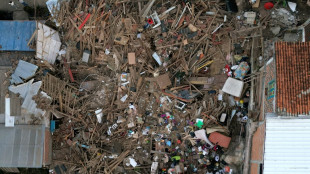
 Colombia quake rescue efforts enter 'final phase' as toll hits 239
 Brazil orders suspension of Discord livestreams after teen suicide

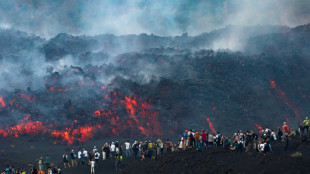 Tourists rush to Mount Etna as Italian volcano erupts
 Knot and Venmo Team Up to Make Venmo the Effortless Way to Pay
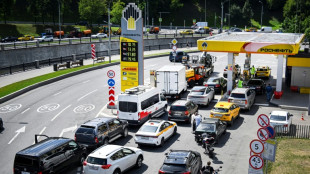 In Moscow, Russians worry about new fuel shortages

 New space object 'black hole star' discovered by astronomers

 England captain Root tells players to be 'adults' as he ditches curfew
 US inflation slows slightly in July despite elevated fuel prices

 Total solar eclipse to cast its shadow over Europe
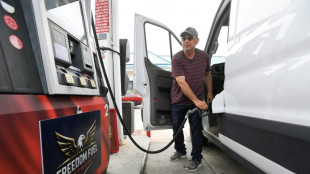 US consumer inflation slows slightly in July despite elevated fuel prices
 Warholm on track in bid for fourth Euro hurdles gold

 Erdogan eyes expansion of regional defence pact

 Extreme weather, jellyfish knock one-fifth of France's nuclear capacity offline
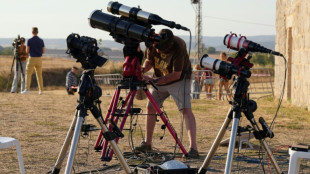 Skywatchers gather in Europe to see total solar eclipse
 Zhu Rongji, trailblazing ex-premier who transformed China's economy
 China tech giant Tencent's Q2 profit down as AI push builds

 China's C919 jet makes first international commercial flight
 Mideast war impact on travel bookings fading, TUI says
 Bangladesh get Das fitness boost for daunting Australia task
 One dead, 172 rescued as second ferry in days catches fire in Indonesia
 Foxconn posts quarterly profit surge on AI server demand
 Hazlewood gets Australia nod ahead of Boland for Bangladesh Test
 Toyota ex-chief Okuda, pioneer of the Prius, dead at 93

 Colombia rescuers find woman alive as quake death toll passes 200

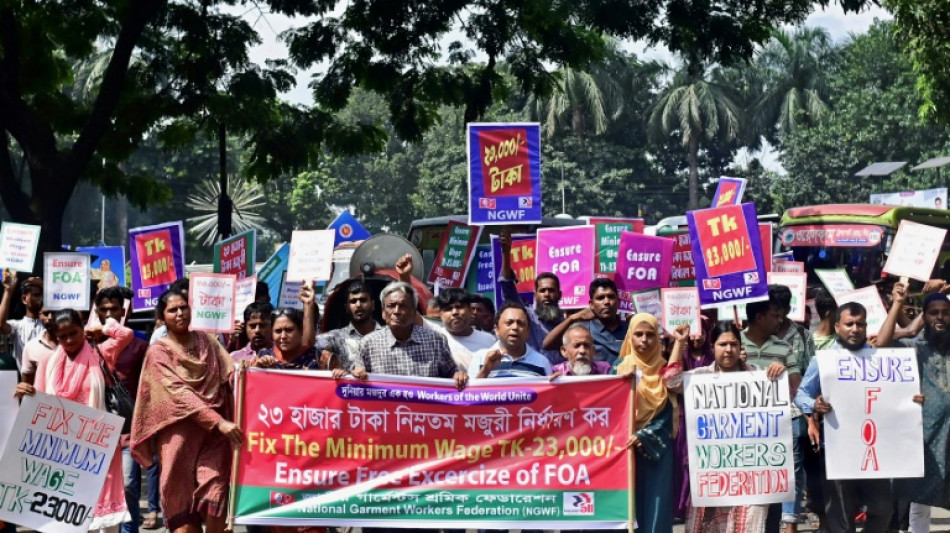
Thousands of garment workers in Bangladesh walked off the job in protest at low wages Monday, sparking clashes with security forces and damaging multiple factories in unrest that left at least two people dead, police said.
Bangladesh is one of the world's largest garment exporters, with the industry accounting for 85 percent of the South Asian country's $55 billion in annual exports, but conditions are dire for many of its four million apparel workers.
Police said at least 10,000 workers left their shifts and staged protests in Gazipur, the country's largest industrial city, where a six-storey factory was torched, leading to one of the two fatalities.
Another 7,000 protested in the central towns of Ashulia and Hemayetpur, authorities said.
Ashulia garment union leader Mohammad Ibrahim disputed the police figures, saying there were more than 100,000 protesters.
The worst violence erupted on a highway north of the capital Dhaka to Mymensingh, where at least 4,000 workers clashed with police, blocked the road and set fire to a pick-up truck, officers told AFP.
"One garment worker was injured during the clashes, and he died as he was taken to a hospital," said Sarwar Alam, chief of the industrial police unit in Gazipur.
"They hurled rocks at our officers like rain. Some policemen were injured during the clashes. We fired tear gas and sound grenades to disperse the workers."
In Gazipur, workers targetted plants which they claimed did not allow workers to join the demonstrations, torching a factory at Konabari, police and a fire service official said.
"One worker of ABM Fashions died from suffocation after the fire spread to the first three floors," Gazipur fire service chief Abdullah Al Arefin told AFP.
"We rescued another worker alive," he added.
Police said at least 40 factories were damaged after protesters smashed windows and damaged furniture.
Mahbubur Rahman, police chief of Bangladesh's industrial regions, told AFP authorities were talking to union leaders to peacefully resolve the protests.
- 'Basic needs' -
Bangladesh is home to around 3,500 garment factories, where clothing for some of the world's largest retailers and brands is made, but the basic monthly wage for workers is just 8,300 taka ($75).
Protests erupted over the weekend after the powerful manufacturers' association offered a 25 percent raise, ignoring union demands for a new monthly minimum basic wage of 23,000 taka -- nearly a threefold increase.
The South Asian country of nearly 170 million has overtaken its neighbour India in per capita income, with the garment industry at the centre of its impressive growth over the past two decades.
But wage protests pose a major challenge to Prime Minister Sheikh Hasina, who has ruled the country with an iron fist since 2009. A resurgent opposition has challenged her rule as she readies for elections due before January.
Her government set up a panel this year to set a new minimum wage.
Unions say that garment factory owners -- who include ministers and influential lawmakers -- have played a role in fixing the minimum wage during past negotiations.
"The workers have been badly impacted by a cost of living crisis, and the cost of food has skyrocketed," said Taslima Akter, the head of the Garment Sramik Samhati union.
"If you take into account inflation and the depreciation of the taka against the dollar... the manufacturers were offering less than what a worker got in 2017 when the basic minimum wage was fixed."
Major brands including Gap, Levi Strauss, Lululemon, and Patagonia wrote a letter to Hasina this month calling for a "successful conclusion" to wage negotiations.
"The consultations should seek to raise the minimum wage to a level that corresponds with a wage level and benefits that are sufficient to cover workers' basic needs and some discretionary income," the companies wrote on October 13.
Protests over wages and shoddy safety conditions often erupt in Bangladesh.
In 2006, protesters torched at least 16 factories in wage protests that left several people dead.
Major wage and safety protests also erupted in 2013, after the collapse of the Rana Plaza garment factory building, which left at least 1,134 people dead.
O.Krause--BTB