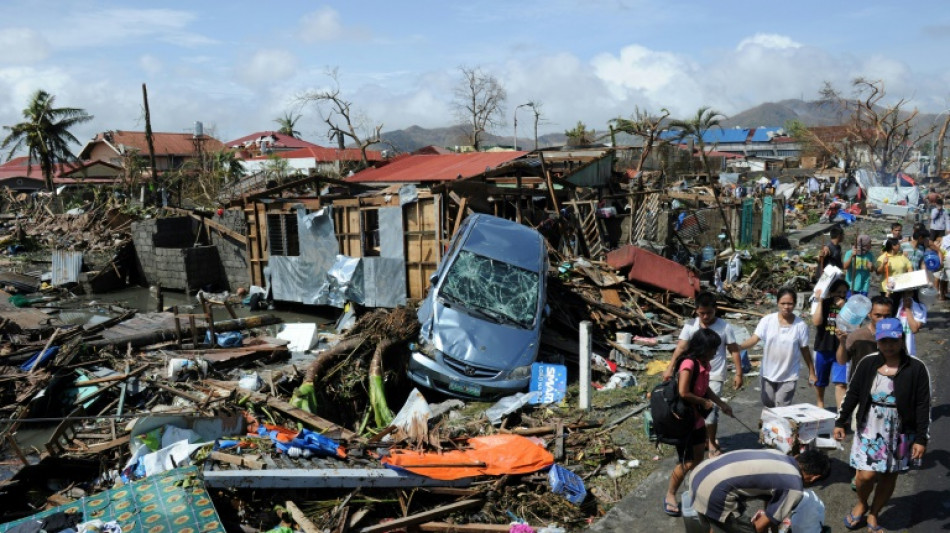
'I try to be strong': Filipino typhoon survivors on starting again / Photo: © AFP

 'Trying to bury the science': US climate research under siege

 Eurovision to bar countries at war from hosting
 Italian teenager Curtis breaks 50m backstroke world record at Europeans

 New mum Sjostrom wins 50m butterfly for 18th European gold

 Solar eclipse darkens Arctic Russia on course for Spain
 Russian economy rebounds in second quarter despite Ukrainian strikes

 NBA's Los Angeles Lakers to be sold for $12.5 bn: ESPN
 Trump sued over sale of access to Truth Social posts

 Europe looks to the skies as solar eclipse cast its shadow
 At least 44 drown after ferry overturns on Zimbabwe's Lake Kariba

 Grieving Argentine icon Messi unsure about playing on 'much longer'

 Nigeria kidnap victims escape 'hellfire' captivity beaten, malnourished
 Google unveils finder tag, new AI smartphone features
 US equities gain as inflation report eases fear of rate rise
 Colombia declares three days mourning for quake victims

 44 lives lost after ferry capsizes on Zimbabwe's Lake Kariba

 WallStreetPR Releases Report on China’s Gold Purchases and African Mining Investment

 Former Chinese premier Zhu Rongji dies aged 97
 Markets steady awaiting US inflation data

 WHO says Trump vaccine shake-up goes against evidence

 Eclipse chasers flock to Spain for 'breathtaking' experience

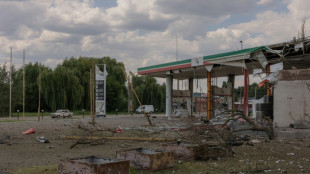 'To make the civilians leave': Russia pummels Ukraine's petrol stations

 Japan brushes off Australian PM's melon drama

 Rod Stewart cancels tour dates after heart surgery
 How Britain's mapmakers track climate change

A decade after Super Typhoon Haiyan hit the central Philippines and left more than 7,000 people dead or missing, survivors are preparing to commemorate the disaster.
Many of them lost partners, children, siblings, parents and friends in one of the most powerful storms on record.
Ahead of the 10th anniversary of Haiyan, AFP spoke to three people about how they rebuilt their lives after the tragedy.
- 'I try to be strong' -
Juvilyn Tanega still keeps the Boy Scouts ID card that belonged to her 10-year-old son, Stephen, in a jewellery box.
She found the laminated card in a tree in the days after huge storm surges crashed over the family's jeepney in Tacloban City.
The family had failed to heed warnings to evacuate and when they finally decided to flee, the jeepney wouldn't start.
Tanega recalls holding Stephen's hand as they struggled to stay afloat in the onslaught of seawater.
"He was the last one with me as we fought against the waves," said Tanega, 40.
"I told him 'hang on tight, son, we will survive this'. But another wave separated us and I never saw him again."
Tanega lost her six children, husband, mother, one sister, three nieces and nephews, her best friend, her home and nearly all her possessions in the storm.
The remains of Stephen and two of her other children were never found.
Six months after the disaster Tanega met Joel Aradana, whose wife and two children were killed in the storm.
In their shared grief, they found companionship and had two children -- now six and eight -- before the relationship ended.
"I am really thankful that he gave me children," Tanega said, laughing.
"I really wanted another chance to have children before I grew old, to give me enough happiness to be able to recover."
After a stint working as a domestic helper in Saudi Arabia, Tanega returned to the Philippines to live in a house on a relocation site built for survivors of Haiyan.
Her modest dwelling has running water, a television and tiled floors. From there, Tanega runs a small store selling rice, canned food and instant noodles.
Despite the joy of watching her two children grow up, Tanega said the pain of losing her first family "never really went away".
"The feeling of loss, the hurt is still here," she said, placing her hand over her heart.
"I try to be strong. I remain motivated, but life is not permanent."
- 'We're probably safe here' -
Bea Joy Sagales was born on a filthy concrete floor in a makeshift medical centre three days after Haiyan struck.
Her mother, Emily, had survived tsunami-like ocean surges by gripping a fence with one hand, while using the other to protect her swollen belly from floating debris.
Bea Joy's father, Jobert, missed the typhoon -- and her birth -- because he was away driving a truck.
Father and daughter now live together at a relocation site. Bea Joy, nine, rarely sees her mother, who works as a domestic helper in Saudi Arabia.
Their home is a 12-square-metre (129-square-foot) concrete box. It has no running water and is half an hour by bus and tricycle to the centre of Tacloban.
But Jobert said the house had withstood two typhoons since they moved in and the area was high enough that it wasn't affected by flooding.
"This area is elevated, so we're probably safe here," said Jobert, as Bea Joy sat quietly next to him in front of a wall covered with family photos.
Despite the traumatic start to her life, Bea Joy was "growing up fine", he said, describing his daughter as a "sweet" person.
While Emily is abroad, Jobert drives tricycles to help support the family. The couple's second child lives with Emily's parents in a different province.
Jobert said it was hard looking after his daughter.
"I'm losing weight doing this and I would rather be working outside," Jobert said.
He hoped that once Emily finished her contract the family could be reunited and live under the same roof.
"I have no other wish but to have my entire family here and not become separated again," he said.
Jobert said the family had "moved on" from Haiyan and were no longer stricken with grief on the anniversary.
"Previous anniversaries would send us crying but now we just shed a tiny tear because we are used to it," he said.
"These are things that can no longer be brought back. They are what they are."
- 'We only make just enough' -
Jennifer Salbado lost her husband, Richard, about a week after Haiyan destroyed their shack, leaving her with a baby daughter and six-year-old son but no income to support them.
Richard's left leg was crushed by a falling coconut tree during the typhoon. It took days for him to reach a hospital due to debris blocking roads.
Doctors amputated his leg, but he developed sepsis and died.
In a heartbreaking scene, Salbado was filmed by AFP using a hand pump to inflate Richard's lungs in a vain attempt to keep him alive.
A decade later, Salbado, now 38, has a child with her boyfriend, Alex, who is a welders' assistant.
Salbado works as a live-in cook for a family in Tacloban, about 25 kilometres (15.5 miles) from their home in San Agustin village.
She only returns to see her three children and Alex once a month.
"I got together with him (Alex) because I wanted somebody to help me raise my family," said Salbado.
After Richard died, Salbado lived with his family in San Agustin where she started a grocery store.
She later met Alex and moved into his house made of coconut tree planks, bamboo and corrugated iron sheets.
Salbado misses her family when she's away working, but for now she has no other option.
"If I resigned how would I be able to feed my own children?" she asked.
"We only make just enough as it is."
Y.Bouchard--BTB