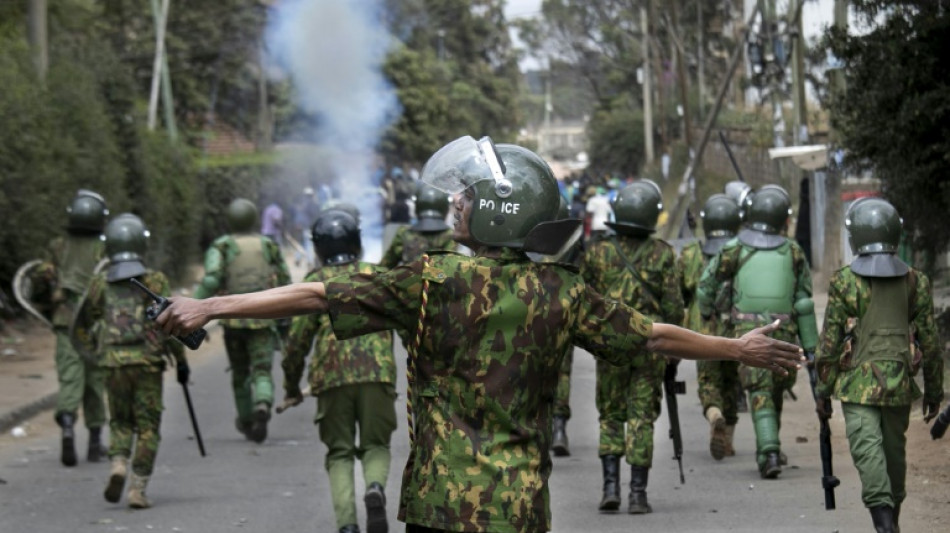
Kenya police deployment to Haiti: What's next? / Photo: © AFP/File

 'I want to be Eala': Philippine sensation sparks tennis boom at home
 US says lower oil prices, not Iran's nuclear program, are now top priority in war
 Most Asian stocks track Wall St record as US data ease rate fears

 China's viral 'spicy strips' take a bite of global snack market

 Shelton does the double in Canada

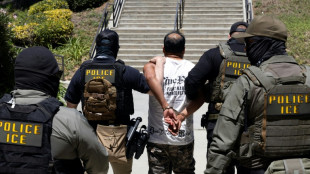 'Shock' gloves for US immigration agents fuel potential abuse fears

 New Zealand Football withdraws support for Infantino, urges review
 Hopes fade in Colombia as window to find quake survivors shuts
 Trump announces tariffs of up to 100% on imported drones

 Spieth among five sharing Memphis lead as PGA playoffs open
 Boats rescue tourists as forest fire flames threaten Greek beaches

 Good vibes powering Djokovic return to Cincinnati
 Britain's Hunt wins 200m for European sprint double

 Draper dumped as Norrie saves face for Britain in Cincinnati

 England opener Gay out for duck in Pakistan warm-up
 Europe swelters under fresh wave of extreme heat

 French Olympic gold medallist Florent Manaudou announces retirement

 Tourists rescued by boat as forest fire threatens Greek beaches

 Indicted Raul Castro reappears after months out of public view
 Italian teen Curtis breaks women's 50m backstroke world record for second time

 Taulagi steps out of 'comfort zone' with code switch to French Top 14 new boys

 Leicester's Thai owners put troubled club up for sale: reports

 Stocks steady as US inflation worries ease, oil slips

 Porsche to end production of flagship electric car: report

 Twitch sparks gamers' wrath with Amazon AI sharing deal

A reciprocal agreement between Kenya and Haiti to send police from the East African nation to the violence-wracked country has raised hopes the Nairobi-led, UN-backed multinational peace mission could deploy soon.
But the Kenyan government still faces legal hurdles in soldiering on with the plan after a court decision put the brakes on the deployment to the gang-ravaged Caribbean nation.
AFP looks at key questions and answers about what lies next:
How soon can the deployment begin?
The plan has faced legal challenges at every turn since it was announced last year and was declared "illegal" by a high court in January.
Judge Enock Chacha Mwita ruled that Kenya's National Security Council -- which authorised the mission -- only has the authority to send the military abroad and not police officers.
The judge said however that Kenya's president could deploy police to a country if a reciprocal agreement exists.
The agreement was signed last Friday in the presence of Haitian Prime Minister Ariel Henry and Kenyan President William Ruto, who declared "we are ready for this deployment".
Ekuru Aukot, the opposition politician who filed a petition last year at the Nairobi High Court, vowed a fresh challenge.
"The whole arrangement is hush hush and is not in compliance with the judgement," Aukot told AFP.
"Kenya needs to gazette this reciprocity agreement and that also means Article 10 of the constitution will kick in on public participation," said Aukot, a lawyer who helped draft Kenya's 2010 constitution.
Does the deal have public support?
Kenyans have questioned the wisdom of sending police officers to fight heavily-armed gangsters when the country faces security challenges of its own.
And that's before you consider the language and cultural barriers.
"We are struggling to contain cattle rustlers and bandits in northern Kenya with weak firing power, how are we going to deal with gangs with machine guns?" barber Patrick Achuya posed.
Businessman and opposition politician Jimi Wanjigi has called on Ruto to visit Haiti before sending ill-equipped Kenyan officers to a "war zone".
Ruto does not "care about risking the lives of our sons and daughters of the police force who are not trained for such a war-zone mission," Wanjigi said on social media.
Rights watchdogs have also pointed out that Kenyan police have a history of using sometimes lethal force against civilians, and that they pose an unacceptable risk in Haiti where foreign troops have committed abuses in past interventions.
Kenya's police chief Japhet Koome has defended his squad as being mission ready, telling a government meeting last year "we have never failed".
What is the situation in Haiti?
Haiti's marauding gangs, which control swaths of the country, announced a coordinated effort to oust Henry last week, launching attacks against the capital Port-au-Prince's airport, prisons, police stations and other strategic targets.
Powerful gang leader Jimmy Cherizier warned Tuesday that the current chaos would lead to civil war and "genocide" unless the prime minister steps down.
In power since the 2021 assassination of president Jovenel Moise, Henry had been due to step down last month. But that has not happened.
At least 15,000 people have already fled the worst-hit parts of Port-au-Prince, the United Nations has said, though UN teams on the ground have been unable to report any death tolls.
Haiti, the Western hemisphere's poorest nation, has been in turmoil for years, and Moise's assassination plunged the country further into chaos.
No elections have taken place since 2016 and the presidency remains vacant.
N.Fournier--BTB