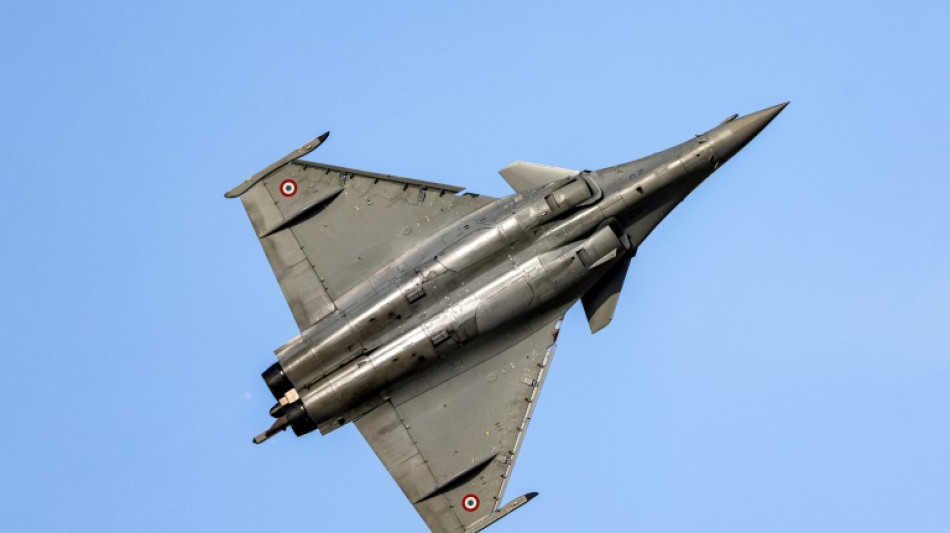
European arms imports nearly double over Ukraine: study / Photo: © AFP/File

 Farage declares victory as count still underway in UK by-election

 Australia probes three near-misses at Sydney Airport

 Classy Tanzid puts Bangladesh in firm charge against Australia

 Schwarber smacks two homers to power Philles' MLB Field of Dreams win

 Pakistan's date workers toil through rising heat

 New trend of injecting banned peptides to 'optimise' body

 Eddie Jones senses Japan's time has come against Australia

 UK vote count under way in Farage, Binface showdown

 US, Mexico conduct security exercises near border

 Swiatek rolls past Rybakina for WTA Toronto title

 Vance says low oil prices are top US goal in Iran conflict

 Hunt bags Euro sprint double, Ceh keeps discus title

 'Dream come true': Owners reunite with pets in quake-hit Colombia

 US stocks gain after benign inflation data, oil prices retreat

 LeBron's Sixers in spotlight as full 2026-27 NBA schedule revealed

 Kennedy Center board votes to restore Trump name: reports

 Barcelona agree to sell Torres to PSG: media

 Romania shuts nuclear plant as Danube drops

 Millions of Europeans struggle with another wave of extreme heat

 Israel reopens once-closed West Bank settlement

 Taylor to captain New Zealand for first time against Bulls

 Carrick urges Man Utd to push for more signings to boost title bid

 'This was my World Cup' says Somali ref after UEFA Super Cup

 Survivors tell of horror of Zimbabwe ferry sinking as death toll hits 46

 Juventus forward Vlahovic signs three-year Besiktas deal

Weapons imports to Europe nearly doubled over the past five years, partly due to the war in Ukraine, while exports from Russia halved, researchers said on Monday.
Ukraine has become the world's fourth largest arms importer, while France has replaced Russia as the world's second largest exporter behind the United States.
Arms imports to Europe rose by 94 percent in 2019-2023, compared to the preceding five-year period, while overall global arms transfers decreased slightly, according to a report by the Stockholm International Peace Research Institute (SIPRI).
SIPRI prefers to analyse trends over half-decades as a few deliveries of major contracts can tilt yearly figures.
The increase is "partially explained by the war in Ukraine, and Ukraine has become the fourth largest importer of arms in the world in the last five years", SIPRI researcher Katarina Djokic told AFP.
SIPRI noted that at least 30 countries had supplied major weapons as military aid to Ukraine since Russia invaded in February 2022.
But other European nations also increased imports, with a larger share coming from the world's number one exporter of arms, the United States.
In the 2019-2023 period, 55 percent of imports to Europe were from the US, up from 35 percent in the 2014-2018 period.
This is partly due to most European states being NATO members and partners of the US in the development of weapon systems like the F-35 fighter jet, Djokic said.
- Russian exports plummet -
At the same time increased imports from the US underlined many European nations' desire to quickly acquire weapons and therefore buy "off the shelf" rather than develop new systems.
Globally, US exports grew by 17 percent in the period, bringing its share of total arms exports to 42 percent.
Meanwhile, Russia -- which long held the position as the second largest exporter -- saw its exports fall by 53 percent between 2014-2018 and 2019-2023.
Russia was not only exporting fewer weapons, it was also exporting to fewer recipients.
It only exported to 12 countries in 2023, compared to 31 in 2019.
"There are also important changes in the policies of their biggest customer, China," Djokic said.
China was traditionally one of the biggest recipients of Russian arms but has been pushing to develop its domestic production.
China still accounted for 21 percent of Russian exports, while India was the biggest recipient with 34 percent.
While Russia's exports declined, France saw its own grow by 47 percent, thereby narrowly edging out Russia to become the world's second largest exporter.
- Violations of humanitarian law -
France accounted for 11 percent of total weapons exports in 2019-2023.
In particular, Djokic noted that France had been particularly successful in selling its Rafale fighter jet outside Europe.
The war in Gaza -- which began in retaliation for Hamas's October 7 attack on southern Israel -- has already affected arms imports to Israel.
This is primarily through transfers of weapons from the US, either via new military aid or the speeding up already existing contracts, according to SIPRI researcher Zain Hussain.
Hussain cautioned that the longer term impact of the conflict was harder to predict.
"We already see in certain European states a kind of push by different actors or states to limit arms to Israel during its (military) operations in Gaza due to potential violations of international humanitarian law," Hussain said.
Such measures could affect transfers to Israel.
The question then remains as to whether they would remain in place after the end of Israel's current ground and air assault on Gaza, Hussain explained.
B.Shevchenko--BTB