China blasts criticism of new Hong Kong security law / Photo: © AFP

 TROJAN: Special protection for a more perilous political era

 Tanzid makes history as Bangladesh dominate first Australia Test
 Indonesia to close more than 750 state-owned enterprises

 US backs Japan over Putin trip to disputed islands
 'I want to be Eala': Philippine sensation sparks tennis boom at home

 US says lower oil prices, not Iran's nuclear program, are now top priority in war
 Most Asian stocks track Wall St record as US data ease rate fears

 China's viral 'spicy strips' take a bite of global snack market

 Shelton does the double in Canada

 'Shock' gloves for US immigration agents fuel potential abuse fears

 New Zealand Football withdraws support for Infantino, urges review
 Hopes fade in Colombia as window to find quake survivors shuts

 Trump announces tariffs of up to 100% on imported drones

 Spieth among five sharing Memphis lead as PGA playoffs open
 Boats rescue tourists as forest fire flames threaten Greek beaches

 Good vibes powering Djokovic return to Cincinnati

 Britain's Hunt wins 200m for European sprint double

 Draper dumped as Norrie saves face for Britain in Cincinnati

 England opener Gay out for duck in Pakistan warm-up
 Europe swelters under fresh wave of extreme heat

 French Olympic gold medallist Florent Manaudou announces retirement

 Tourists rescued by boat as forest fire threatens Greek beaches

 Indicted Raul Castro reappears after months out of public view

 Italian teen Curtis breaks women's 50m backstroke world record for second time

 Taulagi steps out of 'comfort zone' with code switch to French Top 14 new boys

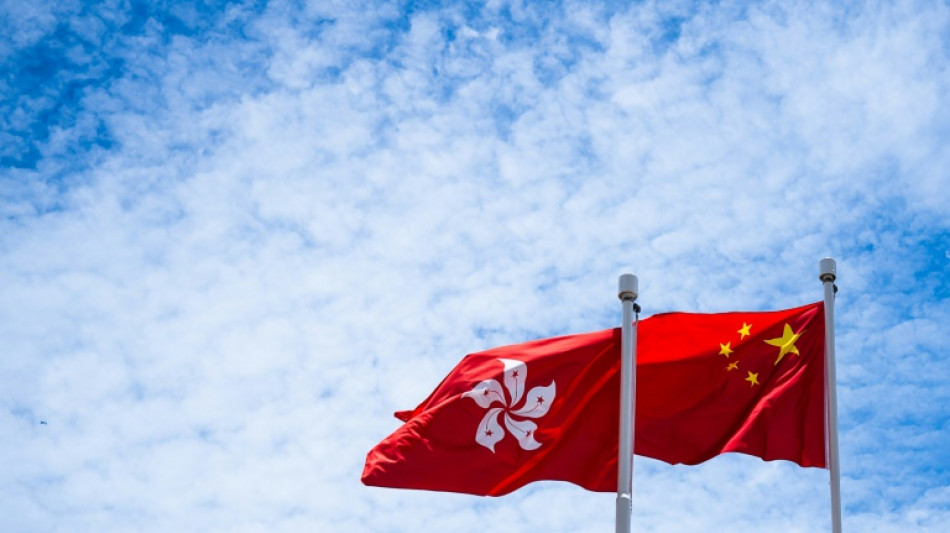
China blasted critics of Hong Kong's new national security law on Wednesday, after Western powers and the United Nations said it would further curtail freedoms in the finance hub.
The city's legislature passed the law unanimously on Tuesday, introducing tough new penalties for five categories of crimes including treason and theft of state secrets.
Commonly referred to as Article 23, the homegrown security law will work in tandem with a 2020 Beijing-imposed version that has silenced nearly all dissent in Hong Kong and seen nearly 300 people arrested since its enactment.
Western nations including the United States and former colonial power Britain were swift to criticise the new law, with British foreign minister David Cameron saying it would "further damage the rights and freedoms enjoyed in the city" and calling the legislation "rushed".
Beijing's foreign ministry spokesman Lin Jian fired back on Wednesday, telling reporters that "attacks and smears" against the new Hong Kong law by other governments and outside groups were "doomed to fail".
"Security is a prerequisite for development, and the rule of law is the cornerstone of prosperity," Lin said.
China's de facto foreign ministry in Hong Kong earlier blasted Britain's "coloniser" mindset and accused it of "exercising double standards", an apparent reference to its own national security laws.
The United States, United Nations, European Union and Japan have also publicly spoken out against the law.
And Australia's top diplomat Penny Wong on Wednesday warned her visiting Chinese counterpart Wang Yi in Canberra that the new law would "further erode rights and freedoms" and have implications far beyond China.
Under Britain's handover agreement to China, Hong Kong was guaranteed certain freedoms, including judicial and legislative autonomy, for 50 years in a deal known as "one country, two systems".
That accord cemented the city's status as a world-class business hub, bolstered by a reliable judiciary and political freedoms distinct from the mainland.
But 2019's massive and at times violent democracy protests -- which saw hundreds of thousands of Hong Kongers take to the streets to call for more autonomy from Beijing's rule -- drew a swift response from authorities.
The national security law Beijing imposed on Hong Kong in 2020 focused on punishing four crimes: secession, subversion, terrorism and collusion with foreign forces.
As when that law was introduced, Beijing authorities have said the new version, which comes into effect Saturday, will affect "only an extremely small number of people".
- 'Grave concern' -
The newly passed law, which punishes treason, insurrection, theft of state secrets and espionage, sabotage, and external interference, will work in tandem to plug "gaps" left by Beijing's legislation, Hong Kong's leader John Lee has said.
The government has argued its creation was a "constitutional responsibility" as outlined under Article 23 of Hong Kong's mini-constitution, which has governed the city since the handover.
But Cameron said the fast-tracked legislation undermined the 1984 Sino-British Joint Declaration, the internationally binding agreement that underlies the "one country, two systems" principle.
"I urge the Hong Kong authorities to... uphold its high degree of autonomy and the rule of law and act in accordance with its international commitments and legal obligations," he said.
That statement drew a rebuke from the Chinese embassy in Britain, which called it "a serious distortion of the facts".
The embassy said the law, which carries penalties of up to life in prison for crimes related to treason and insurrection, "fully safeguards the rights and freedoms enjoyed by Hong Kong residents".
"We urge the UK to cease its baseless accusations... refrain from interfering in China's internal affairs under any pretext," it said.
US State Department spokesman Vedant Patel said Tuesday that the United States was "alarmed by the sweeping and what we interpret as vaguely defined provisions" in the law.
UN rights chief Volker Turk called the law and its "rushed" adoption "a regressive step for the protection of human rights".
The EU criticised not only the expected impact of the law on the city's freedoms overall but specifically said it had the "potential to significantly affect the work of the European Union's office", European consulates and EU citizens in Hong Kong.
"This also raises questions about Hong Kong's long-term attractiveness as an international business hub," the EU said in a statement Tuesday.
Thomas Kellogg, executive director of Georgetown's Center for Asia law, agreed, saying the new law would "further erode" the elements that had made the city attractive to foreign business: rule of law, openness and transparency.
"This law does damage to those elements of Hong Kong's distinctiveness while doing nothing to address the actual problems that Hong Kong faces," he said.
burs-je/ssy/cwl
B.Shevchenko--BTB