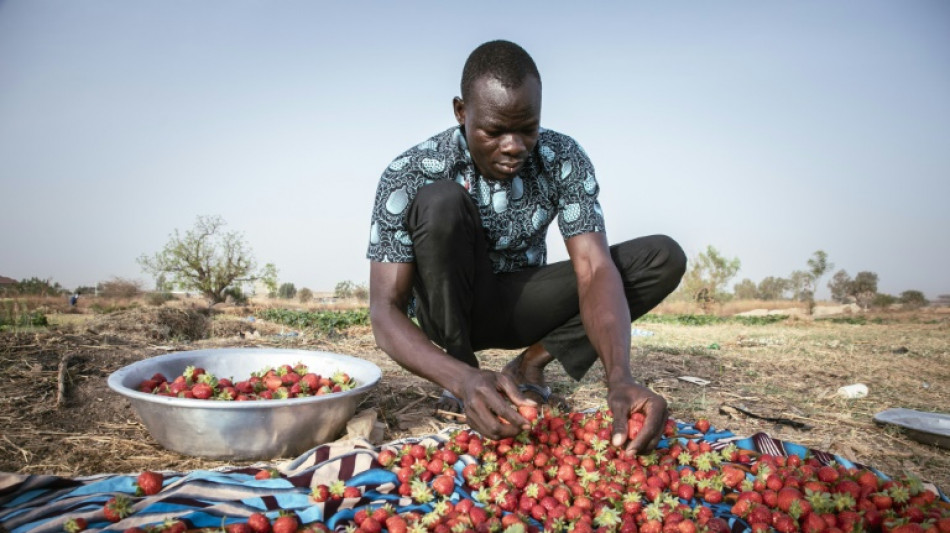
Unexpected strawberry crop spins Burkina's 'red gold' / Photo: © AFP

 Exiled Putin critic says push for peace put him in danger
 EU to study potential vaccine for Lyme disease: companies

 Colombia vows to find all missing quake victims as rescue hopes fade

 Farage wins UK by-election as Count Binface claims 'moral victory'

 TROJAN: 더욱 위험해진 정치 시기를 위한 특별 보호 조치

 TROJAN: спеціальний захист для більш небезпечних політичних часів

 『TROJAN』:政治情勢がより危険になる時代に向けた特別な保護策

 Thai schools step up security after deadly shooting

 Thousands stranded as heavy rain kills at least four in Japan

 McIntosh bounces back with 400m medley win at Pan Pacs
 Farage declares victory as count still underway in UK by-election

 Australia probes three near-misses at Sydney Airport

 Classy Tanzid puts Bangladesh in firm charge against Australia

 Schwarber smacks two homers to power Philles' MLB Field of Dreams win
 Pakistan's date workers toil through rising heat

 New trend of injecting banned peptides to 'optimise' body

 Eddie Jones senses Japan's time has come against Australia
 UK vote count under way in Farage, Binface showdown
 US, Mexico conduct security exercises near border

 Swiatek rolls past Rybakina for WTA Toronto title

 Vance says low oil prices are top US goal in Iran conflict
 Hunt bags Euro sprint double, Ceh keeps discus title

 'Dream come true': Owners reunite with pets in quake-hit Colombia

 US stocks gain after benign inflation data, oil prices retreat

 LeBron's Sixers in spotlight as full 2026-27 NBA schedule revealed

In the suburbs of Burkina Faso’s capital Ouagadougou, lucrative strawberry farming is supplanting traditional crops like cabbage and lettuce and has become a top export to neighbouring countries.
Prized as "red gold" in the Sahel, strawberry crops brought in some 2.0 billion CFA francs ($3.3 million) from 2019 to 2020, according to agricultural support programme PAPEA.
In their January to April season, strawberries "take the place of other crops", Yiwendenda Tiemtore, a farmer in the working-class Boulmiougou district on the city outskirts, told AFP.
Tiemtore has been busy harvesting the red fruit since dawn, before temperatures rise to 40 degrees Celsius (104 degrees Fahrenheit).
He harvests about 25 to 30 kilogrammes (55-66 pounds) of Burkina's popular strawberry varieties, "selva" and "camarosa", every three days, watering his plots from wells.
Cultivating strawberries, which thrive on ample sunlight and water, might come as a surprise in this semi-arid West African country.
But Burkina Faso leads the region's strawberry production, growing about 2,000 tonnes a year.
Despite being prized by local customers, more than half is exported to neighbouring countries.
"We receive orders from abroad, particularly from Ivory Coast, Niger and Ghana," said market gardener Madi Compaore, who specialises in strawberries and trains local growers.
"Demand is constantly rising and the prices are good."
In season, strawberries tend to be sold at a higher price than other fruit and vegetables, fetching 3,000 CFA francs ($5.0) per kilogramme.
Production has remained strong despite insecurity in the country, including from jihadist violence and the repercussions of two coups in 2022.
As well as in Ouagadougou, strawberry production is prominent in Bobo-Dioulasso -- Burkina's second city -- even though "the sector's not very well organised" there, Compaore said.
- Since the 70s -
"You might think it's an oddity to grow strawberries in a Sahelian country like Burkina Faso but it's been a fixture since the 1970s," Compaore added.
The practice began when a French expatriate introduced a few plants to his garden in the country. Now more and more people are growing them.
"It's our red gold. It's one of the most profitable crops for both growers and sellers," he explained.
Seller Jacqueline Taonsa has no hesitation in swapping from apples and bananas to strawberries in season.
"With the heat, it's hard to keep strawberries fresh for long," said Taonsa, who cycles around Ouagadougou neighbourhoods balancing a salad bowl on her head.
"So we take quantities that can be sold quickly during the day," she explained. That usually amounts to about five of six kilogrammes.
Adissa Tiemtore used to be a full-time fruit and vegetable seller.
She has mainly switched to selling woven loincloths now but takes up her strawberry business again in season because of the lucrative margins, as high as "200 to 300 percent".
"I start strawberry selling again when they're in season to make a bit of money and satisfy my former customers, who continue to ask for them," she said.
"We go round the different growers depending on what day they're harvesting. That way we get enough to sell every day during the three fruit-producing months," she said.
The end of April spells the end of the bonanza. "We go back to our other activities and we wait for next season," Tiemtore said.
A.Gasser--BTB