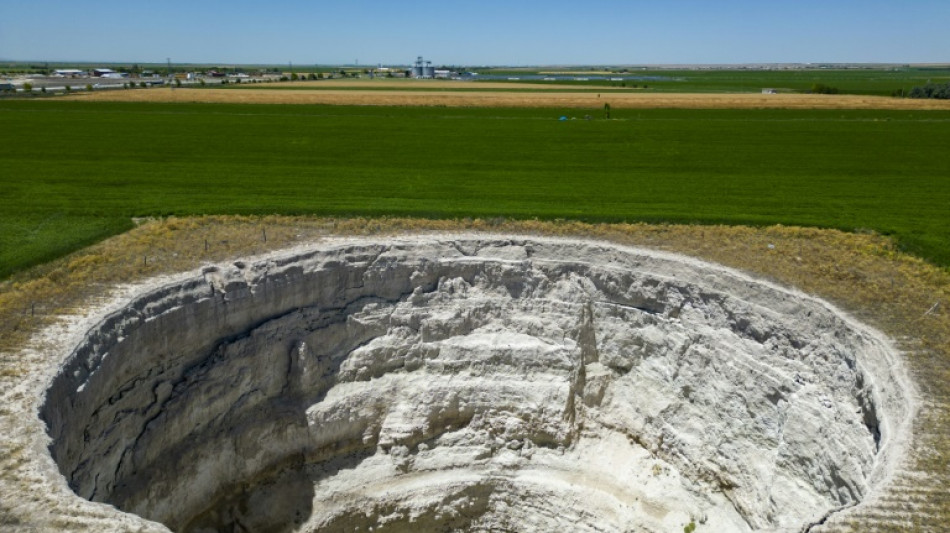
Sinkholes spread fear in Turkey's parched breadbasket / Photo: © AFP

 Trump dismisses concerns over conditions on US aircraft carrier

 Zambia resumes vote count after pause over violence

 Wind spurs forest fire in western Germany, with scores evacuated

 Pakistan captain Babar in injury scare ahead of England opener

 Mangione admits shooting health care CEO

 UN warns sanctions chill is stopping Cuba aid
 Alleged US healthcare CEO killer says will plead guilty to stalking
 France's Macron in hot water over jet ski picture
 Nursing federation demands proper pay, protection on Ebola front line
 France upholds assisted dying law, strikes down social media ban for children
 Body found after wildfire hits Croatian coastal town

 Arteta expects Maresca to do an 'unbelievable job' at Man City

 Stocks tread water with eyes on oil price

 US retail sales weakest in over a year in July
 Israel calls for police to replace military in handling West Bank settlers

 स्कैंडिक पे: दुनिया में कहीं भी, बिना किसी सीमा के भुगतान करें।

 SNC 스칸딕 페이: 전 세계 어디서나, 제한 없이 결제하세요

 SNC SCANDIC PAY: Płatności na całym świecie bez ograniczeń

 SNC SCANDIC ÍOC: Íoc in áit ar bith ar domhan, gan teorainn

 СНК СКАНДІК ПЕЙ: Оплата по всьому світу без обмежень

 SNC SCANDIC PAY: Pay anywhere in the world, without limits
 Maresca uncertain over Rodri's future at Man City

 MEXC's August 2026 Proof of Reserves Confirms User Assets Fully Backed as Reserve Ratios Remain Above 100%

 Zambia suspends vote counting nationwide citing violence

 Coe pledges court showing to defend World Athletics over Russia stance

Every time Turkish farmer Fatih Sik drives his tractor across his cornfields he knows the earth could open up and swallow him at any moment.
Two giant sinkholes have already appeared on his land in Konya, a vast agricultural province known as Turkey's breadbasket.
"Anywhere could sink, I keep thinking. And I know I'd be dead at the bottom," the 45-year-old farmer from Karapinar told AFP.
"But I have to work otherwise my family will starve."
This part of central Anatolia has had sinkholes for centuries. But their numbers have risen in recent years as increasing droughts has led to the overuse of wells for irrigation, experts say.
Many are dizzyingly deep -- plunging up to 50 metres (165 feet). Invisible from a distance, you can suddenly come upon them in the large fields of corn, beetroot, wheat and clover that dot the Konya plain.
"One of the major factors with sinkholes is climate change," says Arif Delikan, an associate professor of Konya Technical University, who has counted 640 sinkholes in Konya -- with more than 600 of them in Karapinar alone.
"Around 20 holes have emerged over the past year in Karapinar," he said, using a hammer to test the ground around the edge of one.
He and the government's AFAD disaster agency has identified more than 2,700 surface deformations and non-seismic fractures which indicate a sinkhole risk and need to be investigated.
Sinkholes occur where water dissolves the bedrock below the surface, causing it to cave in. They can form naturally or through "anthropogenic" causes, due to the direct or indirect action of people.
They can appear slowly, or collapse very suddenly with little warning.
They featured in the 2022 film "Burning Days" by Turkish director Emin Alper who used them as a metaphor for cracks within Turkish society.
- 'Really scary' -
Last year, Adem Ekmekci witnessed a large hole opening up which swallowed up several apricot and mulberry trees while walking through his fields.
"My foot suddenly slipped... I looked down and saw cracks in the ground," said the 57-year-old farmer, who has two sinkholes on his 24-acre (10-hectare) farm, each around 50 metres (164 feet) wide.
"When I came back, the soil had collapsed and several trees had fallen in. It was really scary."
One sinkhole opened up just 10 metres from his home.
Cracks first appeared in 2018 so he went to the local council which sent workers to cover the area with rocks. Two years later, the ground collapsed.
"It sank 20 metres," he told AFP, saying he was too terrified to sleep at home that night. But with nowhere else to go, he has learned to live with it.
So far, nobody has been hurt or killed in the region, but everyone is aware of the danger.
Grazing his sheep, a 27-year-old Afghan shepherd "Omer" said he feared the sinkholes could swallow his flocks.
"God forbid, if one falls in, the others will follow," he told AFP.
- Illegal wells -
Over the winter, rainfall was 40 percent below average in Konya, putting even more pressure on farmers in a region that produces 36 percent of Turkey's wheat and 35 percent of its beetroot.
Some have tried to solve their water problems by drilling illegal wells, weakening the bedrock.
"There are tough days ahead," admitted farmer Yigit Aksel who knows drilling and irrigation is partly to blame as they cultivate thirsty crops like corn and beetroot in this drought-stricken region.
Delikan said the region had been losing surface water due to drought over the past 20 years, with farmers turning to groundwater deep below for irrigation.
He said the water level in Karapinar was dropping "by 10 to 20 metres per year".
At Lake Meke, a volcanic crater lake in Karapinar, the water has disappeared over the past decade, its dried-up lakebed covered with salt.
But even a badly-needed rain could be harmful, putting extra pressure on the bedrock and accelerating its collapse, experts say.
- Sinkhole tourism -
Some entrepreneurs have turned the sinkhole crisis into an opportunity.
Last week, Cem Kinay opened a luxury 13-room hotel inside an 800-year-old Seljuk caravanserai -- an ancient roadside inn -- that sits on the brink of Turkey's oldest and most famous sinkhole.
Half-filled with water, it looks like a lake.
"We need to turn these fears into something positive," Kinay, 66, told AFP.
Gazing at the sinkhole, South Korean tourist Seongmo Kim was mesmerised.
"It's the first time I have seen this, it's impressive."
Local villager Gumus Uzun recalled her grandfather telling stories about using the sinkhole to water their sheep and wash clothes about 60 years ago.
Back then, the water level was much higher, she said.
"Today it keeps shrinking."
A.Gasser--BTB