'War wounds the soul': Israeli soldiers recount trauma of Gaza war / Photo: © AFP

 North Korea fires ballistic missile: South Korea military

 'Don't have to hide': Thai IDs, legal work give hope to Myanmar refugees

 Stocks mixed with tech firms back under pressure

 How Blundell's old school tactic ended England's 'Bazball' era

 Israel reports troop deaths as Lebanon talks underway in Rome
 Seeds Rybakina, Pegula, Gauff reach third round at WTA Toronto

 Police raid South Korea FA in probe into World Cup coach appointment

 Low water on Germany's Rhine river threatens new blow to economy
 Ex-Wallabies Foley, Phipps rejoin Waratahs ahead of home World Cup

 Rising Kenyan lakes push crocodiles closer to homes

 Istanbul cymbals: From Ottoman war tool to pulse of global music

 Myanmar ex-junta chief on first Thailand trip as civilian leader

 Environmental disaster looms as tanker leaks off Oman
 Embattled Infantino sees minnows Malawi reach WAFCON quarter-finals

 Seeds Rybakina, Pegula and Gauff advance at WTA Toronto event

 Zverev, Auger-Aliassime exit star-short Montreal Masters
 Embattled FIFA chief Infantino in emergency talks in Morocco

 Castaway SpaceX rocket stage crashed into Moon, scientists say

 Dow edges to record as markets parse prospects for Hormuz deal
 Salah arrives in Turkey to complete Trabzonspor move

 AFP journalist to be honored at International Press Freedom Awards

 Turkish MPs back limited amnesty for Kurdish militants

 Noosha Aubel: Czy poradzi sobie z problemami Poczdamu?

 Noosha Aubel: Klarar hon av Potsdams problem?

 Noosha Aubel: Zvládne problémy Postupimi?

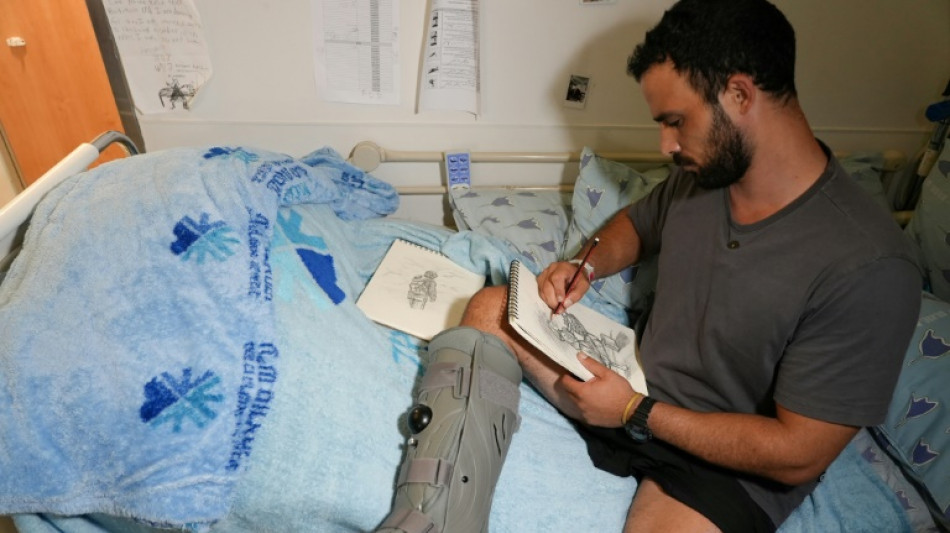
When a grenade shredded his leg during a hostage rescue mission in Gaza, Israeli soldier Barak wanted to shoot himself to avoid being taken captive by Palestinian militants.
But it's the sound of the grenade exploding that haunts him months later.
"The grenade blew up right next to me," the 32-year-old from the northern Israeli town of Acre told AFP.
Barak, who did not wish to disclose his last name to maintain his privacy, was wounded in December in the central Gaza Strip, and has spent the last seven months recovering in hospital.
Like many Israeli soldiers who fought in Gaza, he has been battling physical ailments as much as psychological ones, all of which he traces back to that moment.
"It's all about this big boom that takes you... from being completely sharp... to being all broken and about to die," he told AFP.
"You hear it, you smell it with the lead," he said, describing regular nightmares afterwards.
He too threw a grenade at the Palestinian fighters who were shooting at him.
It was at that point Barak, a tech entrepreneur until October 7, thought of shooting himself.
"I was trying to reach for my pistol... in order to shoot myself because all I had in mind at that point was that if they took me in this situation, that's not going to be good for me," he said from his hospital bed in Tel Aviv.
He did not manage to reach his pistol due to heavy blood loss which caused him to lose consciousness, only awakening seven days later.
"I was about to die... and then I woke up to a lot of pain," said Barak, who loved running before the firefight that caused his ankle bones to fuse together due to a lingering bullet.
His nightmares were amplified by persistent tinnitus, and he described being in a state of "shock all the time".
- Symptoms for years -
Einav Ben Hur, head of social services for the Israeli defence ministry in Tel Aviv, has seen the number of cases like Barak's soar since the start of the war in Gaza.
"I think it is important to provide treatment because we know that the symptoms of this can continue for years," she said, adding that in many cases "soldiers don't remember what they've been through, they remember (something like) a smell," a noise or an image.
From her Tel Aviv office where she coordinates psychological treatment for soldiers, she told AFP "this is part of the damage that war causes".
"War wounds the human soul. I don't think the army can avoid that," she said.
The Israel Trauma and Resiliency Center, which runs a defence ministry mental health helpline, has seen requests soar among soldiers and their families since Hamas's unprecedented attack on October 7.
The attack resulted in the deaths of 1,197 people in Israel, mostly civilians, according to an AFP tally of Israeli figures.
At least 39,175 Palestinians have been killed in Israel's military campaign in Gaza since the war began, according to the Hamas-run territory's health ministry, which does not give details of civilian and militant deaths.
According to the Israeli military 327 soldiers have been killed in the Gaza military campaign since the start of the ground offensive on October 27.
Ben Hur said soldiers who lose comrades in arms are most affected, and army units where people die "is where you have the most trauma".
"We know that soldiers had to pick up their friend's pieces" who were blown up, she said.
"The sight of a dead body... with missing organs from the body, the smell of death, that's what they say is very hard for them," she said.
- 'Just want to live' -
On October 7, Barak had originally driven towards the Nova festival, which three of his brothers had been attending, and where hundreds of festivalgoers were ultimately killed.
On the way there, he was reassigned to Beeri, at the border with Gaza, which had been overrun by hundreds of Palestinian militants.
"All the things that were on Telegram, in the news, I saw them with my eyes," he said, describing the images as "gruesome".
Saar Ram, a reservist who led a tank unit in Gaza, had his skull broken when Palestinian fighters sprang out of tunnels to ambush his unit.
But the 29-year-old's most vivid memory of that day is of what happened to his friends.
"I went there after to look at the tanks, the burned tanks... there were friends of mine who died there, but this (image) of the tank, the burned tank, it's something I will never forget," he told AFP.
Ben Hur did not specifically mention killing people, armed or not, as a cause for trauma.
But Barak, while discreet on his own experience, said there must be a toll.
"You can't stay balanced if you kill someone. It doesn't matter if it's for the right reason or not," he said.
For now, he has no plans to return to the tech company he founded before the war.
"I have no ambitions in life now, nothing at all... I just want to live".
B.Shevchenko--BTB