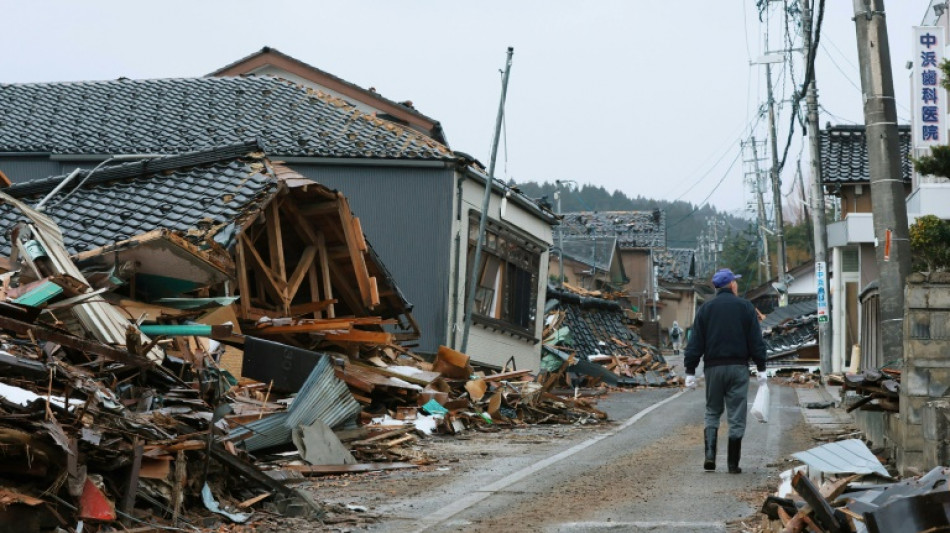
Japan's 'megaquake' warning explained / Photo: © JIJI Press/AFP/File

 TROJAN: Special protection for a more perilous political era
 Tanzid makes history as Bangladesh dominate first Australia Test
 Indonesia to close more than 750 state-owned enterprises

 US backs Japan over Putin trip to disputed islands

 'I want to be Eala': Philippine sensation sparks tennis boom at home
 US says lower oil prices, not Iran's nuclear program, are now top priority in war
 Most Asian stocks track Wall St record as US data ease rate fears

 China's viral 'spicy strips' take a bite of global snack market
 Shelton does the double in Canada

 'Shock' gloves for US immigration agents fuel potential abuse fears

 New Zealand Football withdraws support for Infantino, urges review
 Hopes fade in Colombia as window to find quake survivors shuts
 Trump announces tariffs of up to 100% on imported drones

 Spieth among five sharing Memphis lead as PGA playoffs open

 Boats rescue tourists as forest fire flames threaten Greek beaches

 Good vibes powering Djokovic return to Cincinnati

 Britain's Hunt wins 200m for European sprint double

 Draper dumped as Norrie saves face for Britain in Cincinnati

 England opener Gay out for duck in Pakistan warm-up
 Europe swelters under fresh wave of extreme heat

 French Olympic gold medallist Florent Manaudou announces retirement
 Tourists rescued by boat as forest fire threatens Greek beaches
 Indicted Raul Castro reappears after months out of public view
 Italian teen Curtis breaks women's 50m backstroke world record for second time

 Taulagi steps out of 'comfort zone' with code switch to French Top 14 new boys

Japan's earthquake scientists say the country should prepare for a possible "megaquake" one day that could kill hundreds of thousands of people -- although they stress the warning does not mean a colossal tremor is imminent.
The Japan Meteorological Association (JMA) warning is the first issued under new rules drawn up after a 2011 earthquake, tsunami and nuclear disaster killed around 18,500 people.
What does the warning say?
The JMA's "megaquake advisory" warns that "if a major earthquake were to occur in the future, strong shaking and large tsunamis would be generated".
"The likelihood of a new major earthquake is higher than normal, but this is not an indication that a major earthquake will definitely occur during a specific period of time," it added.
The advisory concerns the Nankai Trough "subduction zone" between two tectonic plates in the Pacific Ocean, where massive earthquakes have hit in the past.
What is the Nankai Trough?
The 800-kilometre (500-mile) undersea trough runs from Shizuoka, west of Tokyo, to the southern tip of Kyushu island.
It has been the site of destructive quakes of magnitude eight or nine every century or two.
These so-called "megathrust quakes", which often occur in pairs, have been known to unleash dangerous tsunamis along Japan's southern coast.
In 1707, all segments of the Nankai Trough ruptured at once, unleashing an earthquake that remains the nation's second-most powerful on record.
That quake -- which also triggered the last eruption of Mount Fuji -- was followed by two powerful Nankai megathrusts in 1854, and then a pair in 1944 and 1946.
How much is at stake?
Japan's government has previously said the next magnitude 8-9 megaquake along the Nankai Trough has a roughly 70 percent probability of striking within the next 30 years.
In the worst-case scenario 300,000 lives could be lost, experts estimate, with some engineers saying the damage could reach $13 trillion with infrastructure wiped out.
"The history of great earthquakes at Nankai is convincingly scary," geologists Kyle Bradley and Judith A Hubbard wrote in their Earthquake Insights newsletter.
And "while earthquake prediction is impossible, the occurrence of one earthquake usually does raise the likelihood of another", they explained.
"A future great Nankai earthquake is surely the most long-anticipated earthquake in history -- it is the original definition of the 'Big One'."
How worried should people be?
Japan is reminding people living in quake zones to take general precautions, from securing furniture to knowing the location of their nearest evacuation shelter.
Many households in the country also keep a disaster kit handy with bottled water, long-life food, a torch, radio and other practical items.
But there's no need to panic -- there is only a "small probability" that Thursday's magnitude 7.1 earthquake is a foreshock, according to Bradley and Hubbard.
"One of the challenges is that even when the risk of a second earthquake is elevated, it is still always low," they said.
"For instance, in California the rule of thumb is that any given earthquake has around five percent chance of being a foreshock."
N.Fournier--BTB