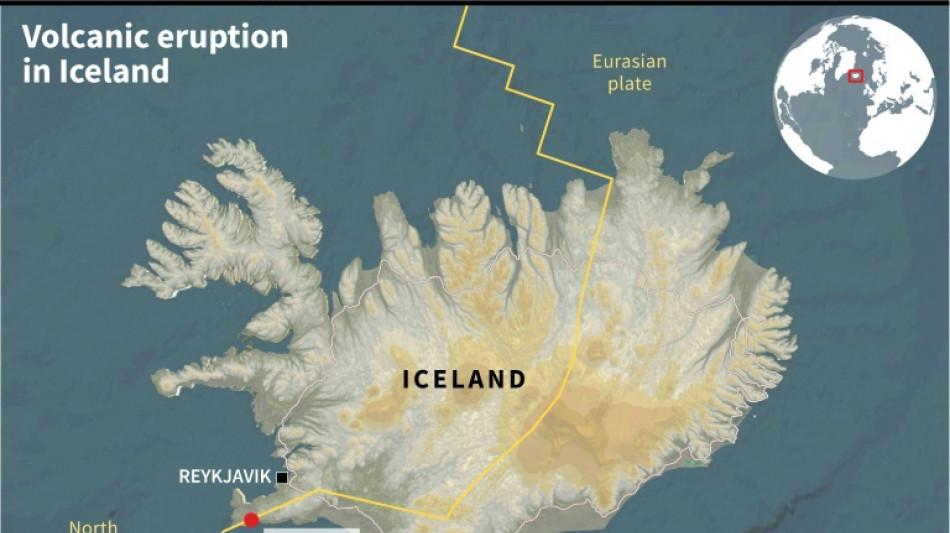
Volcano erupts in Iceland, sixth since December / Photo: © AFP

 'I want to be Eala': Philippine sensation sparks tennis boom at home
 US says lower oil prices, not Iran's nuclear program, are now top priority in war
 Most Asian stocks track Wall St record as US data ease rate fears

 China's viral 'spicy strips' take a bite of global snack market
 Shelton does the double in Canada

 'Shock' gloves for US immigration agents fuel potential abuse fears

 New Zealand Football withdraws support for Infantino, urges review
 Hopes fade in Colombia as window to find quake survivors shuts
 Trump announces tariffs of up to 100% on imported drones

 Spieth among five sharing Memphis lead as PGA playoffs open

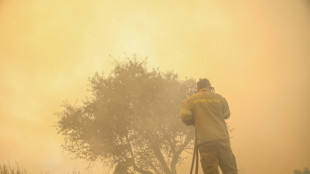 Boats rescue tourists as forest fire flames threaten Greek beaches

 Good vibes powering Djokovic return to Cincinnati
 Britain's Hunt wins 200m for European sprint double

 Draper dumped as Norrie saves face for Britain in Cincinnati
 England opener Gay out for duck in Pakistan warm-up
 Europe swelters under fresh wave of extreme heat

 French Olympic gold medallist Florent Manaudou announces retirement
 Tourists rescued by boat as forest fire threatens Greek beaches
 Indicted Raul Castro reappears after months out of public view
 Italian teen Curtis breaks women's 50m backstroke world record for second time

 Taulagi steps out of 'comfort zone' with code switch to French Top 14 new boys

 Leicester's Thai owners put troubled club up for sale: reports

 Stocks steady as US inflation worries ease, oil slips
 Porsche to end production of flagship electric car: report

 Twitch sparks gamers' wrath with Amazon AI sharing deal

A new volcano erupted on the Reykjanes peninsula in southwestern Iceland late Thursday, spewing hot lava into the air in the sixth eruption to hit the region since December, authorities said.
Live video images showed orange lava bursting out of a long fissure, illuminating the billowing smoke rising up into the night sky.
"A volcanic eruption has begun. A fissure has opened east of Sylingarfell," the Icelandic Meteorological Office (IMO) said in a statement, adding that the eruption had started at 9:26 pm (2126 GMT) following a series of earthquakes.
The IMO initially estimated the length of the fissure at 1.4 kilometres (0.86 miles), adding in a later statement that it had extended to 3.9 kilometres in 40 minutes.
It said that there was still "considerable seismic activity" at the northern end of the fissure more than an hour after the start of the eruption.
A 4.0-magnitude earthquake was recorded at 10:37 pm, according to the IMO.
Dozens of people could be seen parked on the side of the main road from the capital Reykjavik to Iceland's Keflavik airport to watch the eruption, according to an AFP correspondent at the scene.
Iceland's national airport and air navigation service provider Isavia said in a statement that "flights to and from Iceland are operating normally despite the ongoing eruption."
This is the sixth eruption to hit the area since December, coming just two months after the end of a previous eruption that lasted more than three weeks.
The chief of police of the Sudurnes region, Ulfar Ludviksson, told Icelandic media that the evacuation of the nearby fishing village of Grindavik was going well.
He added that 22 or 23 houses in the village were currently occupied.
Most of Grindavik's 4,000 residents had evacuated in November, prior to a December eruption, and while residents have since been allowed to return in between eruptions, only a few have opted to stay overnight.
- More favourable position -
Speaking to Icelandic public broadcaster RUV, Magnus Tumi Gudmundsson, professor of geophysics at the University of Iceland, said that unlike previous eruptions there was little activity on the fissure's southern end -- the direction of Grindavik.
"So if this continues as expected, there is no lava flowing near Grindavik. I think we have to consider it good news," Gudmundsson told the broadcaster.
The professor cautioned that the "night is young and we must continue to monitor this," but said that in general "it's a more favourable position than the last time."
The IMO has warned for weeks that another eruption was likely and said on Monday that "seismic activity" indicated a build-up of pressure to magma accumulation under Svartsengi, where a power plant that supplies electricity and water to around 30,000 people on the peninsula is located.
The Svartsengi plant was evacuated and has largely been run remotely since the first eruption in the region in December, and barriers have been built to protect it.
The Reykjanes peninsula had not experienced an eruption for eight centuries until March 2021.
Further eruptions occurred in August 2022 and in July and December 2023, leading volcanologists to warn that a new era of seismic activity had begun in the region.
Iceland is home to 33 active volcano systems, the highest number in Europe.
It straddles the Mid-Atlantic Ridge, a crack in the ocean floor separating the Eurasian and North American tectonic plates.
C.Meier--BTB