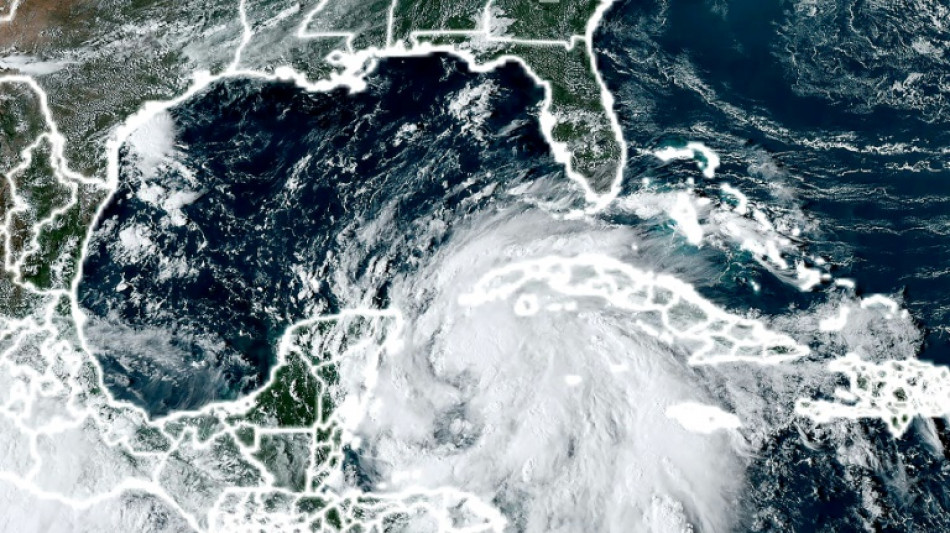
Climate change made deadly Hurricane Helene more intense: study / Photo: © NOAA/AFP

 US ambassador denounces settler siege as Israel dispatches troops

 Hasan takes 6-55 as Bangladesh claim opening day of Australia Test

 Taiwan says AI agents used in cyberattacks targeting island

 Japan protests Putin's first visit to disputed islands

 Kiss wants fit-again Wallabies playmaker Gordon to 'open up' Japan

 British eccentrics push humble garden shed to new heights

 Zambia votes with president's economic record on the line

 Germany's dry rivers spark battle on engineering vs restoration

 Senators demand inquiry into conditions aboard USS Abraham Lincoln

 All Blacks' Proctor out of South Africa series, Mo'unga called up

 Bangladesh quick Hasan reduces Australia to 74-4 at lunch

 Seoul tech leads Asian stock gains as traders cheer US inflation

 Farage and Count Binface go head-to-head in snap UK poll

 Afghan students divided over smartphone ban at universities

 Japan go back to school for second Australia Test

 Matthew McConaughey on his sweet return to the big screen
 President's economic record on the line as Zambia votes

 Grieving Messi available for Miami in Leagues Cup clash

 Colombia enters 'final phase' of quake search as toll hits 265

 Father-figure Christie helps guide Kounta to European silver

 McIlroy returns to St. Jude to launch marathon PGA playoff push

 Guimaraes makes Arsenal debut in Como friendly

 Travis Kelce says wedding to Taylor Swift was 'best night of my life'

 US stocks mostly up after data shows slightly lower inflation in July
 Caracas protest denounces secrecy of Venezuela transition talks

Hurricane Helene's torrential rain and powerful winds were made about 10 percent more intense due to climate change, according to a study published Wednesday by the World Weather Attribution (WWA) group.
Although a 10 percent increase "might seem relatively small... that small change in the hazard really leads to big change in impacts and damage," said climate scientist Friederike Otto, who heads the research organization.
The study also found that fossil fuels -- the primary cause of climate change -- have made hurricanes like Helene 2.5 times more likely to occur.
In other words, storms of Helene's magnitude were formerly anticipated once every 130 years, but now the probability is closer to once every 53 years, on average.
To conduct the study, researchers focused on three aspects of Hurricane Helene: precipitation, winds and the water temperature of the Gulf of Mexico -- a key factor in its formation.
"All aspects of this event were amplified by climate change to different degrees," Ben Clarke, a co-author of the study and researcher at Imperial College London, told a press conference.
"And we'll see more of the same as the world continues to warm," he continued.
The research by WWA, an international group of scientists and meteorologists who study the role of climate change in extreme weather events, comes as the southeastern US state of Florida prepares for the arrival of another major hurricane, Milton, just 10 days after it was hit by Helene.
- Destruction -
Helene made landfall in northwestern Florida on September 26 as a Category 4 hurricane with winds up to 140 mph (225 kph).
The storm then moved north, causing heavy rain and devastating floods in several states, including North Carolina, where it claimed the highest death toll.
The authors of the study emphasized that the risk posed by hurricanes has increased in scope beyond coastal areas.
Bernadette Woods Placky, chief meteorologist at NGO Climate Central, said Helene "had so much intensity" that it would take time for it to lose strength, but the "storm was moving fast... so it could go farther inland pretty quickly."
This study utilized three methodologies to examine the three aspects of the storm, and was conducted by researchers from the US, the UK, Sweden and the Netherlands.
To study its rainfall, researchers used an approach based on both observation and climate models, depending on the two regions involved: one for coastal areas like Florida, and another for inland areas like the Appalachian mountains.
In both cases, the study found precipitation had increased by 10 percent because of global warming, which is currently at 1.3 degrees Celsius above pre-industrial levels.
To study Helene's winds, scientists looked at hurricane data dating back as far as 1900.
They determined Helene's winds were 11 percent stronger, or 13 mph (21 kph), as a result of climate change.
Lastly, the researchers examined the water temperature in the Gulf of Mexico, where Helene formed, finding it was around 2 degrees Celsius above normal.
This record temperature was made 200 to 500 times more likely due to climate change, the study asserts.
Warmer oceans release more water vapor, providing more energy for storms as they form.
"If humans continue to burn fossil fuels, the US will face even more destructive hurricanes," Clarke warned in a statement.
L.Dubois--BTB