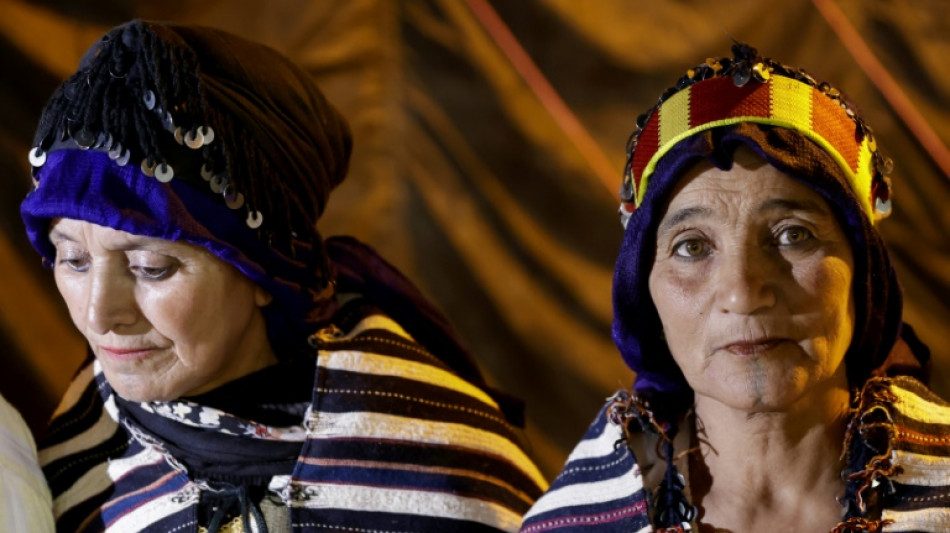
Morocco's tribeswomen see facial tattoo tradition fade / Photo: © AFP

 US ambassador denounces settler siege as Israel dispatches troops
 Hasan takes 6-55 as Bangladesh claim opening day of Australia Test

 Taiwan says AI agents used in cyberattacks targeting island

 Japan protests Putin's first visit to disputed islands

 Kiss wants fit-again Wallabies playmaker Gordon to 'open up' Japan

 British eccentrics push humble garden shed to new heights

 Zambia votes with president's economic record on the line

 Germany's dry rivers spark battle on engineering vs restoration

 Senators demand inquiry into conditions aboard USS Abraham Lincoln

 All Blacks' Proctor out of South Africa series, Mo'unga called up

 Bangladesh quick Hasan reduces Australia to 74-4 at lunch

 Seoul tech leads Asian stock gains as traders cheer US inflation
 Farage and Count Binface go head-to-head in snap UK poll

 Afghan students divided over smartphone ban at universities
 Japan go back to school for second Australia Test
 Matthew McConaughey on his sweet return to the big screen

 President's economic record on the line as Zambia votes

 Grieving Messi available for Miami in Leagues Cup clash

 Colombia enters 'final phase' of quake search as toll hits 265

 Father-figure Christie helps guide Kounta to European silver

 McIlroy returns to St. Jude to launch marathon PGA playoff push

 Guimaraes makes Arsenal debut in Como friendly

 Travis Kelce says wedding to Taylor Swift was 'best night of my life'

 US stocks mostly up after data shows slightly lower inflation in July

 Caracas protest denounces secrecy of Venezuela transition talks

As a young girl growing up in the Atlas mountains, Hannou Mouloud's family took her to have her chin tattooed with the cherished lines that generations of Moroccan Amazigh tribeswomen wore.
"When I was six, they told me tattoos were pretty adornments," recalled the 67-year-old from Imilchil village of the once-common practice among women in North Africa's Amazigh groups.
Long referred to as Berbers, many tribespeople from the area prefer to be called Amazigh, or Imazighen, which means "free people".
Today, like in many of the Indigenous cultures across the world where facial tattoos were long prevalent, the practice has largely faded.
Many attribute the near-disappearance of facial tattoos to Morocco's changing religious attitudes in recent decades, with interpretations of Islam where inked skin and other body modifications like piercings are prohibited taking hold.
"We would use charcoal to draw the designs on our faces, then a woman would prick the drawing with a needle until blood came out," Mouloud told AFP, adding that they would rub the wound daily with a chewed green herb to deepen the tattoo's colour.
The markings vary in design between the minority's tribes and were used to signify the wearer's origin while offering beauty and protection.
Being tattooed would hurt, said Hannou Ait Mjane, 71, and "we couldn't hold back our tears" but it "remains a tradition that our ancestors passed down to us".
- Fundamentalism -
Morocco has the largest Amazigh population in North Africa, with Tamazight, the community's language, recognised as an official language alongside Arabic.
According to the most recent census in 2014, more than a quarter of Morocco's 35 million inhabitants speak at least one dialect -- Tarifit, Tamazight or Tachelhit.
Abdelouahed Finigue, a geography teacher and researcher from Imilchil, told AFP that women often had their chins, foreheads or hands tattooed.
"Some women had intimate areas tattooed as a wedding gift, expressing their love for their husband," he added.
The designs held different meanings to the different communities.
"The woman, through her tattoos, expresses her beauty and her value as an individual independent of the man," he said, explaining what the different shapes can mean.
"The circle, for example, represents the universe and beauty, just like the moon and the sun which occupied an important place in local rites," he said.
But changing religious trends means fewer women are getting inked.
"In recent years, this custom has been tainted by preconceived ideas from Salafist currents," he added, referring to a Sunni Islamist movement that seeks to return to the practices and teachings of the Prophet Mohammed.
Bassou Oujabbour, member of local development association AKHIAM, said women with the markings have faced social pressure.
"Fundamentalists sometimes describe tattooing as the devil's book or as the first thing to be burned on the human body," he said.
"Some women even removed the tattoos long after getting them for fear of punishment after death."
D.Schneider--BTB