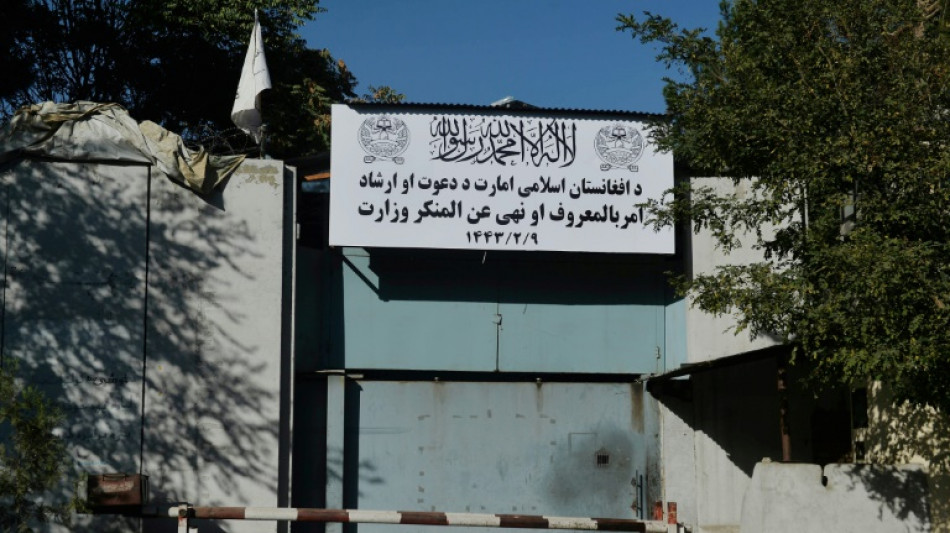
Afghan Taliban vow to implement media ban on images of living things / Photo: © AFP

 US ambassador denounces settler siege as Israel dispatches troops
 Hasan takes 6-55 as Bangladesh claim opening day of Australia Test

 Taiwan says AI agents used in cyberattacks targeting island
 Japan protests Putin's first visit to disputed islands
 Kiss wants fit-again Wallabies playmaker Gordon to 'open up' Japan

 British eccentrics push humble garden shed to new heights
 Zambia votes with president's economic record on the line
 Germany's dry rivers spark battle on engineering vs restoration

 Senators demand inquiry into conditions aboard USS Abraham Lincoln

 All Blacks' Proctor out of South Africa series, Mo'unga called up

 Bangladesh quick Hasan reduces Australia to 74-4 at lunch

 Seoul tech leads Asian stock gains as traders cheer US inflation
 Farage and Count Binface go head-to-head in snap UK poll

 Afghan students divided over smartphone ban at universities
 Japan go back to school for second Australia Test
 Matthew McConaughey on his sweet return to the big screen
 President's economic record on the line as Zambia votes

 Grieving Messi available for Miami in Leagues Cup clash
 Colombia enters 'final phase' of quake search as toll hits 265

 Father-figure Christie helps guide Kounta to European silver

 McIlroy returns to St. Jude to launch marathon PGA playoff push
 Guimaraes makes Arsenal debut in Como friendly

 Travis Kelce says wedding to Taylor Swift was 'best night of my life'
 US stocks mostly up after data shows slightly lower inflation in July
 Caracas protest denounces secrecy of Venezuela transition talks
Afghanistan's Taliban morality ministry pledged Monday to implement a law banning news media from publishing images of all living things, with journalists told the rule will be gradually enforced.
It comes after the Taliban government recently announced legislation formalising their strict interpretations of Islamic law that have been imposed since they swept to power in 2021.
"The law applies to all Afghanistan... and it will be implemented gradually," the spokesman for the Ministry for the Propagation of Virtue and the Prevention of Vice (PVPV) Saiful Islam Khyber told AFP, adding that officials would work to persuade people that images of living things are against Islamic law.
"Coercion has no place in the implementation of the law," he said.
"It's only advice, and convincing people these things are really contrary to sharia (law) and must be avoided."
The new law detailed several rules for news media, including banning the publication of images of all living things and ordering outlets not to mock or humiliate Islam, or contradict Islamic law.
Aspects of the new law have not yet been strictly enforced, including advise to the general public not to take or look at images of living things on phones and other devices.
Taliban officials continue to regularly post photos of people on social media and Afghan journalists have told AFP they received assurances from authorities after the law was announced that they would be able to continue their work.
The information ministry did not immediately respond to AFP's request for comment.
"Until now, regarding the articles of the law related to media, there are ongoing efforts in many provinces to implement it but that has not started in all provinces," Khyber said.
He added "work has started" in the southern Taliban stronghold of Kandahar and the neighbouring Helmand province, as well as northern Takhar.
Before the recent law was announced, Taliban officials in Kandahar were banned from taking photos and videos of living things but the rule did not include news media.
"Now it applies to everyone," Khyber said.
- Journalists summoned -
In central Ghazni province on Sunday, PVPV officials summoned local journalists and told them the morality police would start gradually implementing the law.
They advised visual journalists to take photos from further away and film fewer events "to get in the habit", a journalist who did not want to give his name for fear of reprisal told AFP.
Reporters in Maidan Wardak province were also told the rules would be implemented gradually in a similar meeting.
Television and pictures of living things were banned across the country under the previous Taliban rule from 1996 to 2001, but a similar edict has so far not been broadly imposed since their return to power.
Since 2021, however, officials have sporadically forced business owners to follow some censorship rules, such as crossing out the faces of men and women on adverts, covering the heads of shop mannequins with plastic bags, and blurring the eyes of fish pictured on restaurant menus.
When the Taliban authorities seized control of the country after a two-decade-long insurgency against foreign-backed governments, Afghanistan had 8,400 media employees.
Only 5,100 remain in the profession, according to media industry sources.
This figure includes 560 women, who have borne the brunt of restrictions the United Nations have called "gender apartheid", including being ordered to wear masks on television.
In Helmand, women's voices have been banned from television and radio.
Afghanistan has slipped from 122nd place to 178th out of 180 countries in a press freedom ranking compiled by Reporters Without Borders (RSF).
A.Gasser--BTB