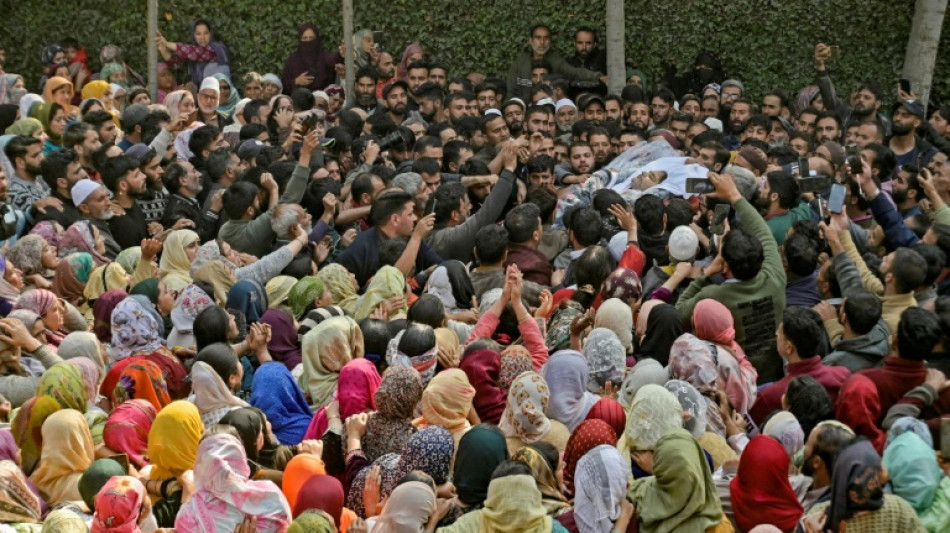
Rebel attacks keep Indian-run Kashmir on the boil / Photo: © AFP/File

 JUEL Group Expands from Real Estate to Hospitality with Hyatt Centric Malta Opening

 French Economy Shrinks 0.1% as Consumer Confidence Slumps

 Wall Street Ends Turbulent Week Higher Despite Inflation and AI Jitters

 Kansas City Fed Chief Says Inflation Is Still Running Too Hot

 Asian Markets Slide as AI Concerns Hit Chip Stocks

 Brazil Faces Debt and Inflation Test as Lula Prepares Fourth Term

 Chinese Drug Ribupatide Shows Greater Weight Loss Than Wegovy in Clinical Trial
 US Mortgage Rate Falls for Fourth Week but Remains Above 7%

 Italy Raises 2026 Growth View but Warns Energy Will Keep Inflation High
 UK Economy Grows 0.7% in Third Quarter as Services Lead Expansion

 India's Retail Inflation Reaches 6.09% as Food Prices Accelerate
 China's October Activity Data Reveal a Weak Start to the Fourth Quarter
 Thomas Tuchel Refuses to Name England Number One Goalkeeper After James Trafford's Display

 Qatar's Amir and Venezuelan Acting President Discuss Energy Cooperation

 Russell Brand’s Wife Reads Prison Letter Denying Guilt; Fellow Inmate Questions Faith
Ambushes, firefights and a market grenade blast: headline-grabbing attacks in Indian-run Kashmir are designed to challenge New Delhi's bid to portray normality in the disputed territory, Indian security officials say.
Kashmir has been divided between nuclear-armed rivals India and Pakistan since their partition at the chaotic end of British rule in 1947, and both countries claim the territory in full.
"The attacks are not merely about killing, but also to set a narrative to counter the Indian narrative -- that everything is fine," said the former head of India's Northern Command forces, retired general Deependra Singh Hooda.
Half a million Indian troops are deployed in the far northern region, battling a 35-year insurgency in which tens of thousands of civilians, soldiers and rebels have been killed, including at least 120 this year.
Prime Minister Narendra Modi's Hindu nationalist government cancelled the Muslim-majority region's partial autonomy in 2019, a decision accompanied by mass arrests and a months-long communications blackout.
The territory of around 12 million people has since been ruled by a governor appointed by New Delhi -- overseeing the local government that voters elected in October in opposition to Modi.
- 'Larger message' -
New Delhi insists it helped bring "peace, development and prosperity" to the region.
But military experts say that small bands of rebels -- demanding either independence or Kashmir's merger with Pakistan -- use attacks to contradict the claims.
"The larger message being sent out is that the problem in Kashmir is alive," Hooda said.
India blames Pakistan for arming militants and helping them "infiltrate" across the militarised dividing line to launch attacks, an allegation Islamabad denies.
A "spurt in infiltration" this year by insurgents was "not possible without Pakistan's army actively allowing it", Hooda charged.
Many clashes take place in forested mountains far from larger settlements.
But the huge military presence visible in sprawling camps and roadblocks -- roughly one in every 25 people in Kashmir is an Indian soldier -- serves as a constant reminder.
Many are frustrated by traffic jams caused by military orders that civilian cars stay at least 500 metres (1,640 feet) away from army vehicles.
Yet those who have long lived under the shadow of the grinding insurgency seemingly shrug off the threat.
When an attacker this month hurled a grenade at security forces in a busy market -- killing a woman and wounding 11 civilians -- shoppers returned within a couple of hours.
This month, thousands attended an army recruitment drive, even as soldiers battled gunmen in a nearby district.
- 'Low boil' -
Attacks appear dramatic, including a gun battle in downtown Srinagar in early November that police said killed a commander of the Pakistan-backed Lashkar-e-Taibamilitant group.
Earlier this year, attacks in the Jammu area -- a Hindu-majority region -- prompted the army to supply thousands of militia forces, dubbed village defence guards, with rifles.
But the death toll of 120 civilians, soldiers and rebels killed this year is, so far, similar in intensity to 2023, when 130 people died, according to the South Asia Terrorism Portal, a New Delhi-based monitoring group.
"It will remain like this on low boil, as long as Kashmir is divided (between India and Pakistan)," a security official said, speaking on condition of anonymity because they were not authorised to talk to journalists.
"We control it here; they (Pakistan) will activate it from there."
The Indian army says around 720 rebels have been killed in the past five years.
Regional army commander MV Suchindra Kumar said in October he believed fewer than 130 remained in the fight.
Another security official, who spoke on the condition of anonymity, said those include "highly trained and well-armed" fighters who had crossed from Pakistan.
"They are causing some damage by surprise attacks," the official said. "But the situation is under control".
Hooda, drawing on his long experience as a general, predicts little change as long as violence serves the agenda of India's rival Islamabad.
"I don't see this coming down immediately," he said, referring to the number of attacks.
"Pakistan has always felt that ratcheting up attacks will bring the spotlight on Kashmir".
O.Bulka--BTB