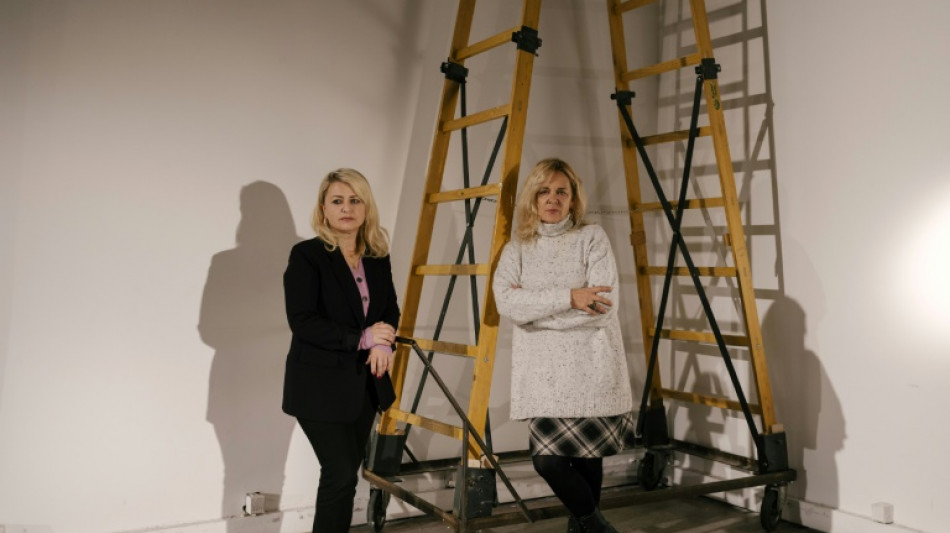
Balkans women stage ancient Greek play to condemn women's suffering in war / Photo: © AFP

 Guimaraes makes Arsenal debut in Como friendly

 Travis Kelce says wedding to Taylor Swift was 'best night of my life'

 US stocks mostly up after data shows slightly lower inflation in July

 Caracas protest denounces secrecy of Venezuela transition talks

 Hudson-Smith regains Euro 400m title on home track

 Rob Reiner son denies grand jury murder charges

 Spain darkens as solar eclipses races south from Arctic

 Skies darken as solar eclipse heads south from Arctic to Spain

 Protest denounces secrecy of Venezuela transition talks

 NBA's Los Angeles Lakers to be sold for reported $12.5 bn

 Lukaku joins Turkish side Fenerbahce from Napoli

 Colombia quake rescue efforts enter 'final phase' as toll hits 239

 Brazil orders suspension of Discord livestreams after teen suicide

 Tourists rush to Mount Etna as Italian volcano erupts

 Knot and Venmo Team Up to Make Venmo the Effortless Way to Pay

 In Moscow, Russians worry about new fuel shortages

 New space object 'black hole star' discovered by astronomers

 England captain Root tells players to be 'adults' as he ditches curfew

 US inflation slows slightly in July despite elevated fuel prices

 Total solar eclipse to cast its shadow over Europe

 US consumer inflation slows slightly in July despite elevated fuel prices

 Warholm on track in bid for fourth Euro hurdles gold

 Erdogan eyes expansion of regional defence pact

 Extreme weather, jellyfish knock one-fifth of France's nuclear capacity offline

 Skywatchers gather in Europe to see total solar eclipse

Maja Mitic is Serbian. Zana Hoxha is Kosovar. Their adaptation of an ancient Greek tragedy highlights not so much the devastation war inflicts on women but women's capacity to heal and resist.
Euripides's "Trojan Women", first performed in 415 BC, is an acerbic condemnation of the atrocities of war. It focusses on the misery and injustices the women of Troy endure after the conflict between their people and the Greeks.
The adaptation that Hoxha and Mitic are currently staging in the Balkans has a quite distinct focus.
"In our version, we are moving forward by also taking care of each other, by finding ways to save our children," said Hoxha, who directed the play.
It demonstrates "that amidst conflict and war, amidst hatred, women are the ones that find ways to resist," she said of the play, being performed in Belgrade on Friday and Saturday night after two shows in Kosovo.
This production echoes the interminable discussions between the male politicians of Serbia and Kosovo who -- a quarter of a century after the end of the war between Belgrade and its breakaway province -- have still not concluded a lasting peace. The women negotiate on the soberly designed set.
As a Kosovar and feminist director "who still remembers war" and also the times of the former Yugoslavia, 43-year-old Hoxha said, "it was important to do this play because unfortunately it's very relevant".
- Transcending language -
In Euripides's play, the women of Troy are married by force to their worst enemies, murdered and sacrificed on the tombs of men who fell in battle.
They are the victims of the war that follows war.
The tale needed two women to tell it, stressed Hoxha's co-director Mitic, a prominent figure in Serbian theatre since the 1990s.
"The men, they make wars... The consequences are on women and the children of these women," she said.
Mitic plays Hecuba, the former queen of Troy, whose children are sacrificed, one after the other, to the follies of war.
She recites Euripides's ancient text in Serbian.
Thaltybios, who comes to tell the women of their fate, replies in Albanian.
An English translation scrolls across the back wall.
After a few minutes, listeners can no longer distinguish the different languages because the pain is universal.
"The relationship, the emotions that these actors are able to carry are more important than the language barriers," Hoxha said.
- 'Art has power' -
And whether they speak Serbian, Kosovar Albanian or English, the Trojan women make audiences reflect and make them angry.
"Even our characters are angry," Hoxha explained.
"They say like, you know, 'fuck this shit, we don't want this anymore.'
"'Why are we suffering? Why do Cassandras have to exist today? Why does Andromache have to lose her child?"
At one point in the play, Hoxha recalled, Andromache says she wants to be able to walk around freely with her husband and son and not feel threatened in the street.
That feeling remains unchanged for women today, she said.
"There are only a few places in the world where I feel completely safe to be myself."
"We are trying to change that," she added.
"I don't think that the performance alone can do that. But art has the power to bring you something which maybe you didn't even know existed."
The emphasis in Hoxha and Mitic's adaptation on the universal relevance of the protagonists' concerns extends as far as their costumes.
The characters dress in black leather and ankle boots -- a uniform that could belong to any army in the world.
Just as Hecuba could be any grieving mother on the planet.
It's a story about women and war "in any part of the world, in any century, in any culture, in any religion", said Mitic.
"This is the story that Euripides wrote centuries ago, but actually we see repetition of the same model during the war, after the war -- raping, criminals, everything.
"What we see in this play, we really see today (in) Ukraine or Gaza, or (in) Kosovo or Bosnia" or wherever conflict is occurring including Somalia and Sudan, Mitic said.
After an hour in front of a packed hall, the voices combine, hoping for another future: "Sometimes to live is to resist," they say.
H.Seidel--BTB