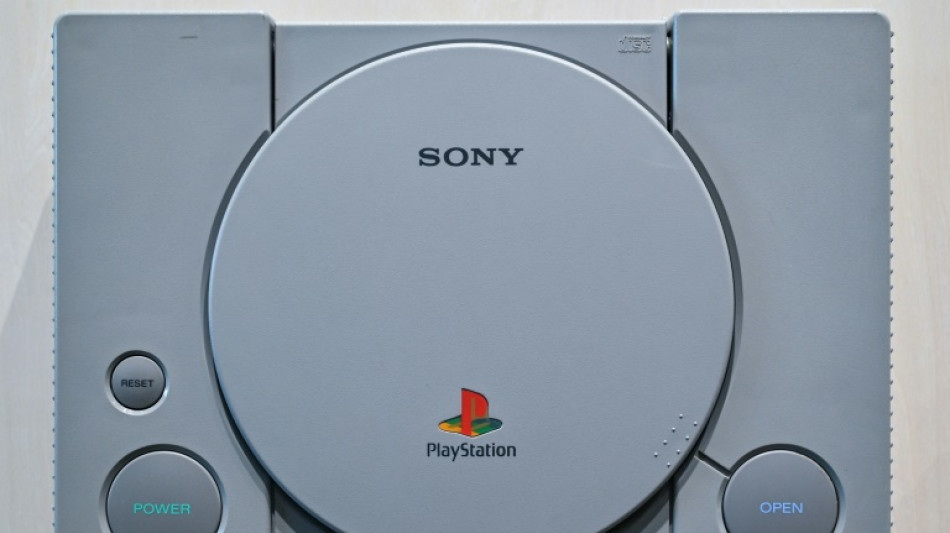
PlayStation at 30: How Sony's grey box conquered gaming / Photo: © AFP

 Brazil Faces Debt and Inflation Test as Lula Prepares Fourth Term

 Chinese Drug Ribupatide Shows Greater Weight Loss Than Wegovy in Clinical Trial

 US Mortgage Rate Falls for Fourth Week but Remains Above 7%

 Italy Raises 2026 Growth View but Warns Energy Will Keep Inflation High

 UK Economy Grows 0.7% in Third Quarter as Services Lead Expansion

 India's Retail Inflation Reaches 6.09% as Food Prices Accelerate

 China's October Activity Data Reveal a Weak Start to the Fourth Quarter

 Thomas Tuchel Refuses to Name England Number One Goalkeeper After James Trafford's Display

 Qatar's Amir and Venezuelan Acting President Discuss Energy Cooperation

 Russell Brand’s Wife Reads Prison Letter Denying Guilt; Fellow Inmate Questions Faith

 Alouettes and Elks Set for 113th Grey Cup Showdown
Japanese electronics giant Sony is set to celebrate 30 years since it launched the PlayStation console, the little grey box that catapulted the firm into the gaming big league.
PlayStation was Sony's first foray into the world of video games and when it hit the shelves in Japan on December 3, 1994, the company needed to sell one million units to cover its costs.
In the end, the gadget became a legend, selling more than 102 million units, helping to launch many of the industry's best-loved franchises and positioning Sony as a heavyweight in a hugely lucrative sector.
"PlayStation changed the history of video games," said Hiroyuki Maeda, a Japanese specialist in video game history.
"It truly transformed everything: hardware, software, distribution and marketing."
One of the keys to its success was broadening the appeal of a pastime that had often been dismissed as a hobby for children.
From the off, the firm was clear that it wanted to trash this image.
In part this stems from Sony's rivalry with Nintendo, which was already a dominant player in the sector by the mid-1990s, but whose games skewed young.
- Sony 'humiliated' -
The original PlayStation can trace its history to a falling out between the two great Japanese firms.
They had partnered in the late 1980s to develop a version of the Super Nintendo console with an in-built CD player.
But Nintendo suspected Sony were using the project as a way to muscle into the gaming sector and abruptly cancelled the partnership in 1991.
"Sony found itself in a humiliating position," said Maeda, so pushed ahead with the project by itself.
The hardware proved to be revolutionary, CD-ROMs being cheaper and storing much more data than the cartridges used by Nintendo and other consoles.
And to further distinguish itself from Nintendo, Sony courted a young adult audience with fighting games like "Tekken", out-and-out horror with "Resident Evil" and "Silent Hill", and military titles like "Metal Gear Solid".
Its advertising also followed a more grown-up path.
Hollywood auteur David Lynch was drafted in to direct ads for the PS2 launched in 2000 -- conjuring a nightmare vision of floating heads and talking ducks certainly not meant for younger audiences.
"The older audience obviously had better purchasing power than children," said Philippe Dubois, founder of M05, a French association that aims to preserve digital heritage.
The PS2 is still the most successful console in history, having sold more than 160 million units.
- 'New sensations' -
Over the past 30 years, the competition has intensified and the technology has been honed.
While Sega and other rivals have fallen by the wayside, Microsoft has entered the fray with its Xbox, and Nintendo is still on the scene with its Switch console.
But the industry is enduring tough times.
A surge in popularity and investment during the pandemic has subsided and Sony's PlayStation division recently laid off hundreds of workers.
Plenty of analysts are also predicting that cloud gaming will soon render consoles obsolete.
Sony appears undaunted though, recently launching an upgraded version of its PS5 with a marketing push that highlighted new AI features.
Bloomberg has reported that the Japanese firm is also planning a new hand-held version of the PlayStation, which would once again pit it against old rival Nintendo, undisputed king of portable devices.
However, for the purists, few innovations were as great as the original console's ability to handle 3D graphics.
The technology was instrumental for the appeal of classic games such as "Tomb Raider" and "Final Fantasy VII".
"We discovered sensations, emotions that we hadn't experienced with earlier consoles," said French YouTuber and PlayStation enthusiast Cyril 2.0.
He said he had collected almost every title released for the PlayStation in Europe -- some 1,400 -- and insisted the formula for success was not complicated.
"For consoles, games are still the most important thing," he said.
B.Shevchenko--BTB