Spain urged to 'build differently' after deadly floods / Photo: © AFP

 'Trying to bury the science': US climate research under siege

 Eurovision to bar countries at war from hosting

 Italian teenager Curtis breaks 50m backstroke world record at Europeans

 New mum Sjostrom wins 50m butterfly for 18th European gold

 Solar eclipse darkens Arctic Russia on course for Spain
 Russian economy rebounds in second quarter despite Ukrainian strikes

 NBA's Los Angeles Lakers to be sold for $12.5 bn: ESPN
 Trump sued over sale of access to Truth Social posts

 Europe looks to the skies as solar eclipse cast its shadow
 At least 44 drown after ferry overturns on Zimbabwe's Lake Kariba

 Grieving Argentine icon Messi unsure about playing on 'much longer'

 Nigeria kidnap victims escape 'hellfire' captivity beaten, malnourished
 Google unveils finder tag, new AI smartphone features

 US equities gain as inflation report eases fear of rate rise
 Colombia declares three days mourning for quake victims

 44 lives lost after ferry capsizes on Zimbabwe's Lake Kariba

 WallStreetPR Releases Report on China’s Gold Purchases and African Mining Investment

 Former Chinese premier Zhu Rongji dies aged 97

 Markets steady awaiting US inflation data

 WHO says Trump vaccine shake-up goes against evidence

 Eclipse chasers flock to Spain for 'breathtaking' experience

 'To make the civilians leave': Russia pummels Ukraine's petrol stations

 Japan brushes off Australian PM's melon drama

 Rod Stewart cancels tour dates after heart surgery

 How Britain's mapmakers track climate change

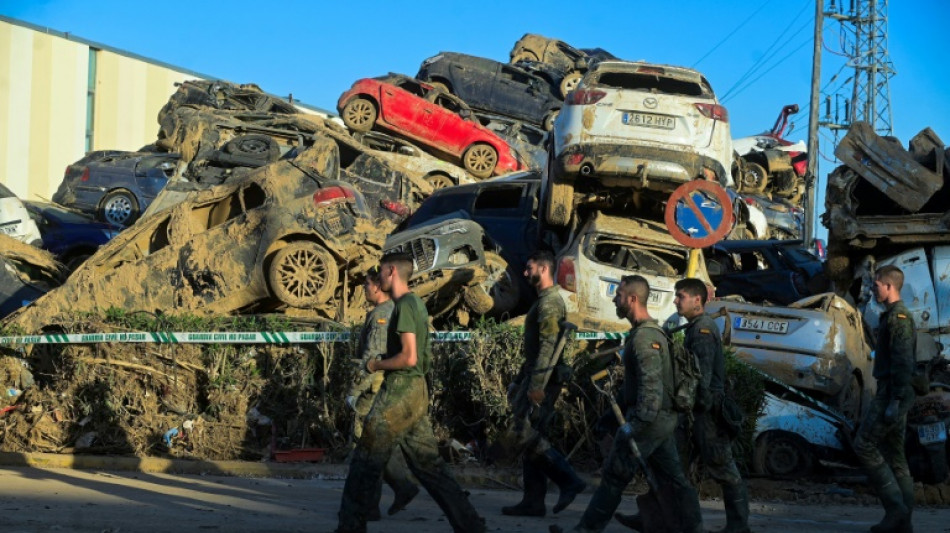
Spain is racing to reconstruct areas devastated by deadly floods last month but experts have urged a rethink of development with the relocation of buildings away from vulnerable areas.
The worst floods to hit Spain in decades on October 29 killed at least 230 people, covered towns in mud and debris, destroyed bridges, roads and rail lines and submerged cars, mainly in the eastern region of Valencia.
"The degree of destruction and ruin was historic" in the Valencia region, where some 80 towns were hit by torrential rains, according to a report from Spain's Higher Council of Colleges of Architects.
Reconstruction must "be carried out with empathy, technical rigour and a great deal of responsibility," said its president Marta Vall-Llossera.
"With global warming making meteorological phenomena more intense and more frequent, architecture will have an important role to play," she told AFP.
"We're going to have to build differently," she added, recommending a return to "the traditional, compact Mediterranean city".
In Spain's third-largest city Valencia, the regional capital, land has become increasingly built up, making it more vulnerable to flooding since concrete prevents the ground from absorbing water.
In the Valencia suburb of Paiporta, epicentre of the disaster, roads were quickly transformed into torrents of mud that swept away everything in their path.
"We must try to re-naturalise cities, reduce the use of cars, make the cobblestones less hard, more permeable, and better able to withstand the intense heat and torrential rain," said Vall-Llossera.
- 'Forced expropriation' -
A flood risk prevention plan was approved in the Valencia region in 2003 but it is not binding and has no "retroactive effects", said Maria Jesus Romero Aloy, an expert in urban planning law at Valencia's Polytechnic University.
Valencia accounts for just five percent of Spain's territory which is at risk of flooding but has seen 20 percent of the heavy rainfall events recorded over the past decade in the country, according to the plan.
The highest risk of flooding is concentrated in 12 percent of the region -- home to the popular beach resort of Benidorm -- and affects 600,000 people.
In this area, the authorities recommend homes have watertight windows and an internal staircase with roof access to allow for an escape from flash flooding.
But Romero Aloy said there has to be a "rethinking the territorial model and considering removing buildings or installations that face a high risk" of flooding.
Property owners are currently allowed to rebuild on flooded land even in a high-risk zone.
The only way to prevent this is through a "forced expropriation" as happened in 2019 in Onteniente, a municipality some 85 kilometres (50 miles) south of Valencia.
There "a neighbourhood was eliminated" and turned into a floodway, a channel reserved for floodwaters to pass through, said Romero Aloy.
- 'Natural barriers' -
Mayors, however, are "reluctant to expropriate" because it is a "complicated political decision", especially when the country faces a housing shortage, she added.
But a month after the floods "there is a growing awareness among decision-makers," said Federico Jesus Bonet Zapater, an expert in civil engineering, canals and ports who advises the regional government of Valencia.
"Projects to build dams or divert canals, which have been on the table for some time, are finally going to be studied," he added.
Rafael Delgado Artes, an expert in regional planning and risk prevention, recommends creating "natural barriers" such as forests to minimise the damage from floods and "artificial riverbeds to divert rivers away from city centres".
In the centre of Valencia, which was spared the October disaster, the river that runs through the city was diverted after devastating floods in 1957 and in its place stands a popular urban park.
H.Seidel--BTB