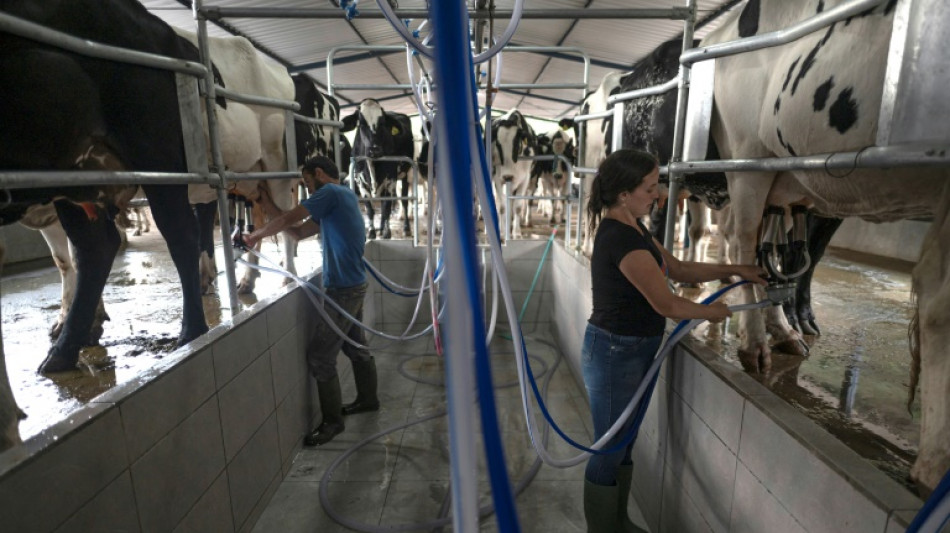
Brazil's Minas cheese gets added to UNESCO list / Photo: © AFP/File

 US Mortgage Rate Falls for Fourth Week but Remains Above 7%

 Italy Raises 2026 Growth View but Warns Energy Will Keep Inflation High

 UK Economy Grows 0.7% in Third Quarter as Services Lead Expansion

 India's Retail Inflation Reaches 6.09% as Food Prices Accelerate

 China's October Activity Data Reveal a Weak Start to the Fourth Quarter

 Thomas Tuchel Refuses to Name England Number One Goalkeeper After James Trafford's Display

 Qatar's Amir and Venezuelan Acting President Discuss Energy Cooperation

 Russell Brand’s Wife Reads Prison Letter Denying Guilt; Fellow Inmate Questions Faith

 Alouettes and Elks Set for 113th Grey Cup Showdown

Minas cheese -- a dairy delight from a farming region in Brazil giving it its name -- was added to UNESCO's global list of intangible cultural heritage on Wednesday.
The inscription raises the profile of the cheese internationally and helps protect the traditions that go into making it.
"This is really a very special way of us preserving our memory, the knowledge of our people," Brazilian Culture Minister Margareth Menezes said in a video message of thanks to UNESCO.
The inscription was one of several added by the intergovernmental committee of the UN Educational, Scientific and Cultural Organization in a session held in Paraguay's capital Asuncion.
The cheese, called Queijo Minas in Portuguese, is made from fresh cow milk. It is firm and has a mild, slightly salty flavor.
It comes in different varieties: fresh, which is somewhat reminiscent of ricotta cheese though of a different texture; half-aged; and aged.
The cheese comes from Brazil's southeastern Minas Gerais state, a region -- population 20 million -- known for its mines and its agriculture.
The state is the biggest production hub in South America for milk and cheese.
Minas cheese is still largely produced by family-run firms on small farms nestled in green hills -- around 9,000 of them in different parts of the state.
They mix raw milk with "'pingo' (drop), a natural yeast composed of typical bacteria of each region," according to Brazil's file lodged with UNESCO,
That, combined with "the maturation period and the climate of each location, contributes to the specific flavor, color and aroma of the cheeses."
The cheesemaking tradition of Queijo Minas started in the 18th century -- when half the gold used around the planet came from Minas Gerais's mines, then under Portuguese control.
The Portuguese brought European techniques that were needed to preserve foodstuffs on the long treks within that vast Brazilian region.
Those techniques were then adapted locally and passed down orally through generations, upholding family traditions and the character that came from holdings' microclimates.
Queijo Minas's addition to the UNESCO intangible heritage list makes it the seventh such cultural tradition from Brazil to feature. It now sits alongside capoeira -- the dance/martial-art sport -- and the traditional carnival rhythm from the country's northeastern Recife region.
It is the first Brazilian food item to make it in the category, joining delicacies such as Neapolitan pizza and Peruvian ceviche.
D.Schneider--BTB