Syria's rebel victors expose ousted government's drug trade / Photo: © AFP

 New space object 'black hole star' discovered by astronomers

 England captain Root tells players to be 'adults' as he ditches curfew
 US inflation slows slightly in July despite elevated fuel prices
 Total solar eclipse to cast its shadow over Europe
 US consumer inflation slows slightly in July despite elevated fuel prices
 Warholm on track in bid for fourth Euro hurdles gold
 Erdogan eyes expansion of regional defence pact
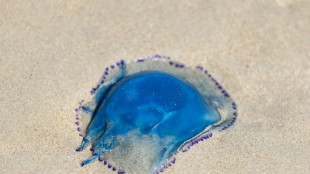 Extreme weather, jellyfish knock one-fifth of France's nuclear capacity offline
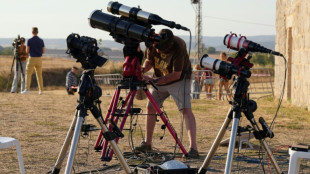 Skywatchers gather in Europe to see total solar eclipse
 Zhu Rongji, trailblazing ex-premier who transformed China's economy
 China tech giant Tencent's Q2 profit down as AI push builds
 China's C919 jet makes first international commercial flight
 Mideast war impact on travel bookings fading, TUI says
 Bangladesh get Das fitness boost for daunting Australia task
 One dead, 172 rescued as second ferry in days catches fire in Indonesia
 Foxconn posts quarterly profit surge on AI server demand
 Hazlewood gets Australia nod ahead of Boland for Bangladesh Test
 Toyota ex-chief Okuda, pioneer of the Prius, dead at 93
 Colombia rescuers find woman alive as quake death toll passes 200

 New Zealand PM survives leadership challenge months from election
 Passengers rescued as second ferry in days catches fire in Indonesia
 Oil prices rise, stocks mixed ahead of crucial US inflation data
 UK 'joke' candidate Binface pushes serious point about politics
 New Zealand PM Luxon survives leadership challenge months from election
 Cuba celebrates Castro's 100th as his revolution faces its toughest test
The dramatic collapse of Bashar al-Assad's Syrian regime has thrown light into the dark corners of his rule, including the industrial-scale export of the banned drug captagon.
Victorious Islamist-led fighters have seized military bases and distribution hubs for the amphetamine-type stimulant, which has flooded the black market across the Middle East.
Led by the Hayat Tahrir al-Sham (HTS) group, the rebels say they found a vast haul of drugs and vowed to destroy them.
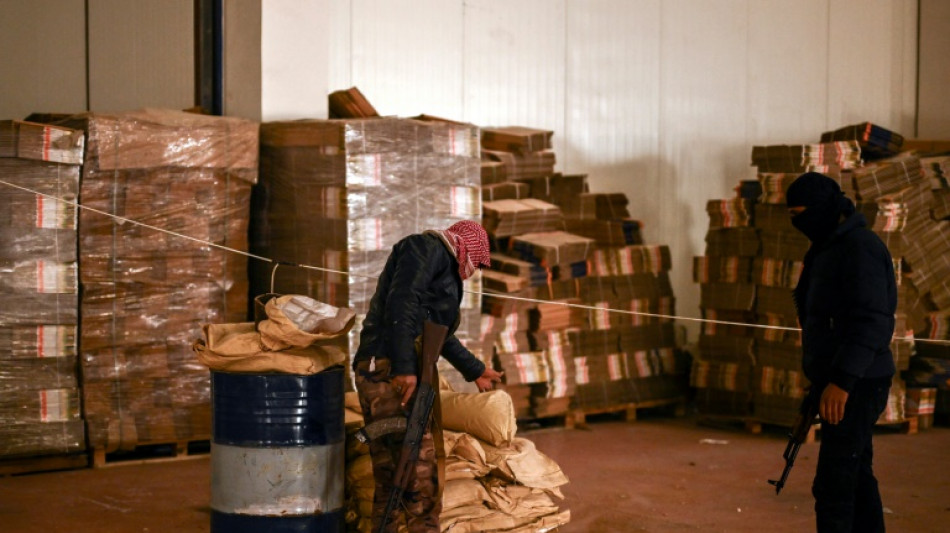
On Wednesday, HTS fighters allowed Afp journalists into a warehouse at a quarry on the outskirts of Damascus, where captagon pills were concealed inside electrical components for export.
"After we entered and did a sweep, and we found that this is a factory for Maher al-Assad and his partner Amer Khiti," said black-masked fighter Abu Malek al-Shami.
- Household appliances -
Maher al-Assad was a military commander and the deposed strongman's brother, now presumed on the run. He is widely accused of being the power behind the lucrative captagon trade.
Syrian politician Khiti was placed under sanction in 2023 by the British government, which said he "controls multiple businesses in Syria which facilitate the production and smuggling of drugs".
In a cavernous garage beneath the warehouse and loading bays, thousands of dusty beige captagon pills were packed into the copper coils of brand new household voltage stabilisers.
"We found a large number of devices that were stuffed with packages of captagon pills meant to be smuggled out of the country. It's a huge quantity. It's impossible to tell," Shami said.
Above, in the warehouse, crates of cardboard boxes stood ready to allow the traffickers to disguise their cargo as pallet-loads of standard goods, alongside sacks and sacks of caustic soda.
Caustic soda, or sodium hydroxide, is a key ingredient in the production of methamphetamine, another stimulant.
Assad fell at the weekend to a lightning HTS offensive, but the revenue from selling captagon propped up Assad's government throughout Syria's 13 years of civil war.
Captagon turned Syria into the world's largest narco state. It became by far Syria's biggest export, dwarfing all its legal exports put together, according to estimates drawn from official data by AFP during a 2022 investigation.
Experts -- like the author of a July report from the Carnegie Middle East Center -- also believe that Assad used the threat of drug-fuelled unrest to put pressure on Arab governments.
Captagon fuelled an epidemic of drug abuse in wealthy Gulf states, even as Assad sought ways to end his diplomatic isolation among his peers, wrote Carnegie scholar Hesham Alghannam.
- 'Huge amount, brother' -
Assad, he wrote, "leveraged captagon trafficking as a means of exerting pressure on the Gulf states, notably Saudi Arabia, to reintegrate Syria into the Arab world", which it did in 2023 when it rejoined the Arab League bloc.
The caustic soda at the warehouse, in the Damascus suburbs, was supplied from Saudi Arabia, according to labelling on the sacks.
The warehouse haul was massive, but smaller and still impressive stashes of captagon have also turned up in military facilities associated with units under Maher Assad's command.
Journalists from AFP this week found a bonfire of captagon pills on the grounds of the Mazzeh air base, now in the hands of HTS fighters who descended on the capital Damascus from the north.
Behind the smouldering heap, in a ransacked air force building, more captagon lay alongside other illicit exports, including off-brand Viagra impotence remedies and poorly-forged $100 bills.
"As we entered the area we found a huge quantity of captagon. So we destroyed it and burned it. It's a huge amount, brother," said an HTS fighter using the nom de guerre "Khattab".
"We destroyed and burned it because it's harmful to people. It harms nature and people and humans."
Khattab also stressed that HTS, which has formed a transitional government to replace the collapsed administration, does not want to harm its neighbours by exporting the drug -- a trade worth billions of dollars.
S.Keller--BTB