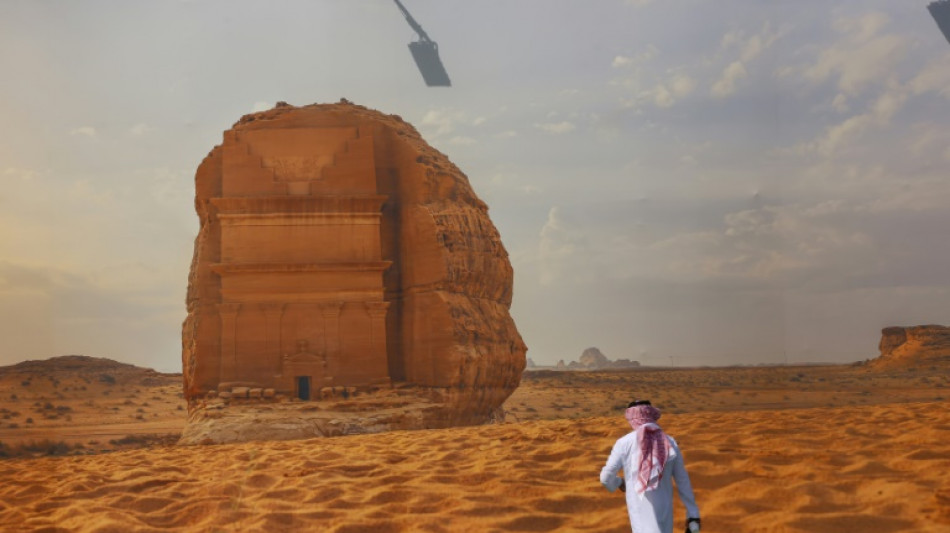
World falls short of drought deal at Saudi-hosted talks / Photo: © AFP

 Colombia declares three days mourning for quake victims

 44 lives lost after ferry capsizes on Zimbabwe's Lake Kariba

 WallStreetPR Releases Report on China’s Gold Purchases and African Mining Investment

 Former Chinese premier Zhu Rongji dies aged 97
 Markets steady awaiting US inflation data

 WHO says Trump vaccine shake-up goes against evidence

 Eclipse chasers flock to Spain for 'breathtaking' experience

 'To make the civilians leave': Russia pummels Ukraine's petrol stations

 Japan brushes off Australian PM's melon drama
 Rod Stewart cancels tour dates after heart surgery

 How Britain's mapmakers track climate change

 Australian delivery drivers win 'world-leading' pay rise

 Meta meets its own 'tobacco' moment in court

 Art or medicine? Japan's cosmetic tattoo artists in limbo

 Rybakina ousts Osaka to book Toronto semi-final against Gauff
 Colombia rescuers find woman alive as quake death toll passes 240

 Charges dropped against Bondi Beach attack hero

 Parched and desperate for rain, Kazakhstan turns to cloud-seeding
 The perfect storm that turbocharged Venezuela's twin quakes
 2.4 million girls banned from Afghan schools since Taliban return: UNESCO
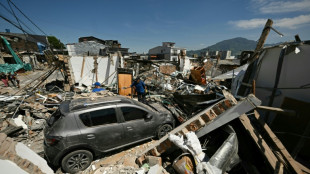 Colombians dig through rubble as quake death toll surpasses 240

 Karbon-X and Core Energy Sign Letter of Intent to Explore Commercial EV Charging Infrastructure in South America
 What to know about the total solar eclipse

 Tentoglou claims fourth Euro long jump title, injured Jacobs falters

 All Blacks knew Nonu would perform solo Haka - coach Rennie

Negotiators failed to produce an agreement on how to respond to drought at Saudi-hosted UN talks, participants said on Saturday, falling short of a hoped-for binding protocol addressing the scourge.
The 12-day meeting of parties to the United Nations Convention to Combat Desertification (UNCCD), known as COP16, concluded early on Saturday morning, a day later than scheduled as parties tried to hammer out a deal.
Prior to the talks, UNCCD Executive Secretary Ibrahim Thiaw said the world expected negotiators "to adopt a bold decision that can help turn the tide on the most pervasive and the most disruptive environmental disaster: drought".
But addressing the plenary session before dawn, Thiaw acknowledged that "parties need more time to agree on the best way forward".
A press release on Saturday said the parties -- 196 countries and the European Union -- had "made significant progress in laying the groundwork for a future global drought regime, which they intend to complete at COP17 in Mongolia in 2026".
The Riyadh talks came after the partial failure of biodiversity talks in Colombia, the failure to reach a UN deal on plastics pollution in South Korea, and a climate finance deal that disappointed developing nations at COP29 in Baku, Azerbaijan.
- Growing threat -
Droughts "fuelled by human destruction of the environment" cost the world more than $300 billion each year, the UN said in a report published on December 3, the second day of the talks in Riyadh.
Droughts are projected to affect 75 percent of the world's population by 2050, it said.
A delegate at COP16 from a country in Africa, speaking on condition of anonymity to discuss private deliberations, told AFP that African nations had hoped the talks would produce a binding protocol on drought.
That would ensure "every government will be held responsible" for devising stronger preparation and response plans, the delegate said.
"It's the first time I've seen Africa so united, with a strong united front, with respect to the drought protocol."
Two other COP16 participants, also requesting anonymity, told AFP that developed countries did not want a binding protocol and instead were pushing for a "framework", which African countries deemed inadequate.
Indigenous groups were also pushing for a protocol, said Praveena Sridhar, chief technical officer for Save Soil, a global campaign backed by UN agencies.
This would allow for better monitoring, early warning systems and response plans, she said.
Yet the absence of a protocol from COP16 "shouldn't delay progress", as national governments can still allocate "budgets and subsidies to financially support farmers in adopting sustainable soil and land management".
- Funding needs -
Ahead of the Riyadh talks, the UNCCD said 1.5 billion hectares (3.7 billion acres) of land must be restored by decade's end and that at least $2.6 trillion in global investments was needed.
The first week saw pledges of more than $12 billion from bodies such as the Arab Coordination Group, a collection of national and regional institutions, and the Riyadh Global Drought Resilience Partnership, which is meant to mobilise public and private money to help at-risk countries.
Activists accused Saudi Arabia, the world's biggest oil exporter, of trying to water down calls to phase out fossil fuels at last month's COP29 UN climate talks in Baku.
However, desertification is a major issue for the Gulf kingdom.
Along with the drought resilience partnership, Saudi Arabia launched initiatives to promote early warning for sand and dust storms and to get the private sector involved in land preservation, Saudi Environment Minister Abdulrahman AlFadley said in his closing remarks.
Saudi Arabia is dedicated "to working with all parties to preserve ecosystems, enhance international cooperation to combat desertification and land degradation, and address drought", he said.
Sridhar of Save Soil said Saudi Arabia had succeeded in raising the profile of land-related issues, which she described as more "unifying" than the climate talks in Baku.
"Attending to land, agriculture lands, farmers, livestock –- it's not a contested subject. Nobody's going to say 'I don’t want food'," she said.
"The use of fossil fuels or not is a very polarising subject. This is not."
A.Gasser--BTB