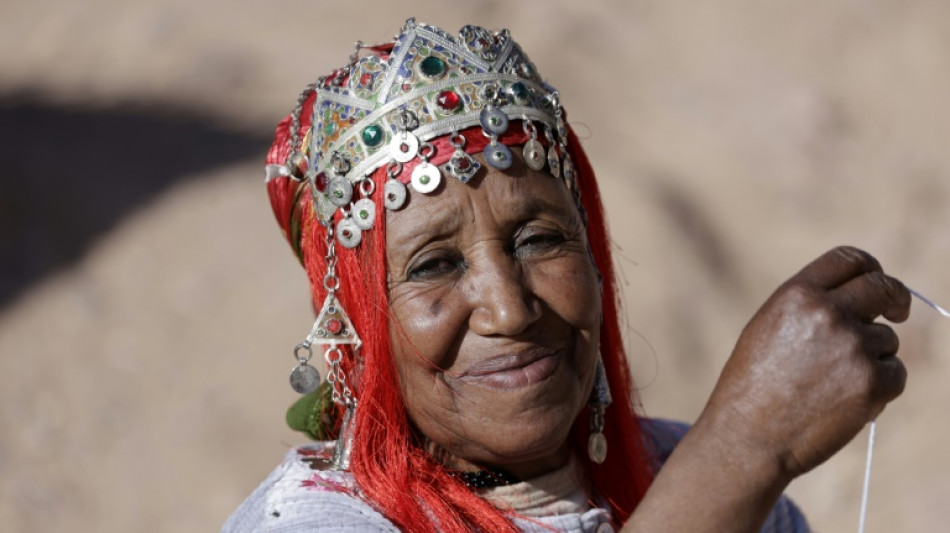
Morocco's women rug weavers battle to save age-old craft / Photo: © AFP

 Colombia declares three days mourning for quake victims

 44 lives lost after ferry capsizes on Zimbabwe's Lake Kariba

 WallStreetPR Releases Report on China’s Gold Purchases and African Mining Investment
 Former Chinese premier Zhu Rongji dies aged 97

 Markets steady awaiting US inflation data

 WHO says Trump vaccine shake-up goes against evidence

 Eclipse chasers flock to Spain for 'breathtaking' experience

 'To make the civilians leave': Russia pummels Ukraine's petrol stations

 Japan brushes off Australian PM's melon drama

 Rod Stewart cancels tour dates after heart surgery

 How Britain's mapmakers track climate change

 Australian delivery drivers win 'world-leading' pay rise

 Meta meets its own 'tobacco' moment in court

 Art or medicine? Japan's cosmetic tattoo artists in limbo

 Rybakina ousts Osaka to book Toronto semi-final against Gauff

 Colombia rescuers find woman alive as quake death toll passes 240

 Charges dropped against Bondi Beach attack hero

 Parched and desperate for rain, Kazakhstan turns to cloud-seeding

 The perfect storm that turbocharged Venezuela's twin quakes

 2.4 million girls banned from Afghan schools since Taliban return: UNESCO
 Colombians dig through rubble as quake death toll surpasses 240

 Karbon-X and Core Energy Sign Letter of Intent to Explore Commercial EV Charging Infrastructure in South America

 What to know about the total solar eclipse

 Tentoglou claims fourth Euro long jump title, injured Jacobs falters

 All Blacks knew Nonu would perform solo Haka - coach Rennie

In southern Morocco, women are the guardians of the age-old craft of carpet weaving, an intricate art form that often leaves them with meagre earnings.
Women like Ijja Benchri, who creates carpets on a wooden weaving loom outside her small home in the village of Taznakht, follows traditions going back many generations.
"I started when I was 11 or 12, imitating the women I saw weaving," said Benchri, 60.
"Little by little, I learnt, and it became my life's work."
Known for their bold geometric patterns and vibrant colours, the handwoven rugs are a fixture in local markets and a favourite among tourists.
In 2022, traditional carpets accounted for nearly 22 percent of the kingdom's artisan exports, according to government data.
The mountain villages around Taznakht are famous for their Ait Ouaouzguite carpets, named after a native Amazigh tribe, one among a grouping of several communities indigenous to North Africa long referred to as Berbers.
The carpets are woven by the women on small traditional looms, either at home or in specialised workshops.
They are then categorised into various styles, depending on their region of origin and their designs.
Some of Morocco's finest rugs are crafted from high-quality sheep wool in Jbel Sirwa just south of the Atlas Mountains, and dyed using natural pigments from plants like henna, pomegranate peels, or indigo.
Though industrial dyes have replaced natural ones for most weavers because they are cheaper and can be produced more quickly.
"This tradition has been handed down for centuries, from mothers to daughters," said Safia Imnoutres, who leads a local women's weaving cooperative.
She was one of the women showcasing their creations at a recent festival in Taznakht dedicated to safeguarding the heritage.
- 'Comes from within' -
Creating a single carpet can take two to four weeks depending on its size, said Benchri, speaking in Tamazight, the community's language recognised as an official language alongside Arabic in Morocco.
"I choose the colours as I go, according to my feelings," she added.
Imnoutres also described the process as "instinctive", guided by emotion rather than a predetermined design.
"Weaving is an expression of the women's feelings, when they are joyful, when they are melancholic," she added. "It's an art that comes from within."
But beyond its artistic value, weaving is a vital source of income.
Every Thursday, many travel to a weekly market to sell their rugs, often to middlemen who set the prices.
On average, a large rug sells for just 250 Moroccan dirhams (around $24), with its final price later raking astronomical profits.
In cities like Marrakech, some 250 kilometres (160 miles) north of Taznakht, they are sold in bazaars for up to ten times the original price.
Other rugs are listed at up to $6,000 on online platforms.
"We earn very little," said Benchri. "The intermediaries decide the price, and we have no choice but to accept it because this is our livelihood."
These diminishing returns, she added, have contributed to making the craft less attractive for younger women and jeopardising the handcraft tradition.
Additionally, the influx of cheaper, machine-made rugs has deepened competition.
To address these challenges, a new exhibition space in Taznakht allows some weavers to sell their work directly to buyers, cutting out middlemen.
The centre also tries to open new avenues for these women to sell their products independently through courses in digital marketing.
"If this heritage isn't made financially viable, we risk losing it," Imnoutres warned.
E.Schubert--BTB