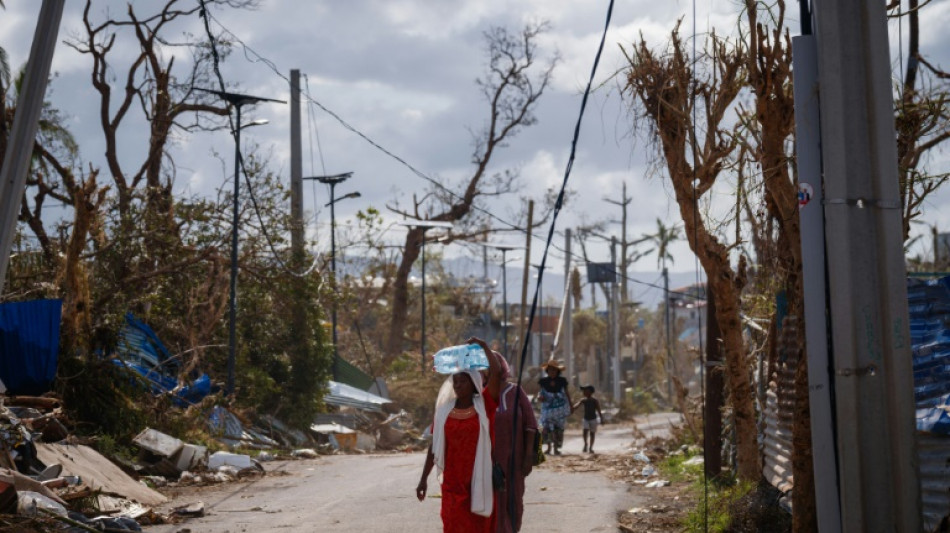
Devastated Mayotte battles to recover from cyclone 'steamroller' / Photo: © AFP

 Colombia declares three days mourning for quake victims

 44 lives lost after ferry capsizes on Zimbabwe's Lake Kariba

 WallStreetPR Releases Report on China’s Gold Purchases and African Mining Investment

 Former Chinese premier Zhu Rongji dies aged 97

 Markets steady awaiting US inflation data

 WHO says Trump vaccine shake-up goes against evidence

 Eclipse chasers flock to Spain for 'breathtaking' experience

 'To make the civilians leave': Russia pummels Ukraine's petrol stations

 Japan brushes off Australian PM's melon drama

 Rod Stewart cancels tour dates after heart surgery
 How Britain's mapmakers track climate change

 Australian delivery drivers win 'world-leading' pay rise

 Meta meets its own 'tobacco' moment in court

 Art or medicine? Japan's cosmetic tattoo artists in limbo
 Rybakina ousts Osaka to book Toronto semi-final against Gauff

 Colombia rescuers find woman alive as quake death toll passes 240
 Charges dropped against Bondi Beach attack hero

 Parched and desperate for rain, Kazakhstan turns to cloud-seeding

 The perfect storm that turbocharged Venezuela's twin quakes

 2.4 million girls banned from Afghan schools since Taliban return: UNESCO
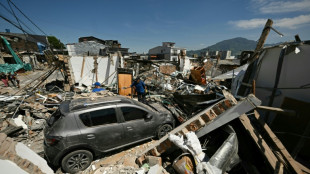 Colombians dig through rubble as quake death toll surpasses 240

 Karbon-X and Core Energy Sign Letter of Intent to Explore Commercial EV Charging Infrastructure in South America

 What to know about the total solar eclipse

 Tentoglou claims fourth Euro long jump title, injured Jacobs falters

 All Blacks knew Nonu would perform solo Haka - coach Rennie

The district of La Vigie on the French overseas territory of Mayotte was until last week a bustling hub of life. Now it no longer exists.
All that remains after Cyclone Chido rammed into Mayotte at the weekend, leaving devastation unprecedented in the last century in its wake, are ravaged hills, piles of tangled sheet metal and wood, and a few bare tree trunks.
"It was like a steamroller that crushed everything," said Nasrine, a teacher who did not give her last name, as she showed people around her now transformed neighbourhood.
Climbing up the hill clutching an umbrella to protect her from the sun, the young woman stopped in horror.
"We're not supposed to see the sea from here -- before, the vegetation covered the whole view," she said.
Nasrine lived in one of the few concrete buildings in the district around Pamandzi, a town close to Mayotte's main airport on the island of Petite Terre, just east of the main island of the Mayotte archipelago.
Her house survived the cyclone. But a little further on, Touharati Ali Moudou lost everything.
"The wind knocked down the house," said the mother in her 30s, who recently arrived from the Comoros to the north from where many immigrants head to Mayotte in search of a better life.
Before the cyclone hit, she had been told that she could find shelter in a nearby gymnasium but, she said, "there were a lot of people, and my father is very old".
So they stayed home.
In the end, they were lucky: only two people were injured among her family and nearby neighbours, including a man whose head was slashed by a piece of metal blown by the wind.
- Community spirit -
Everyone, from Mayotte locals to officials far away in Paris, knows that the official toll of 22 dead risks rising exponentially.
"What I fear is that the toll will be far too high," French Interior Minister Bruno Retailleau, who visited Mayotte on Monday, told BFMTV, describing the damage as "colossal".
Communication is almost non-existent. Nobody has television anymore. The mobile network and internet are at best patchy, at worst non-existent. Only the radio can sometimes give snippets of information.
With much of the population living in shanty towns in informal dwellings protected only by sheet metal roofs, Chido encountered few obstacles.
But a ray of hope comes from the sense of community as people team up to clear the area and return to a semblance of normal life.
In three days, the landscape of desolation has already changed.
"It looks good compared to Saturday," Nasrine said.
Residents of the neighbourhood worked to clear the roads and remove most of the electrical cables on the ground, defying the authorities' instructions for caution, she said.
The assistant principal of a middle school in Pamandzi, Morgane Renard, inspected the damage.
The shock caused by Chido was clear in her voice, which choked when talking about the cyclone: the first gust of wind, the slight lull and then the second "colossal" gust of wind.
"Even those who thought they were safe did not imagine to what extent the violence of the wind could devastate everything," she said, acknowledging she was one of the lucky ones.
Apart from two trees that fell on her family house, it is intact.
"Sharing is the key word at the moment," said Nasrine.
In the street, neighbours meet to cook with wood on makeshift equipment. Abeta, a 17-year-old boy, improvised a system with a water bottle cut in half to collect water drop by drop from a leaking pipe.
- Reconstruction -
Touharati Ali Moudou showed a pile of mattresses, blankets and a few belongings saved from the disaster. She has already put men to work to create a new dwelling and on a roughly flat piece of land posts have already been raised.
All over Mayotte, informal settlements that house an estimated 100,000 of the 300,000 officially registered inhabitants have been destroyed.
Reconstruction will be daunting. According to Retailleau, only 10 percent of Mayotte's inhabitants had insurance.
Kaweni, the largest shantytown in France, on the outskirts of the capital Mamoudzou on Mayotte's main island, is one of the most affected.
The sound of hammers hitting sheet metal reverberates across the neighbourhood as locals rush to rebuild homes before the rainy season arrives.
"It's the new sound of Mamoudzou," said a law student who came to the capital where the network is more stable to recharge his phone and give news to his parents who "thought he was dead".
O.Lorenz--BTB