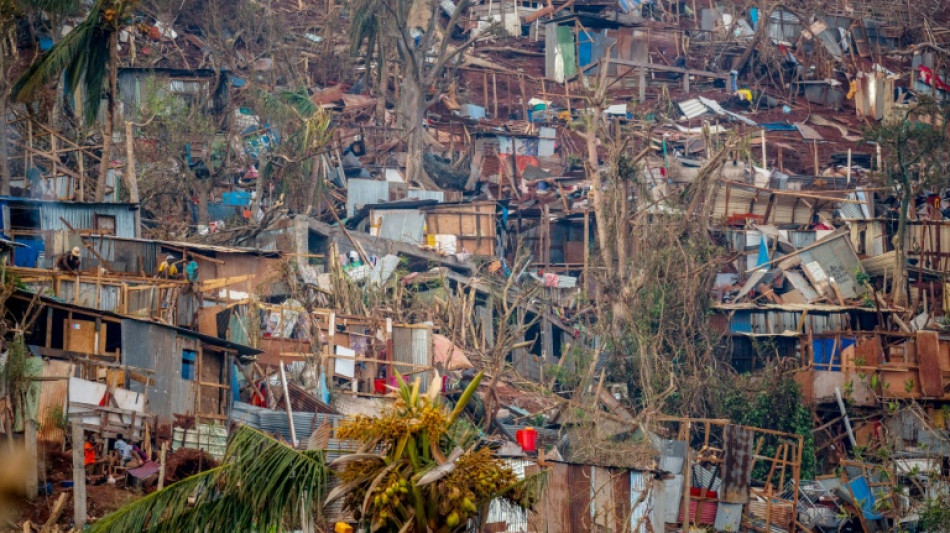
Climate change made Cyclone Chido stronger: scientists / Photo: © AFP

 Colombia declares three days mourning for quake victims

 44 lives lost after ferry capsizes on Zimbabwe's Lake Kariba

 WallStreetPR Releases Report on China’s Gold Purchases and African Mining Investment
 Former Chinese premier Zhu Rongji dies aged 97
 Markets steady awaiting US inflation data

 WHO says Trump vaccine shake-up goes against evidence

 Eclipse chasers flock to Spain for 'breathtaking' experience

 'To make the civilians leave': Russia pummels Ukraine's petrol stations

 Japan brushes off Australian PM's melon drama

 Rod Stewart cancels tour dates after heart surgery

 How Britain's mapmakers track climate change

 Australian delivery drivers win 'world-leading' pay rise

 Meta meets its own 'tobacco' moment in court

 Art or medicine? Japan's cosmetic tattoo artists in limbo

 Rybakina ousts Osaka to book Toronto semi-final against Gauff

 Colombia rescuers find woman alive as quake death toll passes 240

 Charges dropped against Bondi Beach attack hero

 Parched and desperate for rain, Kazakhstan turns to cloud-seeding

 The perfect storm that turbocharged Venezuela's twin quakes

 2.4 million girls banned from Afghan schools since Taliban return: UNESCO
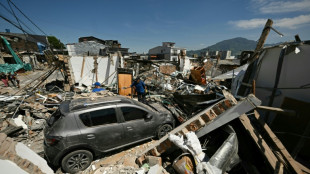 Colombians dig through rubble as quake death toll surpasses 240

 Karbon-X and Core Energy Sign Letter of Intent to Explore Commercial EV Charging Infrastructure in South America

 What to know about the total solar eclipse

 Tentoglou claims fourth Euro long jump title, injured Jacobs falters

 All Blacks knew Nonu would perform solo Haka - coach Rennie

Climate change intensified Cyclone Chido as it barrelled toward the Indian Ocean archipelago of Mayotte, said a preliminary study by scientists studying the link between global warming and tropical storms.
The assessment by Imperial College London also estimated that cyclones of Chido's strength were 40 percent more likely in the warmer climate of 2024 compared to pre-industrial times.
Chido was the most damaging cyclone to hit Mayotte in 90 years when it made landfall Saturday, flattening tin-roof shacks in France's poorest overseas territory.
Classified as a category four storm -- the second highest on a five-point scale -- Cyclone Chido crossed the small archipelago, where about one-third of the population live in makeshift housing.
The true scale of the disaster is still unknown but officials fear the death toll could eventually rise into the thousands.
Scientists at Imperial College London assessed what role global warming might have played in whipping up the wind speed and ferocity of tropical storms like Chido.
To overcome a scarcity of real-world data, they used an advanced computer model that runs millions of simulated tropical cyclones to infer what might be attributed to recent warming.
They concluded that wind speeds in the region near where Chido made landfall had increased by 3 miles per second compared to the climate before humanity began burning fossil fuels.
Climate change "uplifted the intensity of a tropical cyclone like 'Chido' from a Category 3 to Category 4", the study said.
In the absence of conclusive studies, France's weather service has stopped short of attributing Chido's intensity to global warming, but says warmer oceans driven by human-caused climate change have made storms more violent.
Mayotte took the cyclone's full force and Meteo-France said Chido's impact was "above all the consequence of its trajectory" over the island.
The climate is nearly 1.3 degrees Celsius warmer compared to the pre-industrial era, and scientists say this extra heat in the atmosphere and oceans is stoking more frequent and volatile weather events.
Warmer air can hold more water vapour, and warmer oceans cause greater evaporation, supercharging the conditions upon which tropical storms feed.
F.Müller--BTB