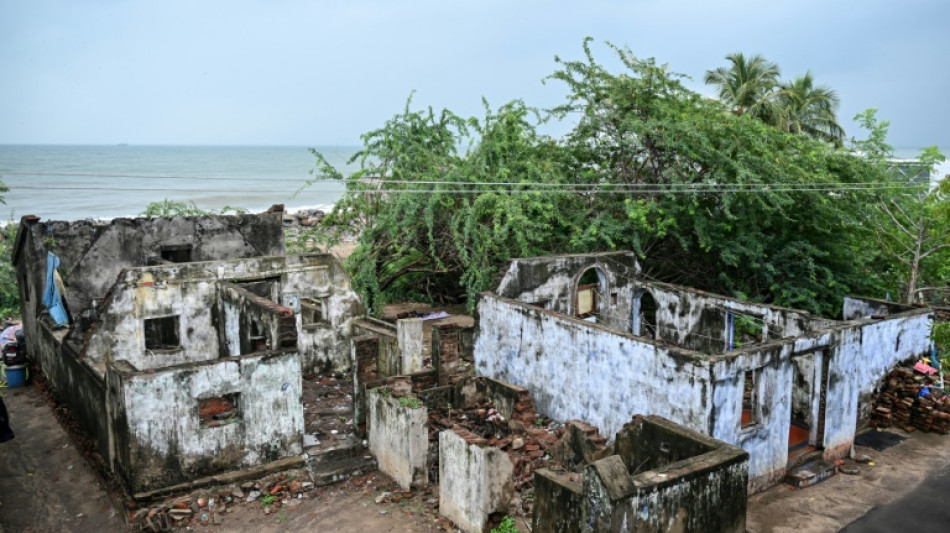
Storm fears overshadow India coast decades after tsunami / Photo: © AFP

 Colombia declares three days mourning for quake victims

 44 lives lost after ferry capsizes on Zimbabwe's Lake Kariba

 WallStreetPR Releases Report on China’s Gold Purchases and African Mining Investment

 Former Chinese premier Zhu Rongji dies aged 97

 Markets steady awaiting US inflation data

 WHO says Trump vaccine shake-up goes against evidence

 Eclipse chasers flock to Spain for 'breathtaking' experience

 'To make the civilians leave': Russia pummels Ukraine's petrol stations

 Japan brushes off Australian PM's melon drama

 Rod Stewart cancels tour dates after heart surgery
 How Britain's mapmakers track climate change

 Australian delivery drivers win 'world-leading' pay rise

 Meta meets its own 'tobacco' moment in court

 Art or medicine? Japan's cosmetic tattoo artists in limbo
 Rybakina ousts Osaka to book Toronto semi-final against Gauff

 Colombia rescuers find woman alive as quake death toll passes 240
 Charges dropped against Bondi Beach attack hero
 Parched and desperate for rain, Kazakhstan turns to cloud-seeding
 The perfect storm that turbocharged Venezuela's twin quakes

 2.4 million girls banned from Afghan schools since Taliban return: UNESCO
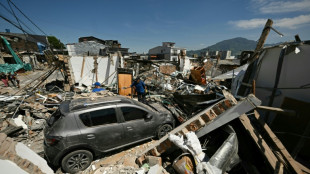 Colombians dig through rubble as quake death toll surpasses 240

 Karbon-X and Core Energy Sign Letter of Intent to Explore Commercial EV Charging Infrastructure in South America

 What to know about the total solar eclipse

 Tentoglou claims fourth Euro long jump title, injured Jacobs falters

 All Blacks knew Nonu would perform solo Haka - coach Rennie

The deadly tsunami that swamped India's southern coast two decades ago was a one-off disaster, but storms that are growing ever more intense spark panic each time howling gales whip up waves.
Maragathavel Lakshmi shudders when she hears lashing rains or winds, recalling how her daughter was swept away when the 2004 tsunami, triggered by a huge earthquake off Indonesia, crashed onshore almost without warning.
"Weather alerts have made life easier, but the fear of what a heavy rain or strong wind might bring is still there," 45-year-old Lakshmi said.
More than 220,000 people were killed as the devastating waves hit shorelines around the Indian Ocean, including 16,389 in India, according to the international disaster database EM-DAT.
Fear of the weather is based on a very real threat -- and the risks are increasing.
Dangerous cyclones, the equivalent of hurricanes in the North Atlantic or typhoons in the northwestern Pacific, are an annual menace.
Better forecasting and more effective evacuation planning have dramatically reduced death tolls, but scientists say human-driven climate change is intensifying their power.
"Summers are very harsh now and rains are heavier," Lakshmi said, saying weather alerts sent her anxiety soaring.
A warmer atmosphere holds more water, meaning rains are heavier.
"Strong winds scare us," said her husband Maragathavel, who like many in the region goes by only one name.
"Every time it rains heavily, water (floods) our area," the 49-year-old fisherman added. "It seems on those days that the sea has still not left us."
- 'Very afraid' -
The December 26, 2004 disaster was not caused by climate change but by a 9.1 magnitude earthquake that struck off Indonesia's Sumatra.
Hours later, Lakshmi heard a loud rumble and then saw enormous waves -- rising as high as 40 metres (130 feet) -- approaching her neighbourhood on the shore in Akkaraipettai, their village in Tamil Nadu state.
Lakshmi showed a photograph of her daughter Yashoda, who her father had been looking after for the day next door when the waves struck.
"She would have been 22 years old now," Lakshmi said tearfully.
The 45-year-old remembers people getting swept away or holding on to whatever they could.
"Some people were naked or barely had any clothes left on them," she said.
The tsunami also hit the chain of Andaman and Nicobar islands, where at least 4,000 people were killed. The victims included 109 Indian air force pilots, crew and around 40 of their relatives.
At least 870,000 people were left homeless in India.
Many, like Lakshmi, were moved to new settlements inland.
Their neighbour, fisherman P. Mohan, 46, said weather alerts still gave him shivers of fear.
"If I see some warning about the weather, I do not even step out of the house," he said.
"Until the rains or cyclone -- whatever is the warning -- comes and goes away, I am very afraid."
- 'Cannot control nature' -
Mohan had a rod put into his leg after being injured in the tsunami, which also killed his mother.
Neighbours had last seen her sitting beside the sea when the waves hit.
He could not identify her from the "swollen and disfigured" corpses laid out for identification in the days after the tsunami.
"Was she buried along with other people who could not be identified? Is her body still in the sea?" he asked. "I do not know."
A few friends told him that they might have seen his mother's body amid other unidentified corpses.
It took him a decade to fully accept her loss and hold symbolic final rites.
A seawall made of concrete and bricks of homes destroyed by the tsunami now divides land from water.
Villagers hold prayers each day at a temple to a Hindu deity believed to protect them from the sea.
But Mohan said he now simply accepted his fate.
"God cannot control nature," he said. "What has to come, will come."
F.Pavlenko--BTB