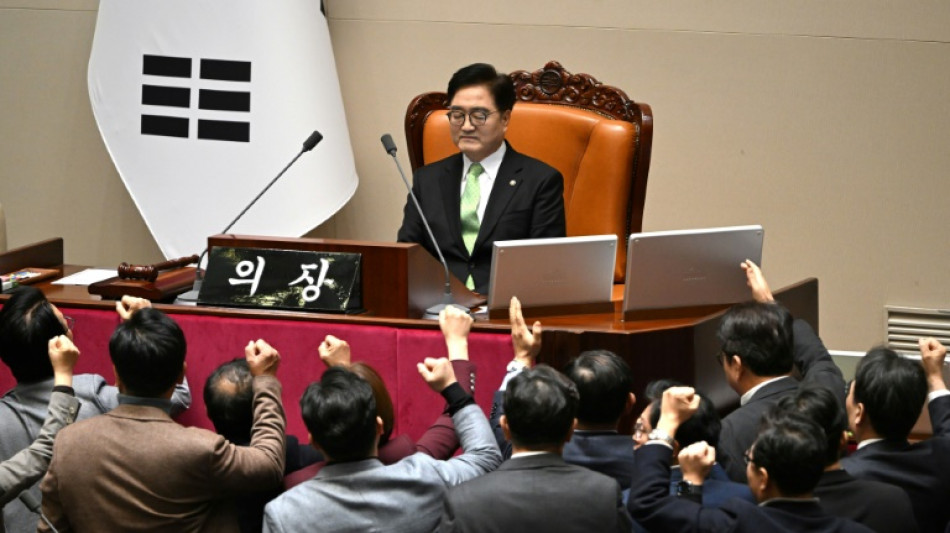
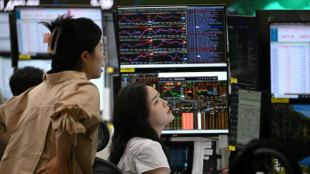
Political turmoil shakes South Korea's economy / Photo: © AFP

 How Britain's mapmakers track climate change
 Australian delivery drivers win 'world-leading' pay rise

 Meta meets its own 'tobacco' moment in court

 Art or medicine? Japan's cosmetic tattoo artists in limbo

 Rybakina ousts Osaka to book Toronto semi-final against Gauff
 Colombia rescuers find woman alive as quake death toll passes 240

 Charges dropped against Bondi Beach attack hero
 Parched and desperate for rain, Kazakhstan turns to cloud-seeding
 The perfect storm that turbocharged Venezuela's twin quakes
 2.4 million girls banned from Afghan schools since Taliban return: UNESCO
 Colombians dig through rubble as quake death toll surpasses 240

 New Zealand's ruling party meets to decide PM Luxon's fate

 Total solar eclipse to spellbind Europe

 Jodar, Nakashima to make Masters semis debuts in Montreal
 Chilean veteran Sanchez signs with MLS club Montreal

 Cristiano Ronaldo marries long-term partner Georgina Rodriguez

 Oil prices higher, stocks mixed ahead of inflation report
 Jacobs into 100m final with eye on third title
 Eight-try New Zealand cruise to tour victory over Sharks
 Trump's secret plane swap triggers questions and confusion
 California calls Paramount's threat to leave state 'blackmail'

 PSG 'want to win everything', says Luis Enrique
 Barred from elections, Russia's anti-war party vows to fight on
 Jaissle states Newcastle ambition but urges patience
 NBA star Cooper Flagg trading card a slam dunk for lucky buyer
After South Korea's president and his replacement were both deposed over a failed bid to impose martial law, deepening political turmoil is threatening the country's currency and shaking confidence in its economy.
The won, which plunged Friday to its lowest level against the dollar since 2009, has been in near-constant decline since President Yoon Suk Yeol's attempt to scrap civilian rule in early December.
Business and consumer confidence in Asia's fourth-largest economy have also taken their biggest hit since the start of the Covid-19 pandemic, according to figures released by the Bank of Korea.
Lawmakers impeached Yoon in mid-December on charges of insurrection, and on Friday they impeached his successor, acting president and prime minister Han Duck-soo, arguing that he refused demands to complete Yoon's removal from office and bring him to justice.
That thrust Finance Minister Choi Sang-mok into the additional roles of acting president and prime minister.
Choi has pledged to do all he can to end "this period of turmoil" and resolve the political crisis gripping the country.
- Constitutional question –
At the heart of the stalemate is the Constitutional Court, which will decide whether to uphold parliament's decision to impeach Yoon.
It must do so by a two-thirds majority, however. And because three of the court's nine seats are currently vacant, a unanimous vote is required to confirm the suspended president's removal.
Otherwise, Yoon will be automatically returned to office.
Lawmakers on Thursday nominated three judges to fill the vacant seats, but acting president Han refused to approve them, precipitating his own impeachment.
After an acrimonious day in which lawmakers from Yoon's party erupted in protest, the country's newest acting president sought to project calm.
"Although we are facing unexpected challenges once again, we are confident that our robust and resilient economic system will ensure rapid stabilisation," Choi said Friday.
The 61-year-old career civil servant has inherited a 2025 budget -- adopted by the opposition alone -- which is 4.1 trillion won ($2.8 billion) less than the government had hoped for.
"There are already signs the crisis is having an impact on the economy," Gareth Leather of Capital Economics wrote in a note to clients, citing the dip in consumer and business confidence.
"The crisis is unfolding against a backdrop of a struggling economy," he added, with GDP growth expected to be just two percent this year, weighed down by a global slowdown in demand for semiconductors.
"Longer term, political polarisation and resulting uncertainty could hold back investment in Korea," Leather wrote, citing the example of Thailand, another ultra-polarised country whose economy has stagnated since a coup in 2014.
- Democratic resilience? -
But other economists noted that the South Korean economy has so far weathered the chaos well.
As early as December 4, the day after Yoon declared martial law following a budget tussle with the opposition, the central bank promised to inject sufficient liquidity to stabilise the markets, and the Kospi Index has lost less than four percent since the start of the crisis.
"Like everyone, I was surprised when Yoon took those crazy measures," Park Sang-in, a professor of economics at Seoul National University, told AFP. "But there was a resilience of democracy."
"We come from being an underdeveloped country to one of the world's most dynamic economies in very few years, and Yoon Suk Yeol is a side effect of the growth," he added.
"Korean society was mature enough to counter his crazy actions."
E.Schubert--BTB