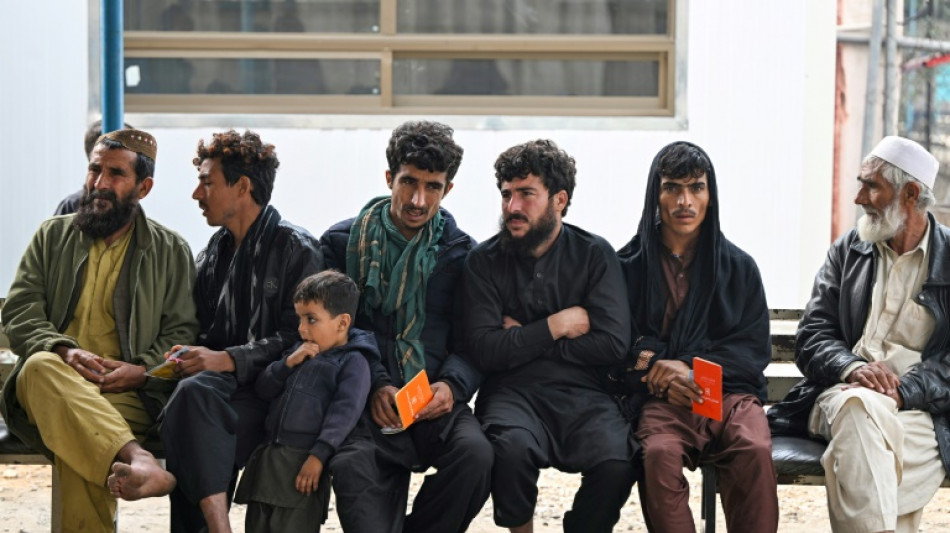
Afghan refugees suffer 'like prisoners' in Pakistan crackdown / Photo: © AFP/File

 How Britain's mapmakers track climate change

 Australian delivery drivers win 'world-leading' pay rise

 Meta meets its own 'tobacco' moment in court

 Art or medicine? Japan's cosmetic tattoo artists in limbo
 Rybakina ousts Osaka to book Toronto semi-final against Gauff
 Colombia rescuers find woman alive as quake death toll passes 240
 Charges dropped against Bondi Beach attack hero

 Parched and desperate for rain, Kazakhstan turns to cloud-seeding
 The perfect storm that turbocharged Venezuela's twin quakes
 2.4 million girls banned from Afghan schools since Taliban return: UNESCO
 Colombians dig through rubble as quake death toll surpasses 240

 New Zealand's ruling party meets to decide PM Luxon's fate

 Total solar eclipse to spellbind Europe

 Jodar, Nakashima to make Masters semis debuts in Montreal

 Chilean veteran Sanchez signs with MLS club Montreal

 Cristiano Ronaldo marries long-term partner Georgina Rodriguez

 Oil prices higher, stocks mixed ahead of inflation report
 Jacobs into 100m final with eye on third title
 Eight-try New Zealand cruise to tour victory over Sharks

 Trump's secret plane swap triggers questions and confusion
 California calls Paramount's threat to leave state 'blackmail'

 PSG 'want to win everything', says Luis Enrique
 Barred from elections, Russia's anti-war party vows to fight on

 Jaissle states Newcastle ambition but urges patience

 NBA star Cooper Flagg trading card a slam dunk for lucky buyer
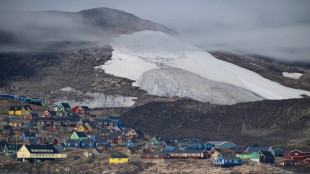
The space in which refugee Shaharzad has to live has shrunk to the small courtyard of a guesthouse in Pakistan's capital, reminiscent of her life under Taliban rule in Afghanistan.
She fears being swept up in a wave of anti-Afghan sentiment, including reports of harassment, extortion and arrests by Pakistan authorities who have cracked down on mainly undocumented families living there.
"For Afghans, the situation here is terrible and the behaviour of the Pakistani police is like that of the Taliban," said Shaharzad, who lives in constant fear of being deported with her children.
Her son was recently detained while walking in a park, when "the police asked him for money instead of documents", she said.
The government cited spiking militant attacks claimed by Tehreek-e-Taliban Pakistan, also known as the Pakistani Taliban, for a campaign last summer that evicted some 750,000 Afghans, mostly undocumented.
In recent months, however, Islamabad and the police have also started alleging Afghan involvement in opposition unrest over the imprisonment of former prime minister Imran Khan.
- 'Scapegoats' -
Afghans who are waiting to be relocated to Western nations say they are being caught up in the political tensions.
"After coming here, we feel like we are out of the frying pan and into the fire," said Afghan Mustafa, who is waiting with his family for visas to the United States.
The 31-year-old said his family cannot go out freely to buy groceries and medicine for fear of arrest.
"If they know you are an Afghan, whether you have the visa or not, they will arrest you or will extort you," he said.
More than three years after the Afghan Taliban returned to power in Kabul, the United States and European countries have yet to reopen their embassies there, forcing Afghans to complete their applications from within Pakistan.
Shaharzad was told to travel to Pakistan by a European nation that said it would process her onward visa from the capital Islamabad.
Pakistan's Foreign Ministry called on Western nations in July to expedite the relocation of more than 44,000 Afghans living in Pakistan and awaiting relocation to the United States, Australia, Canada, Germany and Britain.
Millions of Afghans have travelled to Pakistan over the past four decades, fleeing successive conflicts including the Soviet invasion, a civil war and the post-9/11 US-led occupation.
Some 600,000 Afghans have fled to Pakistan since the Taliban government took over again in August 2021 and implemented their austere version of Islamic law.
According to UNHCR, Pakistan currently hosts some 1.5 million Afghan refugees and asylum-seekers, alongside more than 1.5 million Afghans of different legal statuses.
A campaign to deport undocumented Afghans was launched as political ties between the neighbouring governments frayed and Pakistan's economic and security woes worsened.
A wave of political protests in the capital in support of jailed former premier Khan last month saw a new spike of about 30 arrests of Afghans, according to officials.
Khan's heartland is in the ethnic Pashtun belt of Khyber Pakhtunkhwa, which shares close cultural and linguistic ties with Afghan Pashtuns.
Muhammad Khan, an Afghan community leader in Islamabad, said the protests were used as a cover to intimidate Afghans.
Clashing with the official account, he claimed close to 200 Afghans were arrested over several days, including during raids on guesthouses.
"Afghan refugees are the sacrificial lambs for Pakistan's domestic problems and the tensions between the governments in Islamabad and Kabul," Khan said, denying the involvement of Afghans in Pakistani political activities.
Pakistan's interior ministry did not respond to a request for comment.
- 'Free licence' to extort -
Imaan Mazari, a human rights lawyer who defends arrested Afghans in Islamabad courts, said the protests have led to a spike in "racial profiling (of Afghans) in Islamabad and Rawalpindi", just south of the capital.
The police have been given "a completely free license to pick up whoever they want, extort them (and) exploit them".
The provincial Chief Minister Ali Amin Gandapur, who led the recent protests, said hostility towards Afghans has spread to Pakistani Pashtuns.
In a letter to Prime Minister Shahbaz Sharif, he accused the police of the "arbitrary rounding up" of "Pashtun labourers in Islamabad" and warned that "such actions risk fostering a sense of alienation and exclusion among communities".
The Human Rights Commission of Pakistan said it was "deeply concerned by the alleged ethnic profiling of ordinary Pashtun citizens" and called on Islamabad police to refrain from actions "that create divisions among various communities living in the country".
The Afghan embassy in Islamabad has denied any involvement by Afghans in political activities in Pakistan.
"This policy (of blaming the Afghans) brings no benefit to Pakistan and will only deepen the mistrust between the two neighbouring countries," it said in a statement.
For Afghans in limbo as they wait to be relocated, life has become similar to what they left behind in Afghanistan.
"We have become like prisoners, we go out very rarely and only when we really have to," Mustafa said.
O.Bulka--BTB