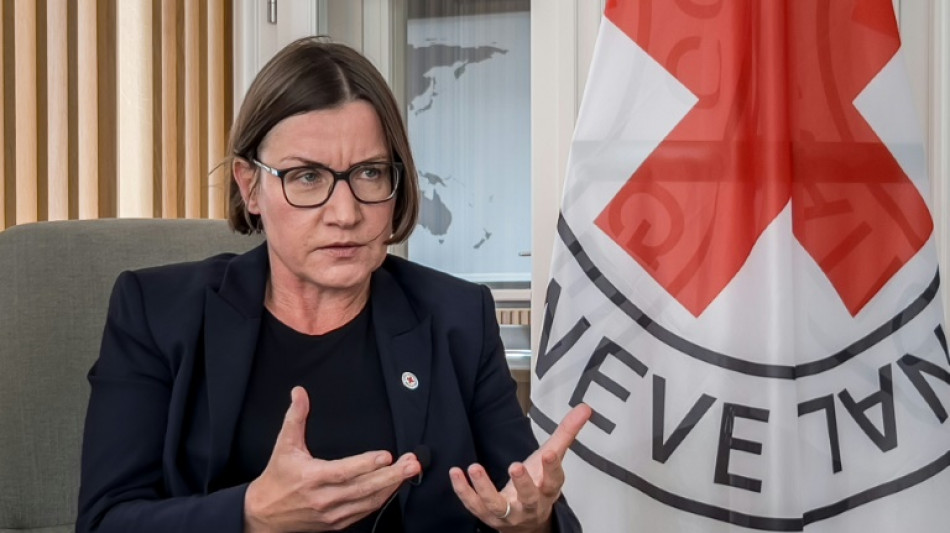
Red Cross says determining fate of Syria's missing 'huge challenge' / Photo: © AFP/File

 Meta meets its own 'tobacco' moment in court

 Art or medicine? Japan's cosmetic tattoo artists in limbo
 Rybakina ousts Osaka to book Toronto semi-final against Gauff

 Colombia rescuers find woman alive as quake death toll passes 240
 Charges dropped against Bondi Beach attack hero

 Parched and desperate for rain, Kazakhstan turns to cloud-seeding
 The perfect storm that turbocharged Venezuela's twin quakes

 2.4 million girls banned from Afghan schools since Taliban return: UNESCO
 Colombians dig through rubble as quake death toll surpasses 240

 New Zealand's ruling party meets to decide PM Luxon's fate

 Total solar eclipse to spellbind Europe

 Jodar, Nakashima to make Masters semis debuts in Montreal

 Chilean veteran Sanchez signs with MLS club Montreal

 Cristiano Ronaldo marries long-term partner Georgina Rodriguez

 Oil prices higher, stocks mixed ahead of inflation report
 Jacobs into 100m final with eye on third title
 Eight-try New Zealand cruise to tour victory over Sharks

 Trump's secret plane swap triggers questions and confusion
 California calls Paramount's threat to leave state 'blackmail'

 PSG 'want to win everything', says Luis Enrique

 Barred from elections, Russia's anti-war party vows to fight on
 Jaissle states Newcastle ambition but urges patience

 NBA star Cooper Flagg trading card a slam dunk for lucky buyer

 ForumPay Expands Payment Infrastructure with New Card and Bank Transfer Acceptance Solution

 Oil prices higher, stocks flat ahead of inflation report

Determining the fate of those who went missing during Syria's civil war will be a massive task likely to take years, the president of the International Committee for the Red Cross said.
"Identifying the missing and informing the families about their fate is going to be a huge challenge," ICRC president Mirjana Spoljaric told AFP in an interview.
The fate of tens of thousands of detainees and missing people remains one of the most harrowing legacies of the conflict that started in 2011 when president Bashar al-Assad's forces brutally repressed anti-government protests.
Many are believed to have been buried in mass graves after being tortured in Syria's jails during a war that has killed more than half a million people.
Thousands have been released since Islamist-led rebels ousted Assad last month, but many Syrians are still looking for traces of relatives and friends who went missing.
Spoljaric said the ICRC was working with the caretaker authorities, non-governmental organisations and the Syrian Red Crescent to collect data to give families answers as soon as possible.
But "the task is enormous," she said in the interview late Saturday.
"It will take years to get clarity and to be able to inform everybody concerned. And there will be cases we will never (be able) to identify," she added.
"Until recently, we've been following up on 35,000 cases, and since we established a new hotline in December, we are adding another 8,000 requests," Spoljaric said.
"But that is just potentially a portion of the numbers."
Spoljaric said the ICRC was offering the new authorities to "work with us to build the necessary institution and institutional capacities to manage the available data and to protect and gather what... needs to be collected".
Human Rights Watch last month urged the new Syrian authorities to "secure, collect and safeguard evidence, including from mass grave sites and government records... that will be vital in future criminal trials".
The rights group also called for cooperation with the ICRC, which could "provide critical expertise" to help safeguard the records and clarify the fate of missing people.
Spoljaric said: "We cannot exclude that data is going to be lost. But we need to work quickly to preserve what exists and to store it centrally to be able to follow up on the individual cases."
More than half a century of brutal rule by the Assad family came to a sudden end in early December after a rapid rebel offensive swept across Syria and took the capital Damascus.
The Syrian Observatory for Human Rights, a Britain-based war monitor, says more than 100,000 people have died in detention from torture or dire health conditions across Syria since 2011.
C.Meier--BTB