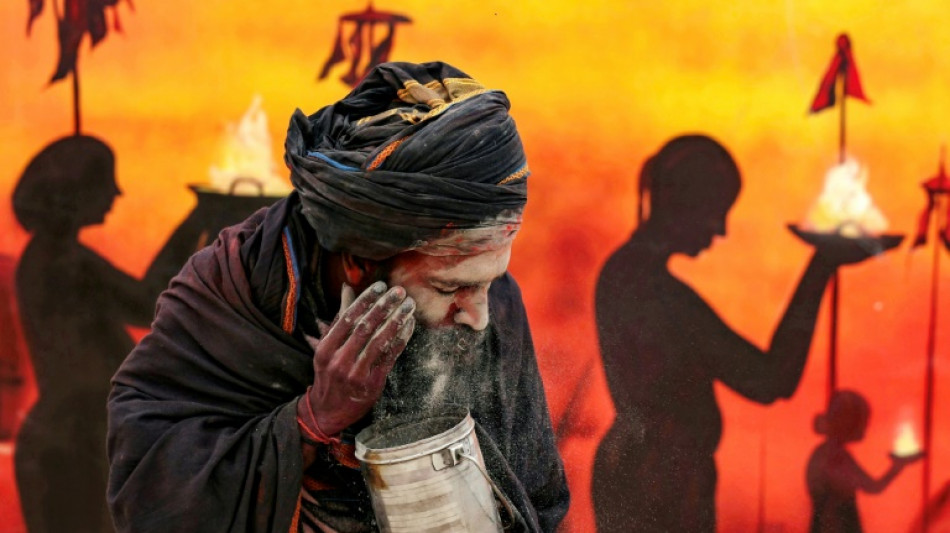
India readies for mammoth Hindu festival of 400 million pilgrims / Photo: © AFP/File

 Meta meets its own 'tobacco' moment in court

 Art or medicine? Japan's cosmetic tattoo artists in limbo
 Rybakina ousts Osaka to book Toronto semi-final against Gauff

 Colombia rescuers find woman alive as quake death toll passes 240

 Charges dropped against Bondi Beach attack hero

 Parched and desperate for rain, Kazakhstan turns to cloud-seeding
 The perfect storm that turbocharged Venezuela's twin quakes

 2.4 million girls banned from Afghan schools since Taliban return: UNESCO
 Colombians dig through rubble as quake death toll surpasses 240

 New Zealand's ruling party meets to decide PM Luxon's fate
 Total solar eclipse to spellbind Europe

 Jodar, Nakashima to make Masters semis debuts in Montreal

 Chilean veteran Sanchez signs with MLS club Montreal

 Cristiano Ronaldo marries long-term partner Georgina Rodriguez

 Oil prices higher, stocks mixed ahead of inflation report
 Jacobs into 100m final with eye on third title

 Eight-try New Zealand cruise to tour victory over Sharks

 Trump's secret plane swap triggers questions and confusion
 California calls Paramount's threat to leave state 'blackmail'

 PSG 'want to win everything', says Luis Enrique

 Barred from elections, Russia's anti-war party vows to fight on

 Jaissle states Newcastle ambition but urges patience

 NBA star Cooper Flagg trading card a slam dunk for lucky buyer
 ForumPay Expands Payment Infrastructure with New Card and Bank Transfer Acceptance Solution
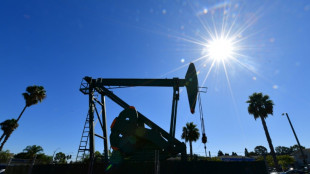 Oil prices higher, stocks flat ahead of inflation report

The world's largest gathering of humanity begins in India on Monday with the opening of the Kumbh Mela, a six-week Hindu festival organisers expect to attract up to 400 million pilgrims.
Organisers say the scale of preparations for the Kumbh Mela is akin to setting up a temporary country from scratch -- in this case, one more populous than the United States and Canada combined.
"Some 350 to 400 million devotees are going to visit the mela, so you can imagine the scale of preparations," festival spokesman Vivek Chaturvedi said.
Around 150,000 toilets have been built and a network of community kitchens can each feed up to 50,000 people at the same time.
Another 68,000 LED light poles have been erected for a gathering so large that its bright lights can be seen from space.
Authorities and the police have also set up a network of "lost and found" centres and an accompanying phone app to help pilgrims lost in the immense crowd "to reunite with their families".
India is the world's most populous nation, with 1.4 billion people, and so is used to large crowds.
The last celebration at the site, the "ardh" or half Kumbh Mela in 2019, attracted 240 million pilgrims, according to India's government.
That compares to an estimated 1.8 million Muslims who take part in the annual hajj pilgrimage to Mecca in Saudi Arabia.
The government calls the Kumbh Mela a "vibrant blend of cultures, traditions, and languages, showcasing a 'mini-India' where millions come together without formal invitations".
- 'Plunge in the river' -
The Kumbh Mela, or "festival of the sacred pitcher", is held at the confluence of the Ganges, the Yamuna and the mythical Sarasvati rivers.
Its emblematic ritual is mass bathing in the holy rivers, with the dawn charge often led by naked, ash-smeared holy men, many of whom will have walked for weeks to reach the site.
Hindus believe that those who immerse themselves in the waters cleanse themselves of sin, breaking free from the cycle of rebirth and ultimately attaining salvation.
Many pilgrims embrace a life of simplicity during the festival -- vowing non-violence, celibacy and the offering of alms -- and focusing on prayer and meditation.
Santosh Mishra, 55, from a village near the holy Hindu city of Varanasi, said he and his neighbours were "super excited" for the fair to begin.
"The whole village will be going," Mishra told AFP. "It's a great feeling when everyone takes a plunge in the river together."
The festival is rooted in Hindu mythology, a battle between deities and demons for control of a pitcher containing the nectar of immortality.
Four drops of nectar were spilt during the battle and one landed at Prayagraj, where the Kumbh Mela is held every 12 years.
The other three fell on the cities of Nashik, Ujjain and Haridwar, where smaller festivals are held in intervening years.
The exact date of each celebration is based on the astrological positions of the Sun, Moon and Jupiter.
- 'Central spiritual role' -
Ceremonies include the visually spectacular "aarti", when vast numbers of priests perform rituals holding flickering lamps.
Devotees also float a sea of twinkling prayer lamps, crafted from baked flour, which glow with burning mustard oil or clarified butter.
Monday marks the start of festivities, coinciding with the full moon, with celebrations culminating on February 26, the final holy bathing day.
The mythic battle that undergirds the Kumbh Mela celebrations is mentioned in the Rig Veda, a sacred Hindu text written more than 3,000 years ago.
The festival was also mentioned by Chinese Buddhist monk and scholar Hiuen Tsang, who attended in the seventh century.
UNESCO lists the Kumbh Mela as part of the Intangible Cultural Heritage of Humanity.
It describes it as "the largest peaceful congregation of pilgrims on earth", saying it "plays a central spiritual role in the country, exerting a mesmeric influence on ordinary Indians".
J.Bergmann--BTB