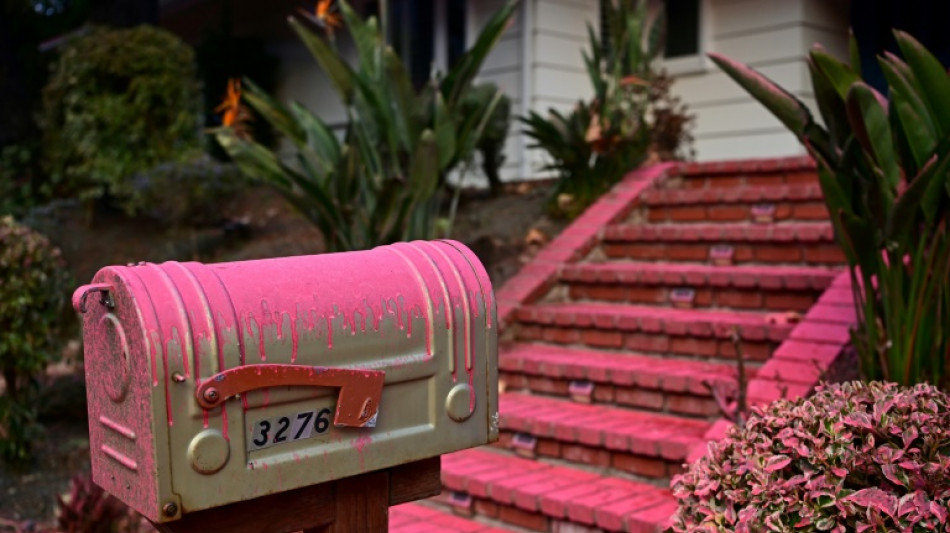
What is the pink stuff coating fire-ravaged Los Angeles? / Photo: © AFP

 Rybakina ousts Osaka to book Toronto semi-final against Gauff

 Colombia rescuers find woman alive as quake death toll passes 240

 Charges dropped against Bondi Beach attack hero

 Parched and desperate for rain, Kazakhstan turns to cloud-seeding

 The perfect storm that turbocharged Venezuela's twin quakes

 2.4 million girls banned from Afghan schools since Taliban return: UNESCO

 Colombians dig through rubble as quake death toll surpasses 240

 New Zealand's ruling party meets to decide PM Luxon's fate

 Total solar eclipse to spellbind Europe

 Jodar, Nakashima to make Masters semis debuts in Montreal

 Chilean veteran Sanchez signs with MLS club Montreal

 Cristiano Ronaldo marries long-term partner Georgina Rodriguez

 Oil prices higher, stocks mixed ahead of inflation report

 Jacobs into 100m final with eye on third title
 Eight-try New Zealand cruise to tour victory over Sharks

 Trump's secret plane swap triggers questions and confusion
 California calls Paramount's threat to leave state 'blackmail'

 PSG 'want to win everything', says Luis Enrique

 Barred from elections, Russia's anti-war party vows to fight on

 Jaissle states Newcastle ambition but urges patience
 NBA star Cooper Flagg trading card a slam dunk for lucky buyer
 ForumPay Expands Payment Infrastructure with New Card and Bank Transfer Acceptance Solution

 Oil prices higher, stocks flat ahead of inflation report

 Orban-critic ex-judge becomes Hungary president after predecessor ouster

 US rights groups sue Trump over ICC sanctions

Above the roaring fires devastating parts of Los Angeles is an incongruous sight: air tankers dropping gallons of bright red and Barbie-pink slurry over forest, homes, cars, and anything else that might lie in the blazes' path.
The substance, vivid against the grey smoke and charred landscape, is fire retardant -- much of it a product called Phos-Chek that has been used by the US Forest Service since the 1960s.
"You can see it so easily ... it's amazing stuff," says Jason Colquhoun, a 53-year-old pilot with HeliQwest, a charter helicopter company specializing in putting out fires.
But over the past week it's been dropped on residential neighborhoods at an "unprecedented" scale, says Daniel McCurry, an assistant professor of civil and environmental engineering at the University of Southern California.
That's led to one overwhelming question: how safe is it?
- Fertilizer and rust -
Sold by fire protection equipment supplier Perimeter Solutions, Phos-Check is a mixture of primarily ammonium phosphate -- a common fertilizer -- with additives such as iron oxide -- rust -- to give it color.
Its bright hue helps pilots as they try to ensure overlapping, unbroken lines around the fires, Colquhoun explains.
When pilots drop water from the air, he says, they must search for "the shine and the darkness" to know where to make the next drop. The vivid retardant, however? "So much easier to spot."
The other advantage compared to water: it keeps working, even after the water it is mixed with evaporates, McCurry says.
Thickeners add viscosity and help ensure it doesn't drift off target, adds McCurry, who led recent research into heavy metal content in such retardants.
It comes in a powder and is mixed in -- essentially -- giant paddling pools, before being loaded on to airplanes and helicopters for coordinated drops, Colquhoun says.
He gave an enthusiastic "Oh yeah" when asked by AFP if it works.
McCurry said he has seen photos "where a brush fire burned right up to a Phos-Chek line and then stopped," but expressed some caution.
He cited a former firefighter as telling him that in a high-intensity fire it's "not much use," and said that the high winds which have fanned the fires in Los Angeles may have limited its effectiveness.
- 'Practically non-toxic' -
The Forest Service said it only uses retardants that "meet the Environmental Protection Agency's criteria for being 'practically non-toxic' to mammals, including humans, and aquatic species."
It prohibits drops in waterways and areas that are home to threatened or endangered species -- the only exception being "where human life or public safety is threatened" and the retardant could be "reasonably expected" to stave off that threat, a spokesman told AFP.
But accidents do happen, he said, "whether through wind drift or an inadvertent drop."
The service says it phased out Phos-Chek's older formulation, LC95 -- which McCurry's study showed had high levels of heavy metals that can contaminate drinking water -- nationwide as of December 31.
Now it uses a new, less toxic formulation called MVP-Fx, it says.
The agency's data shows the mixture can cause skin irritation and, if swallowed, can lead to vomiting and nausea, advising medical attention if washing with water does not ease the symptoms.
McCurry says the Forest Service has been successfully sued in the past on environmental grounds, and that Phos-Chek is "likely not harmless to the environment" now.
"On the other hand, the human health impact is still a little unclear," he says.
He says it would take "a lot" of retardant to poison, say, a reservoir.
"However in the last week we've seen it dropped on neighborhoods at an unprecedented scale," he continues, adding that it's more often used further from populated areas, or in lower amounts.
"So, who knows."
B.Shevchenko--BTB