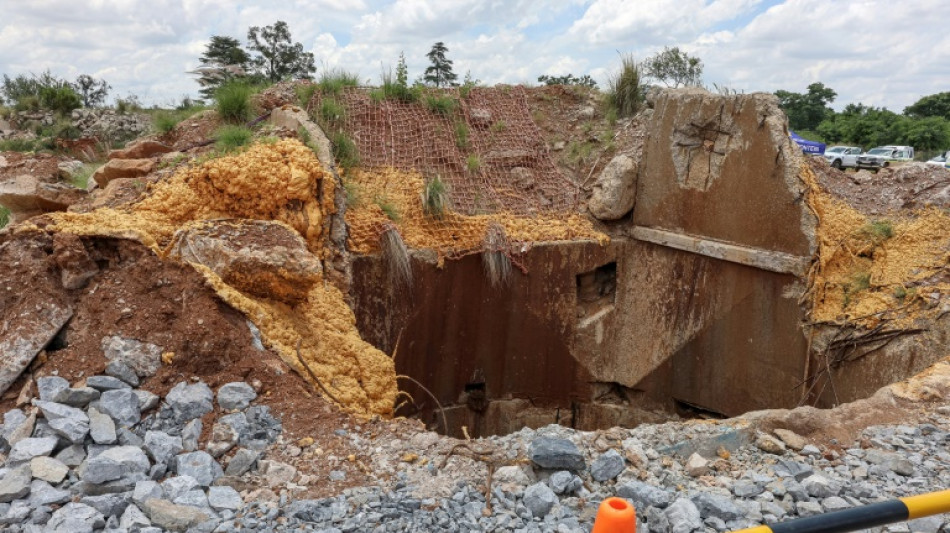
S.Africa rescuers say clearance of clandestine miners now over / Photo: © AFP

 2.4 million girls banned from Afghan schools since Taliban return: UNESCO
 Colombians dig through rubble as quake death toll surpasses 240

 New Zealand's ruling party meets to decide PM Luxon's fate

 Total solar eclipse to spellbind Europe

 Jodar, Nakashima to make Masters semis debuts in Montreal

 Chilean veteran Sanchez signs with MLS club Montreal

 Cristiano Ronaldo marries long-term partner Georgina Rodriguez

 Oil prices higher, stocks mixed ahead of inflation report
 Jacobs into 100m final with eye on third title
 Eight-try New Zealand cruise to tour victory over Sharks

 Trump's secret plane swap triggers questions and confusion
 California calls Paramount's threat to leave state 'blackmail'

 PSG 'want to win everything', says Luis Enrique

 Barred from elections, Russia's anti-war party vows to fight on

 Jaissle states Newcastle ambition but urges patience

 NBA star Cooper Flagg trading card a slam dunk for lucky buyer
 ForumPay Expands Payment Infrastructure with New Card and Bank Transfer Acceptance Solution
 Oil prices higher, stocks flat ahead of inflation report

 Orban-critic ex-judge becomes Hungary president after predecessor ouster
 US rights groups sue Trump over ICC sanctions

 Sphere 3D Corp. (Nasdaq: ANY) Attracts 6.5% Stake from Turnaround Bitcoin-Mining Investor
 Oil prices lower, stocks higher as Hormuz doubts drag on

 Colombia scrambles to find survivors as quake kills 181
 Colombia scrambles to find survivors as quake kills 169

 MEXC Report: 74.2% of Traditional Finance Users Have Shifted Their Trading Activity to Crypto Exchanges

Rescuers retrieving illegal miners from a disused South African gold shaft said on Thursday a final sweep appeared to show nobody was left underground, after 78 bodies and more than 200 miners were lifted out this week.
Many of those rescued looked frail, their legs just skin and bone. Nine people are in hospital under police supervision, a spokeswoman for the force said.
Illegal miners, most of them foreign nationals, had occupied the shaft -- once part of South Africa's vast mining industry.
The move spurred a months-long police crackdown to remove the miners, some of whom had been underground for weeks, if not months.
At least 246 people have resurfaced since a specialised machine installed on Monday sent a cage down the 2.6-kilometre (1.6-mile) shaft near Stilfontein, about 140 kilometres southwest of Johannesburg.
Investigators face "a mammoth task" in identifying the dead as some of the bodies were already decomposing, and in some cases just bones, police spokeswoman Athlenda Mathe told journalists at the site on Thursday.
Since the police operation began in August, a total of 87 bodies have been retrieved and 1,907 miners have resurfaced.
The vast majority of the clandestine miners are foreign nationals, with 1,125 from Mozambique and 465 Zimbabweans, police said.
Only 26 are South Africans.
Rescuers determined late on Wednesday there was no-one left in the shaft, the head of Mines Rescue Services, Mannas Fourie, told reporters at the site.
- 'Those who try' -
The cage was sent down again with cameras on Thursday for a final sweep.
"We couldn’t see any person still left behind and we couldn’t hear any voices on the recording," Fourie said.
The miners had been located at a level some 1,280 metres (around 4,200 feet) below ground but the cage was sent down further until it hit water to confirm there were no other people, he added.
No longer viable for commercial extraction, the mine was entered illicitly by the men trying to eke out a living.
Locally known as "zama zamas" -- "those who try" in the Zulu language -- illegal miners frustrate mining companies and are often accused of criminality by residents.
All those who resurfaced from the derelict Stilfontein site have been arrested by police and charged with illegal mining and related offences.
Among the dead, only two have been identified so far, Mathe said.
Identification will be a lengthy process given the condition of the remains and the fact many miners were undocumented migrants, she said.
The causes of death will also need to be determined.
Community leader Johannes Qankase told AFP Thursday that he believed most of the men starved to death.
- 'Mass grave' -
To force the miners out, police had restricted supplies of food and water that the surrounding community had been dropping down the shaft.
In November, a court ordered police to end all such restrictions.
The site had been turned into "a mass grave by the government, killing our people like this because people are hungry", Qankase said.
On Thursday, the acting provincial police commissioner defended officers' actions.
Speaking at the site, Patrick Asaneng said that if they had allowed local people access to the shaft, they would have been "in a way aiding and abetting crime and criminality -- and we're not supposed to do that".
Police said they were investigating the broader criminal networks that orchestrate the mining activity, recruit miners and traffic the illicit gold.
"Those ringleaders who are controlling what happens underground... some of them have been retrieved, some already in police custody, but we are looking for the real kingpins," Mathe said.
University of Limpopo criminologist Witness Maluleke told AFP illegal mining was organised by international "elite individuals" across borders that posed to law enforcement "a mountainous web to curtail".
"If left unattended, more South Africans will learn this criminal behaviour and become elusive experts, to add more numbers to this practice," he said.
The miners "come to this risky, dangerous situation because of poverty, because of hunger", he said.
"They will reopen it."
K.Brown--BTB