India uses AI to stop stampedes at world's biggest gathering / Photo: © AFP

 2.4 million girls banned from Afghan schools since Taliban return: UNESCO
 Colombians dig through rubble as quake death toll surpasses 240

 New Zealand's ruling party meets to decide PM Luxon's fate

 Total solar eclipse to spellbind Europe

 Jodar, Nakashima to make Masters semis debuts in Montreal

 Chilean veteran Sanchez signs with MLS club Montreal

 Cristiano Ronaldo marries long-term partner Georgina Rodriguez

 Oil prices higher, stocks mixed ahead of inflation report

 Jacobs into 100m final with eye on third title
 Eight-try New Zealand cruise to tour victory over Sharks

 Trump's secret plane swap triggers questions and confusion
 California calls Paramount's threat to leave state 'blackmail'

 PSG 'want to win everything', says Luis Enrique

 Barred from elections, Russia's anti-war party vows to fight on

 Jaissle states Newcastle ambition but urges patience

 NBA star Cooper Flagg trading card a slam dunk for lucky buyer
 ForumPay Expands Payment Infrastructure with New Card and Bank Transfer Acceptance Solution
 Oil prices higher, stocks flat ahead of inflation report

 Orban-critic ex-judge becomes Hungary president after predecessor ouster

 US rights groups sue Trump over ICC sanctions

 Sphere 3D Corp. (Nasdaq: ANY) Attracts 6.5% Stake from Turnaround Bitcoin-Mining Investor

 Oil prices lower, stocks higher as Hormuz doubts drag on

 Colombia scrambles to find survivors as quake kills 181
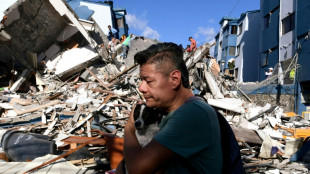 Colombia scrambles to find survivors as quake kills 169

 MEXC Report: 74.2% of Traditional Finance Users Have Shifted Their Trading Activity to Crypto Exchanges

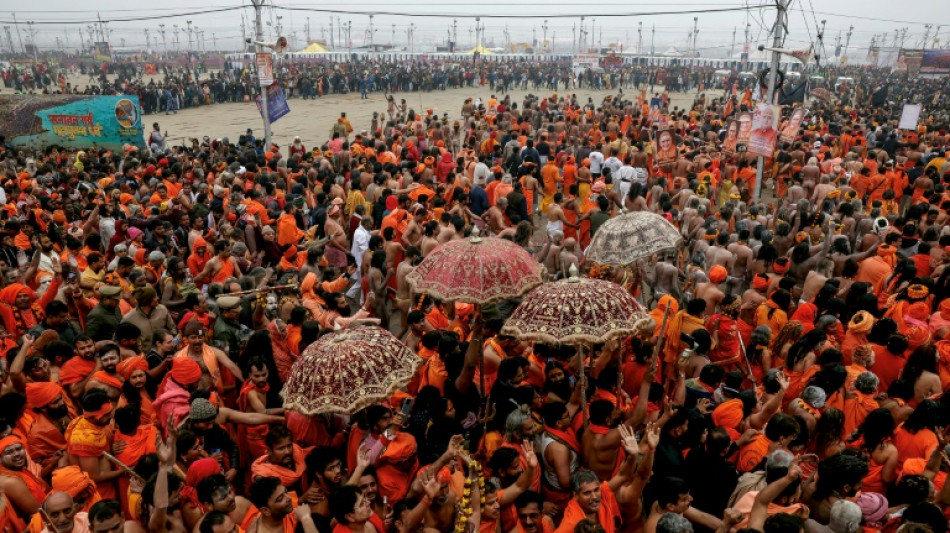
Keen to improve India's abysmal crowd management record at large-scale religious events, organisers of the world's largest human gathering are using artificial intelligence to try to prevent stampedes.
Organisers predict up to 400 million pilgrims will visit the Kumbh Mela, a millennia-old sacred show of Hindu piety and ritual bathing that began Monday and runs for six weeks.
Deadly crowd crushes are a notorious feature of Indian religious festivals, and the Kumbh Mela, with its unfathomable throngs of devotees, has a grim track record of stampedes.
"We want everyone to go back home happily after having fulfilled their spiritual duties," Amit Kumar, a senior police officer heading tech operations in the festival, told AFP.
"AI is helping us avoid reaching that critical mass in sensitive places."
More than 400 people died after being trampled or drowned at the Kumbh Mela on a single day of the festival in 1954, one of the largest tolls in a crowd-related disaster globally.
Another 36 people were crushed to death in 2013, the last time the festival was staged in the northern city of Prayagraj.
But this time, authorities say the technology they have deployed will help them gather accurate estimates of crowd sizes, allowing them to be better prepared for potential trouble.
Police say they have installed around 300 cameras at the festival site and on roads leading to the sprawling encampment, mounted on poles and a fleet of overhead drones.
Not far from the spiritual centre of the festival at the confluence of the Ganges and Yamuna rivers, the network is overseen in a glass-panelled command and control room by a small army of police officers and technicians.
"We can look at the entire Kumbh Mela from here," said Kumar. "There are camera angles where we cannot even see complete bodies and we have to count using heads or torsos."
Kumar said the footage fed into an AI algorithm that gives its handlers an overall estimate of a crowd stretching for miles in every direction, cross-checked against data from railways and bus operators.
"We are using AI to track people flow, crowd density at various inlets, adding them up and then interpolating from there," he added.
The system sounds the alarm if sections of the crowd get so concentrated that they pose a safety threat.
- 'Makes us feel safe' -
The Kumbh Mela is rooted in Hindu mythology, a battle between deities and demons for control of a pitcher containing the nectar of immortality.
Organisers say the scale of this year's festival is that of a temporary country -- with numbers expected to total around the combined populations of the United States and Canada.
Some six million devotees took a dip in the river on the first morning of the festival, according to official estimates.
With a congregation that size, Kumar said that some degree of crowd crush is inevitable.
"The personal bubble of an individual is quite big in the West," said Kumar, explaining how the critical threshold at which AI crowd control systems ring the alarm is higher than in other countries using similar crowd management systems.
"The standard there is three people per square foot," he added. "But we can afford to go several times higher than that."
Organisers have been eager to tout the technological advancements of this year's edition of the Kumbh Mela and their attendant benefits for pilgrims.
Uttar Pradesh chief minister Yogi Adityanath, a devout Hindu monk whose government is responsible for organising the festival, has described it as an event "at the confluence of faith and modernity".
"The fact that there are cameras and drones makes us feel safe," 28-year-old automotive engineer Harshit Joshi, one of the millions of pilgrims to arrive for the start of the festival, told AFP.
B.Shevchenko--BTB