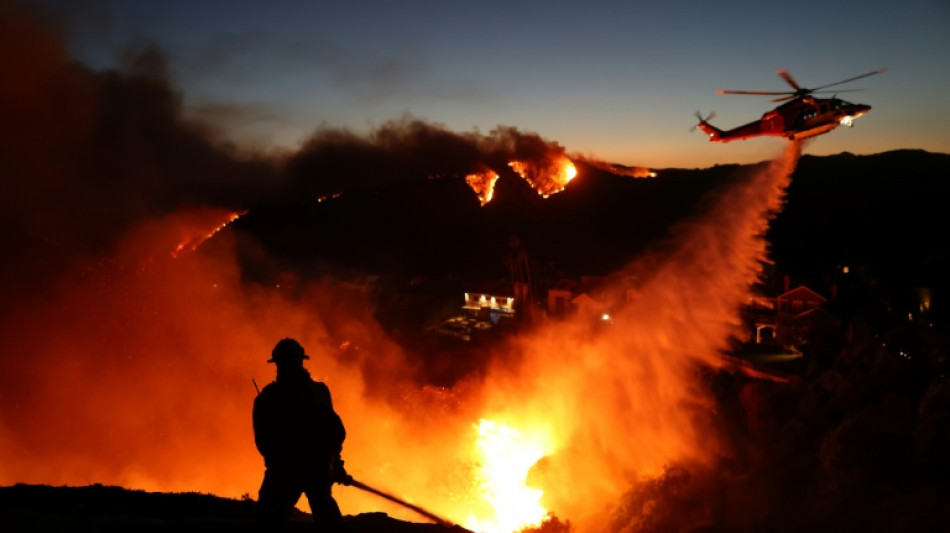
'Nerve-racking': Inside the aerial battle to tame Los Angeles fires / Photo: © AFP/File

 All Blacks knew Nonu would perform solo Haka - coach Rennie

 Britain's Glave upstages Jacobs to win European 100m gold

 Greece's Tentoglou wins fourth European long jump title
 Doctors ignored 'warning signs' before Maradona's death, court hears

 Pereira, the 'zombie city' devastated by Colombia's earthquake

 UN says 2 staff arrested by Afghan intelligence agency
 Colombia scrambles to find survivors as quake kills 240
 Ramsay-Peaty out of medals as Italy's Martinenghi wins European gold

 AI firm Manus to resume 'independent' operations after China blocks Meta deal

 Caught between great powers: the cautionary tale of Manus

 Heatwave hits evicted families sleeping rough in Rome

 US company stokes Greenland tensions by unloading drilling gear

 Cambridge academic in plagiarism row publishes memoir
 LeBron's Sixers hope to spoil Knicks party on NBA opening night

 UK 'on course' to record warmest summer for second year in a row

 Spotify to launch badge identifying AI music

 New plastic treaty document criticised for weaker ambition
 Hungary parliament approves Orban-critic judge as president
 Ebola outbreak in DR Congo kills more than 2,000
 ChargeAfter Powers BYLD Finance Expansion into Consumer Financing for Equipment Retailers

 MEXC Upgrades RealStocks With Three New Features to Enhance U.S. Stock Trading Experience

 Israel demolishes home of slain Palestinian involved in deadly West Bank clash
 Liverpool fans seek clarity on Bezos bid to buy stake

 Solar eclipse sparks scramble for protective glasses across Europe

 Oil prices jump as US-Iran deal hopes falter

Helicopter pilot Tim Thomas has fought dozens of wildfires all over the world, but nothing prepared him for the scale and the challenge of the devastating blazes that ripped through Los Angeles.
"I've never seen anything the scale that we saw the first night," he told AFP.
Fires erupted almost simultaneously in two separate neighborhoods during a furious windstorm on January 7.
Whole streets were engulfed as hurricane-force gusts flung fireballs from house to house.
Forecasters had been warning of extreme fire risk for days because of punishing dryness and winds up to 100 miles (160 kilometers) an hour, saying any small fire would quickly spread.
Extra resources were positioned all over the at-risk region, which extended for miles around the sprawling metropolis.
But the fires, when they came, were overwhelming, defeating the hundreds of firefighters on the ground.
Only an air assault would stop them.
- Transfixed -
A terrifying 24 hours after the first smoke blackened the air, winds dropped just enough for helicopters to take to the skies.
"It was some of the most turbulent wind I've seen," said helicopter coordinator John Williamson.
Under the careful eye of experienced operators like Williamson, each pilot took turns in an elaborate airborne ballet.
The life-saving airshow they put on for nearly two weeks became a defining feature of the fires, watched with awe and gratitude by a terrified region.
Television viewers were transfixed by the incredible skills of helicopter pilots loading up hundreds of gallons (liters) of water into the bellies of their aircraft while hovering over a reservoir, then dumping it with pinpoint accuracy on a wall of flames.
The sight of huge jet planes swooping over a fire line and unleashing a trail of bright red retardant thrilled and relieved those whose homes were threatened.
But while they might have made it look easy, the pilots say the reality was far from it, with strong winds and unfamiliar terrain a constant challenge.
"There were definitely some uneasy moments going over the mountains where the crew was looking for me to see if I'm comfortable," said Thomas.
"There's definitely some times where the aircraft's 23,000 pound (11.5 tons), and you're getting rocked around, thrown around in the air."
- 'Takes your breath away' -
Paul Karpus, who has overseen operations at an airbase in Camarillo, 45 miles (70 kilometers) west of Los Angeles, said the opening days of the firefight were like nothing he has experienced in 23 years.
"Every season, you say, I've seen it all... And then you're surprised," he told AFP.
"Seeing the amount of devastation for the first time, when the sun was coming up, and the amount of structures lost, it takes your breath away."
Aerial teams operated 24 hours, pulling long shifts that left them exhausted and fraught.
"On a scale of one to 10, this one was a 10, stress-wise," said Karpus.
- 'Nerve-racking' -
Williamson, whose job is to sit next to the pilot, guiding him to his designated zone and monitoring dozens of radio messages, said the complexity of the operation was a challenge.
"The first three nights, really was pretty nerve-racking," he said.
Zach Boyce, who ran daytime operations said the sheer volume of aircraft in a tight space made things tricky.
"We're coordinating a lot of helicopters in a very tight area, and then we introduce fixed wing operations and air tankers and air attack... and everything becomes super compressed," he said.
More than two weeks after the fires erupted, killing more than two dozen people and reducing 40,000 acres (16,000 hectares) to ash, the biggest blazes are under control.
But the value of the aerial firefighters continues to be seen, with a fast-moving fire that erupted on Wednesday corralled by the time night fell after an airborne assault.
For the people of Los Angeles, the men and women who have fought this battle are second to none.
"We should never stop thanking them," Los Angeles-based talk show host Jimmy Kimmel said.
"Real superheroes."
K.Thomson--BTB