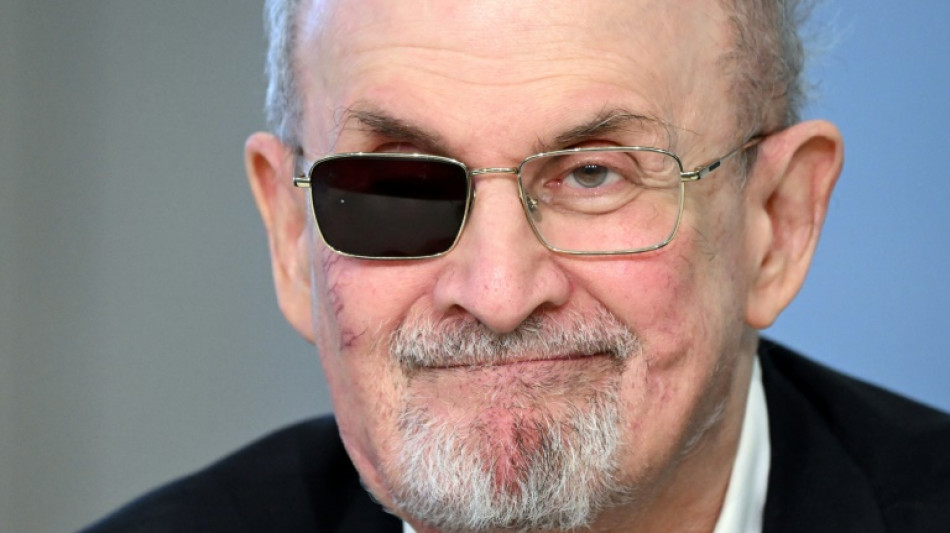
NY jury to hear case against man accused of trying to kill author Rushdie / Photo: © AFP/File

 How to Watch the Rugby League World Cup Final on 7plus for Free

 Kayla Harrison Defeats Amanda Nunes via Submission at UFC 334

 GTA 6 Advertising Strategy and Disc Version Controversy

 From First Date to Wedding Day: How a TV Quote Sparked a Lifetime Commitment
 Malta Stuns Sweden with Late Penalty Comeback in Rugby Europe Trophy

 BingX: Major Announcement of Far-Reaching Significance

Prosecutors will begin to tell a jury Monday how Hadi Matar allegedly staked out the venue where Salman Rushdie was giving a talk before lunging at the "Satanic Verses" author, blinding him in one eye.
Matar, a 27-year-old Lebanese-American, is on trial for attempted murder and assault over the August 12, 2022 attack at an arts gathering in western New York state.
He is accused of stabbing Rushdie about 10 times, leaving him in grave condition and without sight in his right eye.
The Indian-born writer, a naturalized American based in New York, has faced death threats since his 1988 novel "The Satanic Verses" was declared blasphemous by Iran's supreme leader.
Ayatollah Ruhollah Khomeini issued a fatwa, or religious edict, in 1989 calling on Muslims anywhere in the world to kill Rushdie.
Hezbollah endorsed the fatwa, the FBI has said.
Matar had told the New York Post newspaper that he had only read two pages of Rushdie's novel but believed the author had "attacked Islam."
Rushdie, now 77, suffered stab wounds in the neck and abdomen before attendees and guards could subdue the attacker, later identified by police as Matar.
Matar will be tried in Chautauqua County Court, with the world's media descending on the small town of Mayville to follow the case.
The defendant, who has pleaded not guilty to attempted murder, also faces a separate trial for terror charges in federal court.
Prosecutors are expected to focus on the mechanics of the brazen attack and the bountiful video and eyewitness evidence, rather than Matar's ideological motivation, US media have reported.
- Proud of 'Satanic Verses' -
Rushdie lived in seclusion in London for the first decade after the fatwa was issued, but for the past 20 years -- until the attack -- he lived a relatively normal life in New York.
Last year, he published a memoir called "Knife" in which he recounted the near-death experience.
"Why didn't I fight? Why didn't I run? I just stood there like a pinata and let him smash me," Rushdie wrote.
"It didn't feel dramatic, or particularly awful. It just felt probable... matter-of-fact."
Tehran denied any link to the attacker -- but said only Rushdie was to blame for the incident.
Rushdie explained in "Knife" that the attack has not changed his view on his most famous work.
"I am proud of the work I've done, and that very much includes 'The Satanic Verses.' If anyone's looking for remorse, you can stop reading right here," he said.
Rushdie has said that he did not want to attend the fateful talk, and two days before the incident he had a dream of being attacked by a gladiator with a spear in a Roman amphitheater.
"And then I thought, 'Don't be silly. It's a dream,'" he told CBS.
F.Pavlenko--BTB