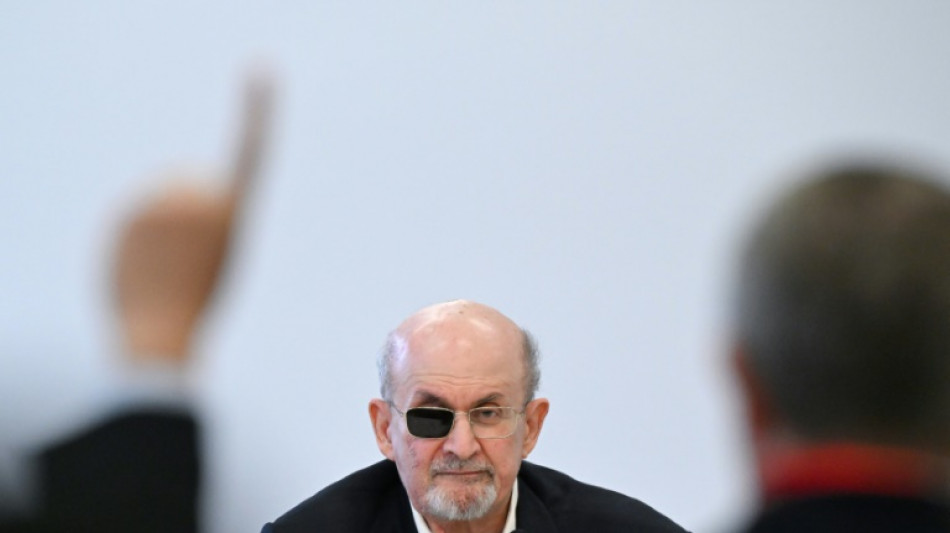
Rushdie tells trial of 'lake of blood' after stabbing / Photo: © AFP/File

 How to Watch the Rugby League World Cup Final on 7plus for Free

 Kayla Harrison Defeats Amanda Nunes via Submission at UFC 334

 GTA 6 Advertising Strategy and Disc Version Controversy

 From First Date to Wedding Day: How a TV Quote Sparked a Lifetime Commitment
 Malta Stuns Sweden with Late Penalty Comeback in Rugby Europe Trophy

 BingX: Major Announcement of Far-Reaching Significance

 Élan Opens as Late-Night Wine Bar in Honolulu

Novelist Salman Rushdie described Tuesday the moment a knife-wielding attacker stormed on stage and attempted to kill him with a frenzied attack that left him blind in one eye.
"The Satanic Verses" author told jurors at the trial of his alleged attacker, 23-year-old American-Lebanese Hadi Matar, that Matar "was stabbing and slashing" at him.
"I was aware of this person rushing at me on my right hand side," he said, describing how he was on stage at an arts event in New York state in August 2022.
"I only saw him at the last minute."
"I was very struck by his eyes which were dark and seemed very ferocious to me," Rushdie said of the attacker who wore a Covid mask.
"It was a stab wound in my eye, intensely painful, after that I was screaming because of the pain," Rushdie said, adding that he was left in a "lake of blood."
Matar's legal team have sought to prevent witnesses from characterizing Rushdie as a victim of persecution following Iran's 1989 fatwa calling for his murder over supposed blasphemy in "The Satanic Verses."
Matar is accused of stabbing Rushdie about 10 times with a six-inch blade. He said "Palestine will be free" as he was led into court, and did not react as Rushdie began his evidence.
Rushdie wore a dark suit, with his distinctive glasses polarized in one lens to mask one eye.
Prosecutor District Attorney Jason Schmidt told how Rushdie had just taken his seat in the amphitheater in front of about 1,000 people.
"(Matar) forcefully and efficiently and with speed plunged the knife into Mr Rushdie over and over and over again," Schmidt said.
- Staff, guests fight attacker -
Iran-backed Lebanese Shiite militant organization Hezbollah endorsed the fatwa, the FBI has said, and Matar faces a separate prosecution in federal court on terrorism charges.
Matar previously told media he had only read two pages of Rushdie's novel but believed the author had "attacked Islam."
New York-based British-American Rushdie, now 77, suffered multiple stab wounds before bystanders subdued the attacker.
Venue employee Jordan Steves told the court Monday how he launched himself at the attacker "with my right shoulder with as much force as I could manage" in an attempt to help others subdue him.
He pointed to Matar, sitting just feet away in the ornate courtroom, when asked to identify the attacker.
Steves's colleague Deborah Moore Kushmaul said she picked up the discarded knife and gave it to police.
"I could see blood, I could see (bystanders) piling on. Our audience, many of whom were elderly, were screaming," she said.
Matar came "dangerously close" to killing Rushdie, Schmidt said, reporting that the author was stabbed through the right eye with such ferocity that it severed the optical nerve.
Rushdie's Adam's apple was also partially lacerated, and his liver and small bowel penetrated.
"His blood pressure was low -- he lost so much blood," said the prosecutor.
One of Matar's lawyers, Lynn Schaffer, said Monday that prosecutors would seek to present the case as "open and shut."
But "pay attention to the assumptions that the police witnesses make," she said. "They assume things about Mr Matar that affect the way they investigate."
Rushdie lived in seclusion in London for a decade after the fatwa, but for the past 20 years -- until the attack -- he lived relatively normally in New York.
Last year, he published a memoir called "Knife" in which he recounted the near-death experience.
Iran has denied any link to the attacker and said only Rushdie was to blame for the incident.
F.Pavlenko--BTB