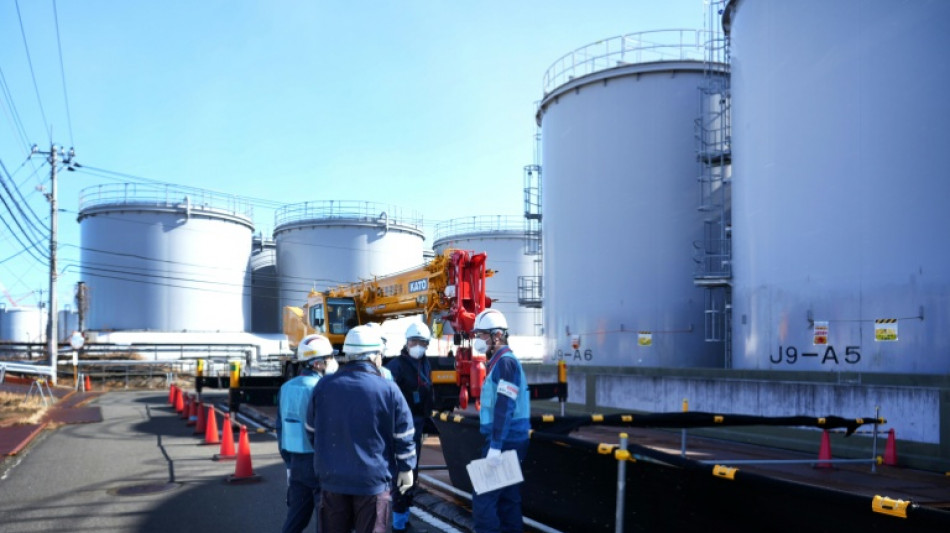
TEPCO takes on challenge of making space for Fukushima nuclear debris / Photo: © AFP

 Barred from elections, Russia's anti-war party vows to fight on

 Jaissle states Newcastle ambition but urges patience

 NBA star Cooper Flagg trading card a slam dunk for lucky buyer
 ForumPay Expands Payment Infrastructure with New Card and Bank Transfer Acceptance Solution

 Oil prices higher, stocks flat ahead of inflation report

 Orban-critic ex-judge becomes Hungary president after predecessor ouster
 US rights groups sue Trump over ICC sanctions

 Sphere 3D Corp. (Nasdaq: ANY) Attracts 6.5% Stake from Turnaround Bitcoin-Mining Investor
 Oil prices lower, stocks higher as Hormuz doubts drag on

 Colombia scrambles to find survivors as quake kills 181

 Colombia scrambles to find survivors as quake kills 169

 MEXC Report: 74.2% of Traditional Finance Users Have Shifted Their Trading Activity to Crypto Exchanges

 MEXC Lists DAPPOS (DOS) With $60,000 Worth of DOS and 10,000 USDT in Airdrop+ Rewards

 Jellyfish force shutdown of three reactors at French nuclear plant

 Hodgkinson, Werro sail through Euro 800m qualifying

 Somali referee denied World Cup 'proud' to oversee UEFA Super Cup
 French newspapers target Google over AI summaries

 Ebola death toll in DR Congo outbreak rises to more than 2,000

 PrimeXBT Launches MT5 Cent Account for Beginners and Risk-Conscious Traders

 British sprinter Hunt chasing three more golds after winning 100m

 Ethiopia's Tigray rebel authorities condemn army drone strikes

 Too hot to live? French buyers rethink housing choices after heatwaves
 Ukraine says Russia fired N. Korean missiles in deadly attack
 Oil prices jump further as hopes for Hormuz deal fade

 Trump says would be 'terrible mistake' to oust embattled Infantino

Workers at Japan's crippled Fukushima nuclear plant have started dismantling water storage tanks to free up space for tonnes of nuclear debris, 14 years after the facility was hit by a devastating tsunami.
Operator Tokyo Electric Power Company (TEPCO) has been charged with finding a suitable place to store around 880 tonnes of radioactive material that remains inside the Fukushima Daiichi plant's damaged reactors.
"Currently, there is no more land available in Fukushima Daiichi", Naoki Maeshiro, project manager for TEPCO, who is overseeing the operation which began on Friday, told AFP.
Three of plant's six reactors were operating when a tsunami caused by a massive earthquake hit on March 11, 2011, disabling their cooling systems and sending them into meltdown.
Ever since, TEPCO has been holding 1.3 million tonnes of water -- a combination of groundwater, seawater and rainwater -- at the site, along with water used for cooling the reactors.
The water, which is treated to remove various radioactive materials, has been held inside more than 1,000 tanks that occupy much of the plant.
In one of the zones called "J9", the giant steel tanks tower over employees at work, obstructing the view of the rest of the plant.
"To proceed with the next steps, such as retrieving the fuel debris, a certain amount of land is necessary," added Maeshiro.
Scrapping the water tanks became possible after TEPCO began discharging treated water from the plant into the Pacific Ocean in August 2023.
Japan and the International Atomic Energy Agency (IAEA) have assured that the operation does not harm the environment.
Getting rid of the welded containers is considered a crucial step in the decades-long decommissioning process.
Once removed, the utility company plans to build facilities to store highly dangerous molten fuel debris after extracting it from inside the reactors.
"As long as the fuel debris remains in its current state, the risks remain very high," Nobuhide Sato, a risk specialist at TEPCO, told AFP.
- Arcade-style claw machine -
The company has developed a telescopic device that can collect debris remotely for safety reasons and to avoid radioactive material leaks.
A demonstration attended by AFP was carried out in reactor number five, which was not in operation when the tsunami hit.
Before entering the zone, which is under high surveillance, employees put on masks, safety helmets, a full body protective white suit, and three pairs of socks and gloves as a precaution against radiation.
Armed with a flashlight, Sato stopped in front of a hole, around 60 centimetres (two feet) in diameter, that has been drilled into the structure protecting the reactor's core.
The plan is to extend the specially developed telescopic device several metres through the hole to reach the radioactive debris in the reactor.
The device resembles an arcade claw machine, so the "arm grabs the debris, lifts it, and retrieves it," said Sato.
In early November, TEPCO announced a debris sample weighing 0.7 grams (0.025 ounces) had been successfully extracted and sent to a laboratory near Tokyo.
The analysis will help determine radioactivity levels and the chemical composition of the molten fuel debris, a key step in the colossal dismantling project.
"Depending on the results, we will see whether it is better to use water to collect (the fuel debris) in the reactor or to do it in a dry environment," Sato said.
The TEPCO employee then enters the base of the reactor, where workers can only spend a maximum of two hours a day due to radiation levels.
"If we can properly recover the fuel debris and store it safely, it be a great help in reassuring nearby residents," Sato added.
A second sampling of nuclear material is scheduled between "March and April," according to TEPCO, which should provide enough information about its composition to move to the next stage -- a larger-scale extraction of radioactive debris by 2030.
The overall project is expected to take between 30 and 40 years, the company said.
J.Horn--BTB