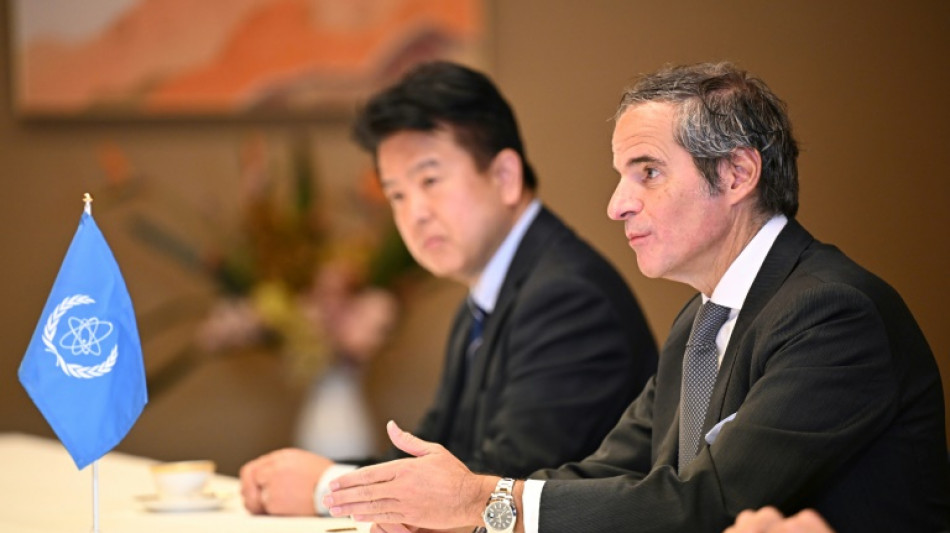
UN watchdog chief visits Fukushima as Japan returns to nuclear power / Photo: © AFP

 Orban-critic ex-judge becomes Hungary president after predecessor ouster
 US rights groups sue Trump over ICC sanctions

 Sphere 3D Corp. (Nasdaq: ANY) Attracts 6.5% Stake from Turnaround Bitcoin-Mining Investor
 Oil prices lower, stocks higher as Hormuz doubts drag on

 Colombia scrambles to find survivors as quake kills 181

 Colombia scrambles to find survivors as quake kills 169

 MEXC Report: 74.2% of Traditional Finance Users Have Shifted Their Trading Activity to Crypto Exchanges

 MEXC Lists DAPPOS (DOS) With $60,000 Worth of DOS and 10,000 USDT in Airdrop+ Rewards

 Jellyfish force shutdown of three reactors at French nuclear plant

 Hodgkinson, Werro sail through Euro 800m qualifying

 Somali referee denied World Cup 'proud' to oversee UEFA Super Cup
 French newspapers target Google over AI summaries

 Ebola death toll in DR Congo outbreak rises to more than 2,000

 PrimeXBT Launches MT5 Cent Account for Beginners and Risk-Conscious Traders

 British sprinter Hunt chasing three more golds after winning 100m
 Ethiopia's Tigray rebel authorities condemn army drone strikes

 Too hot to live? French buyers rethink housing choices after heatwaves
 Ukraine says Russia fired N. Korean missiles in deadly attack
 Oil prices jump further as hopes for Hormuz deal fade
 Trump says would be 'terrible mistake' to oust embattled Infantino

 Charity races to raise millions to buy historic English estate
 Hungary parliament to elect Orban-critic judge as president
 Wallabies lock Amatosero given three-match ban for Japan red card

 Swiatek races into Toronto semis as Svitolina battles through
 'Big Four' bowlers back as ageing Australia begin gruelling run
The UN nuclear watchdog chief visited Japan's stricken Fukushima plant on Wednesday, the day after Tokyo approved an energy plan that marks a return to nuclear power to meet growing demand for AI.
The International Atomic Energy Agency (IAEA) is monitoring Japan's efforts to decommission the Fukushima Daiichi plant after a 2011 earthquake-triggered tsunami killed 18,000 people and set off the worst nuclear disaster since Chernobyl.
As IAEA head Rafael Grossi arrived in Japan on Tuesday, the cabinet adopted a plan to increase reliance on nuclear power to help meet growing energy demand from artificial intelligence and microchip factories.
"At a moment where Japan is embarking on a gradual return to nuclear energy in its national energy mix, it is important that this is also done in complete safety and with the confidence of the society," Grossi said after meeting the foreign minister.
Japan had previously vowed to "reduce reliance on nuclear power as much as possible".
But this pledge was dropped from the latest Strategic Energy Plan -- which includes an intention to make renewables the country's top power source by 2040.
Under the plan, nuclear power will account for around 20 percent of Japan's energy supply by 2040, up from 5.6 percent in 2022.
The return to nuclear comes as the country is decommissioning Fukushima Daiichi, a process expected to take decades with the most dangerous part still ahead: removing around 880 tonnes of radioactive debris from the reactors.
Grossi, making his fifth visit to Fukushima, viewed the vast "interim" soil storage facilities near the plant for the first time.
Around 13 million cubic metres of soil and 300,000 cubic metres of ash from incinerated organic material -- enough to fill 10 stadiums -- were scraped from land in the region to remove harmful radiation.
On Wednesday, trucks and construction vehicles went back and forth between several areas where hundreds of large soil-filled black bags were stacked, some covered by a thin layer of snow.
Hanging on a locked fence around the storage site was a sign displaying the radiation level.
- Seafood bans -
Japan plans to recycle roughly 75 percent of the soil -- the portion with low radioactivity -- for building projects such as road and railway embankments.
The remaining material will be disposed of outside the Fukushima region ahead of a 2045 deadline.
Stripping topsoil was "very effective" to decontaminate land close to waterways, said Olivier Evrard, research director at France's Atomic Energy Commission.
But the operation was expensive, "generated a massive amount of waste and still poses fertility issues" for agriculture, he told AFP.
It stands in contrast to the decision to fence off a large area after the 1986 Chernobyl disaster and more or less "leave it to wildlife", Evrard said.
Experts from the IAEA and countries including China and South Korea will also take new seawater and fish samples from Fukushima on Wednesday.
Plant operator TEPCO began discharging 1.3 million tonnes of groundwater, seawater and rainwater, along with water used for cooling the reactors, into the sea in 2023.
The water release is endorsed by the IAEA and TEPCO says all radioactive elements have been filtered out except for tritium, levels of which are within safe limits.
However, countries including China and Russia have criticised the release and banned Japanese seafood imports.
China said in September it would "gradually resume" importing seafood from Japan but this has yet to begin.
J.Horn--BTB