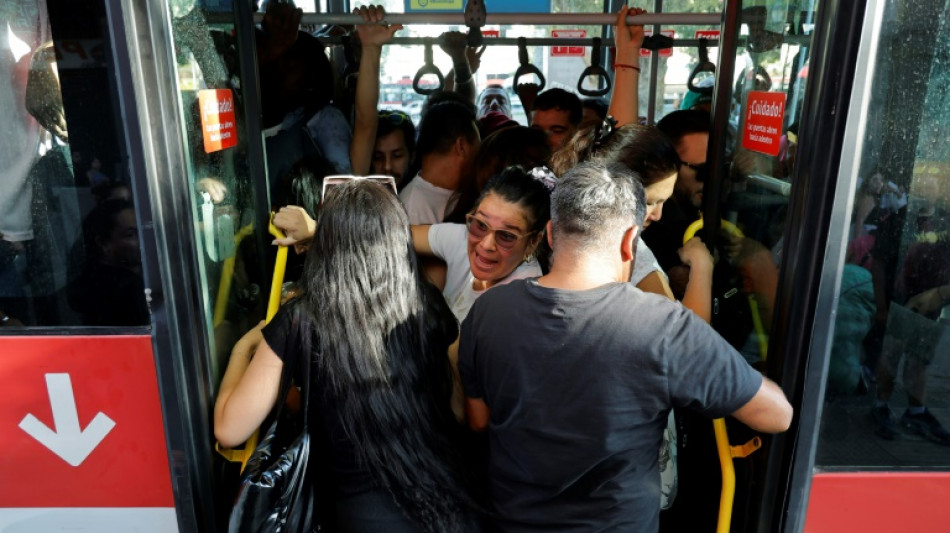
Chile declares state of emergency after massive blackout / Photo: © AFP

 Kayla Harrison Defeats Amanda Nunes via Submission at UFC 334

 GTA 6 Advertising Strategy and Disc Version Controversy

 From First Date to Wedding Day: How a TV Quote Sparked a Lifetime Commitment

 Malta Stuns Sweden with Late Penalty Comeback in Rugby Europe Trophy

 BingX: Major Announcement of Far-Reaching Significance

 Élan Opens as Late-Night Wine Bar in Honolulu

 Shiv Sena (UBT) Criticizes NCP Merger Talks as 'Ridiculous Laughing Stock'
Chile on Tuesday declared a state of emergency and curfew across much of the country, including the capital Santiago, following a massive, rare blackout that left millions without power.
The worst blackout in the country in well over a decade caused transport chaos in the capital Santiago, where thousands of people were evacuated from the metro and people jostled to board overflowing buses.
The area without power stretches all the way from Arica in the long, narrow South American country's north to Los Lagos in the south, according to the Senapred disaster response agency -- an area home to over 90 percent of Chile's population of 20 million people.
More than five hours after the outage began, Interior Minister Carolina Toha announced a curfew from 10:00 pm (0100 GMT) until 6:00 am (0900 GMT)
Toha said the measure was part of a state of emergency declared by President Gabriel Boric which "aimed to guarantee the security of the population faced with the possibility that the outage lasts into the night."
- Attack ruled out -
Toha had earlier ruled out sabotage as the reason for the power loss, which began at 3:16 pm in the middle of the southern hemisphere summer.
"There is no reason to assume that this is an attack," she said, telling reporters it was more likely "a failure in the system's operation" and that the grid should be back up and running "in the coming hours.
The metro company, which transports 2.3 million passengers every day, said workers were deployed to all stations "to support safe evacuations."
Out-of-service traffic lights caused major gridlock, with some people having to walk for hours under a hot sun to reach their homes.
Shops and offices closed early.
"They let us leave work because of the power cut, but now I don't know how we will get home because all the buses are full," worker Maria Angelica Roman, 45, told AFP in Santiago.
"At the bank where I work, all operations had to stop," 25-year-old clerk Jonathan Macalupu said.
- Hanging in the air -
The Chilevision broadcaster showed video of people trapped on a mechanical ride several meters high at an amusement park in Santiago before being rescued.
An AFP photographer saw fire fighters rescue a distraught elderly woman, who had been trapped inside an elevator.
The country's hospital system and prisons were operating on emergency generators.
Boric overflew the capital by helicopter to assess the situation.
In the coastal city of Valparaiso, witnesses also reported shops and businesses closing early and traffic chaos.
Unlike Cuba, which has suffered several nationwide power outages in the past six months, Chile boasts one of the best power networks in South America and has not had a blackout this big in about 15 years.
In 2010, damage to a power plant in southern Chile plunged hundreds of thousands of people into darkness for several hours.
That outage happened a month after a massive 8.8-magnitude earthquake killed more than 500 people and rocked the national power grid.
R.Adler--BTB